
What Is Self-Rostering?
Self-rostering means that employees create their duty and shift schedules collaboratively and plan attendances and absences in consultation with one another. Although certain framework schedules or company regulations must be observed, the assignment itself is otherwise carried out freely without further external influence.
Originally developed in Scandinavia, the concept is strongly focused on co-determination and transparency – fully in line with the New Work approach. While in many sectors in Germany, such as healthcare and especially hospital duty rosters, schedules are still often drawn up centrally by supervisors, self-rostering transfers this “responsibility” to the team.
Benefits of Self-Rostering
The ability to create one’s own duty rosters brings a number of practical benefits – both for the employees involved and for the company concerned:
- Higher motivation: Employees who can actively help shape their working hours generally feel a greater sense of appreciation for their work. Self-rostering gives them the opportunity to work in a more “self-determined” way, which in turn has a positive effect on their motivation.
- Improved work-life balance: Work and private life can be combined more effectively and autonomously. The ability to factor planned activities or family commitments into duty scheduling reduces the risk of conflicts and the associated stress.
- Greater planning reliability and commitment: When employees are actively involved in workforce planning or even create their own duty rosters, as in self-rostering, this creates greater planning reliability for everyone involved. Both colleagues and the organization itself can be more confident that an employee will show up for a shift if they have voluntarily signed up for that duty.
- Reduced workload for HR: Through self-rostering and intensive co-determination in duty scheduling, those responsible for planning are relieved of actively creating rosters. When employees coordinate shift planning among themselves, for example in care, HR teams can focus their capacities on other tasks.
- Better employee retention: Offering employees a higher degree of flexibility is also a differentiator in the cross-industry competition for skilled workers. Measures such as self-rostering can therefore help both to attract qualified employees and to retain capable staff within the organization.
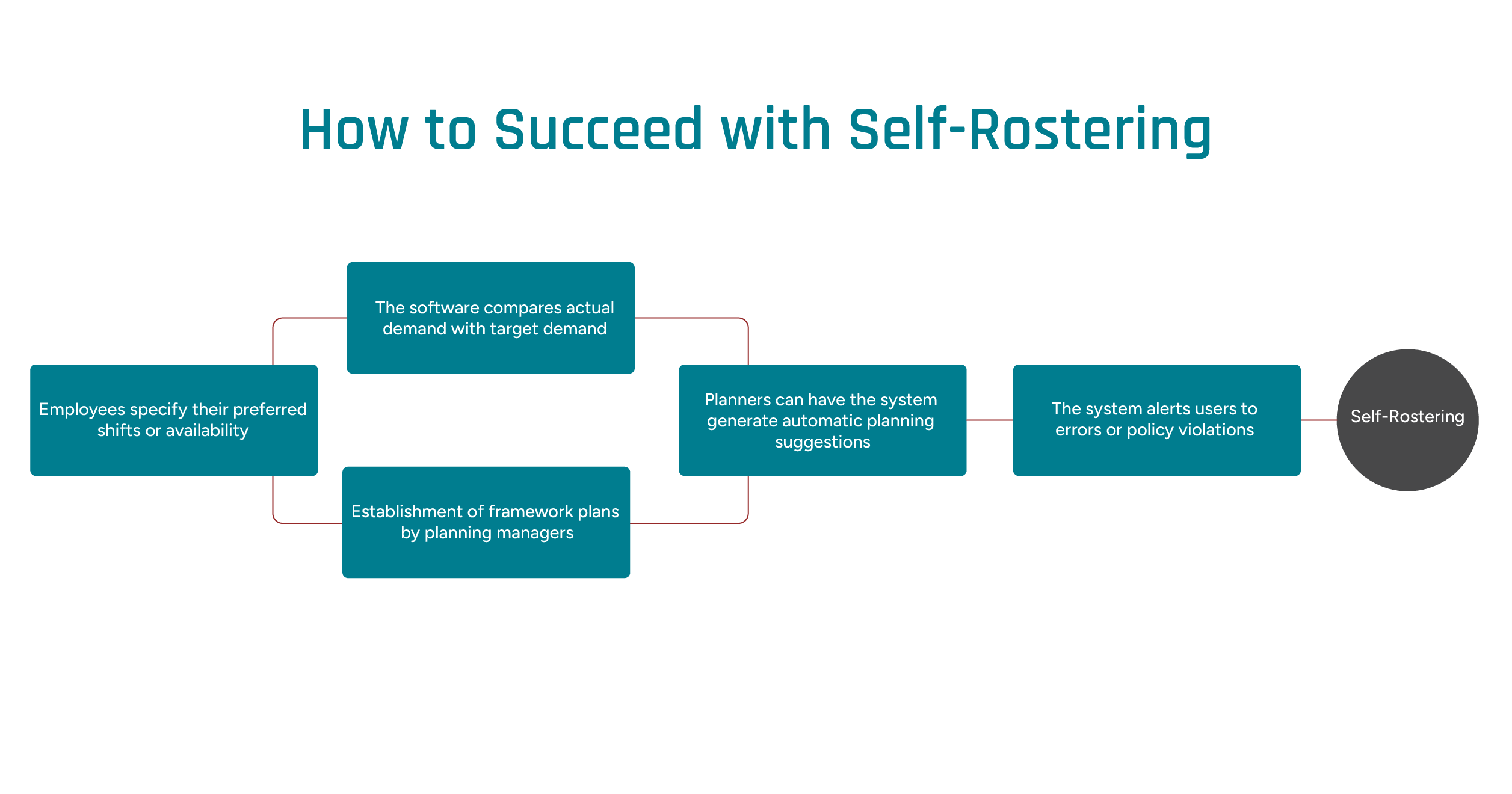
Self-rostering – whether in its pure form or with HR support – relies on actively involving employees in the planning process. © GFOS Group
How Does Self-Rostering Work? A Look at Current Practice
For co-determination in duty scheduling to work well in everyday business operations, several clear guidelines are needed. The following procedure has proven to be best practice for involving employees:
Definition of framework schedules
First, those responsible for planning define the basic planning parameters. These include target staffing requirements, capacity limits, statutory working-time requirements and internal company regulations.
With our GFOS solution, these specifications can be flexibly stored as mandatory or optional rules. This ensures that both legal requirements and individual company guidelines are consistently taken into account, while still leaving the necessary degree of flexibility in planning.
Entries by employees
Employees then enter their preferred shifts or availability directly into the system. These self-reported details can vary – from fixed preferences for certain days through to time windows during which a person is particularly flexible and available for deployment.
Or is an assignment not possible during a certain period for personal reasons? In the spirit of self-rostering, employees enter all this information themselves, and digital capture ensures that the data is taken into account immediately in the planning process.
Automatic software comparison
The software compares individual preferences with the previously defined target staffing requirements. The system checks which preferences can be fulfilled and where overlaps or bottlenecks exist.
Intelligent solutions for SaaS workforce management also directly consider a wide range of aspects here – including statutory working-time regulations, break rules and company minimum staffing levels – so that this comparison results in practical planning proposals.
Review by responsible parties
Based on the entered preferences and framework schedules, the system in use creates intelligent planning proposals. These proposals include the fairest and most balanced possible distribution of shifts.
As an intermediate step, those responsible for planning now review these proposals to determine whether they contain any inconsistencies or need to be adjusted urgently – for example, if new circumstances have arisen that were not yet reflected in the system.
Adjustments where needed
It may also be the case that the system is unable to create a completed shift schedule based on the information provided by employees. This can happen, for example, if information is incomplete or mutually incompatible, such as overlapping vacation plans.
If such errors or rule violations occur, those responsible for planning must step in and find a solution with the people involved. Thanks to the software, however, such emerging conflicts can be identified very precisely and usually with sufficient lead time.
Many technical solutions today are not pure self-rostering solutions, but rather hybrid forms in which employees and planning managers work together to create duty rosters.
At GFOS, we offer a range of industry-leading tools in this area – from simple coordination of attendance and a dedicated ESS portal through to straightforward time recording via app.
What Challenges Does Self-Rostering Pose for Companies?
For most companies, allowing employees to create their own duty rosters is not a concept that can simply be established “overnight” in everyday business operations. There are several very practical reasons for this:
- Technical requirements / IT infrastructure: Self-rostering requires a modern IT infrastructure. Cloud systems are particularly suitable, as they give both employees and the company flexible access to the system and all important availability information at any time.
Of course, companies must ensure that IT security, data protection and sufficient server performance are guaranteed so that the duty rosters in question can always be accessed.
- Training and participation: Whether pure self-rostering or a hybrid model, implementation depends on employee participation. To ensure employees know which options and limits apply to co-determination in their own duty rosters, appropriate training is required.
Likewise, there may be employees who, on their own initiative, have little interest in maintaining their own duty rosters. They need to be specifically addressed, involved in the process and convinced of the benefits that such a transition can also bring for them.
- Cultural adaptation: In addition to “regular” employees, those responsible for planning must also be willing to adapt to the concept of self-rostering. After all, the additional degree of co-determination also brings changes for them.
On the one hand, HR can hand over a considerable amount of responsibility; on the other hand, there must also be trust that employees will handle their additional freedom responsibly. This once again underlines the importance of appropriate training.
- Co-determination by the works council: If the company has a works council, it must be involved. Any works agreements should contain clear provisions to ensure that self-directed duty scheduling is legally compliant.
The basis for this is the works council’s co-determination right regarding working hours and technical systems (Section 87 BetrVG). At this point, early dialogue is recommended in order to proactively address any concerns.
Software and Integration – What to Look for When Choosing a Provider
In addition to a general willingness to change and support from the employees who play a key role in implementing this concept, the right software solution is, of course, also required. It should offer (at least) the following features:
- Intuitive user interface that enables easy operation and does not create an entry barrier even for employees who are less technically experienced
- Mobile availability so that employees can access their duty rosters anytime and from anywhere and stay informed about changes
- Automated rule checks to detect violations at an early stage, always guarantee sufficient staffing and ensure legal compliance
- Interfaces to the IT landscape for seamless integration into ERP, HR or time recording systems – ideally even as an all-in-one solution
- HR analytics and reporting to identify trends within the company and make better long-term workforce decisions
At GFOS, we provide companies with the right technical foundation to cover everything related to workforce deployment, from planning through to analysis. With our new HR analytics module GFOS Intelligence and our AI assistant “Atlas”, we also create new and smart HR structures for our customers. From cross-month evaluations of departmental KPIs and support with workforce planning through to direct queries about the attendance and absences of individual employees – precise analyses and individual insights are only one request away with our tools. We would also be happy to advise you on our HR solutions.
Smart Workforce Scheduling Starts Now
Use GFOS’s “Workforce Planning” bundle to meet innovative requirements in your workforce planning. This makes it possible to implement employee preferences and address the challenges of increased flexibility in a modern workforce management platform. We would be happy to advise you.
