
Shift Schedule Template: A Strong Starting Point
A shift schedule Excel template already helps cover key aspects of shift and workforce scheduling. It supports the most basic requirements and reduces day-to-day organizational and planning effort.
With a clear, structured view of employees and shifts, users can immediately see when and where they are scheduled. Implementing a shift schedule template is therefore a great first step toward standardizing shift-work processes in a short amount of time.
What a Shift Schedule Template Should Include
Regardless of where the shift schedule template is used, it should include the following information:
- Employees
- Qualifications
- Work Area
- Work Pattern
- Staffing Requirements
However, a spreadsheet-based template rarely presents all of this information in a truly clear and scalable way.
What Does a Practical Shift Schedule Template Look Like?
A practical shift schedule template should start with a clear core structure that combines a weekly and monthly calendar view with an easy-to-read employee list. Standardized shift types, employee qualification details, and comment fields help document the plan as well as exceptions and last-minute changes.
Clearly defined required fields are essential, such as the employee name, assignment to teams and/or departments, zone, shift type, work location, and qualifications. This ensures staffing decisions are documented consistently and can be understood at any time.
To respond to fluctuating demand, the schedule should also create visibility into seasonal peak periods. Color coding weeks with higher workloads, plus dedicated fields for additional shifts and extra staff, helps identify capacity gaps early and plan accordingly.
Finally, version control is critical for smooth day-to-day execution. Clear naming conventions and a centralized storage location per site ensure that everyone works with the current, approved version of the shift schedule.
Shift Scheduling in Logistics and Manufacturing
Shift scheduling in logistics and manufacturing is among the most complex planning tasks in industrial organizations. On one hand, it helps ensure continuity of operations (including through forward-looking capacity planning). On the other hand, schedules must comply with legal and collective bargaining requirements. At the same time, planning needs to remain flexible enough to respond to fluctuations, disruptions, and short-notice changes.
Specific Requirements in Logistics
In logistics, shift scheduling is heavily shaped by parallel work and time dependencies. Receiving, picking, packing, and shipping often run simultaneously but with different workload patterns. Receiving may experience high volume at specific times, picking peaks may occur later, and shipping is tied to carrier pickup windows and cutoff times.
- Different start times and shift lengths: Early starts in receiving, extended late shifts in shipping, or shorter part-time shifts in picking are common.
- Break and rest-period rules: Depending on the shift model, labor agreement, and applicable labor law, these requirements must be followed precisely to avoid bottlenecks in parallel processes.
- Dependency on freight and cutoff times: Schedules must ensure staff are available when trucks arrive, containers are unloaded, or shipping windows must be met.
- Zone and process orientation: Large warehouses are divided into zones that operate in parallel but require different skill sets and staffing levels.
Specific Requirements in Manufacturing
In manufacturing, cycle time is central to employee scheduling because it directly determines staffing demand. Shorter cycles require more employees per shift, while longer cycles enable leaner staffing but often increase dependency on specific qualifications.
Key challenges include:
- Cycle time and line alignment: Schedules must ensure every station on a line is continuously staffed to prevent interruptions in material flow.
- Machine assignments versus qualifications: Not every skilled worker is authorized to operate every machine. Schedules must reflect skills matrices and plan for redundancy.
- Managing unplanned downtime: Machine failures, quality issues, and material shortages require short-notice re-planning, reassignments, or maintaining float staff.
- Synchronizing multiple production areas: Upstream and downstream processes must be aligned to minimize buffers and waiting times.
What Larger Industrial Companies Need From Shift Schedules
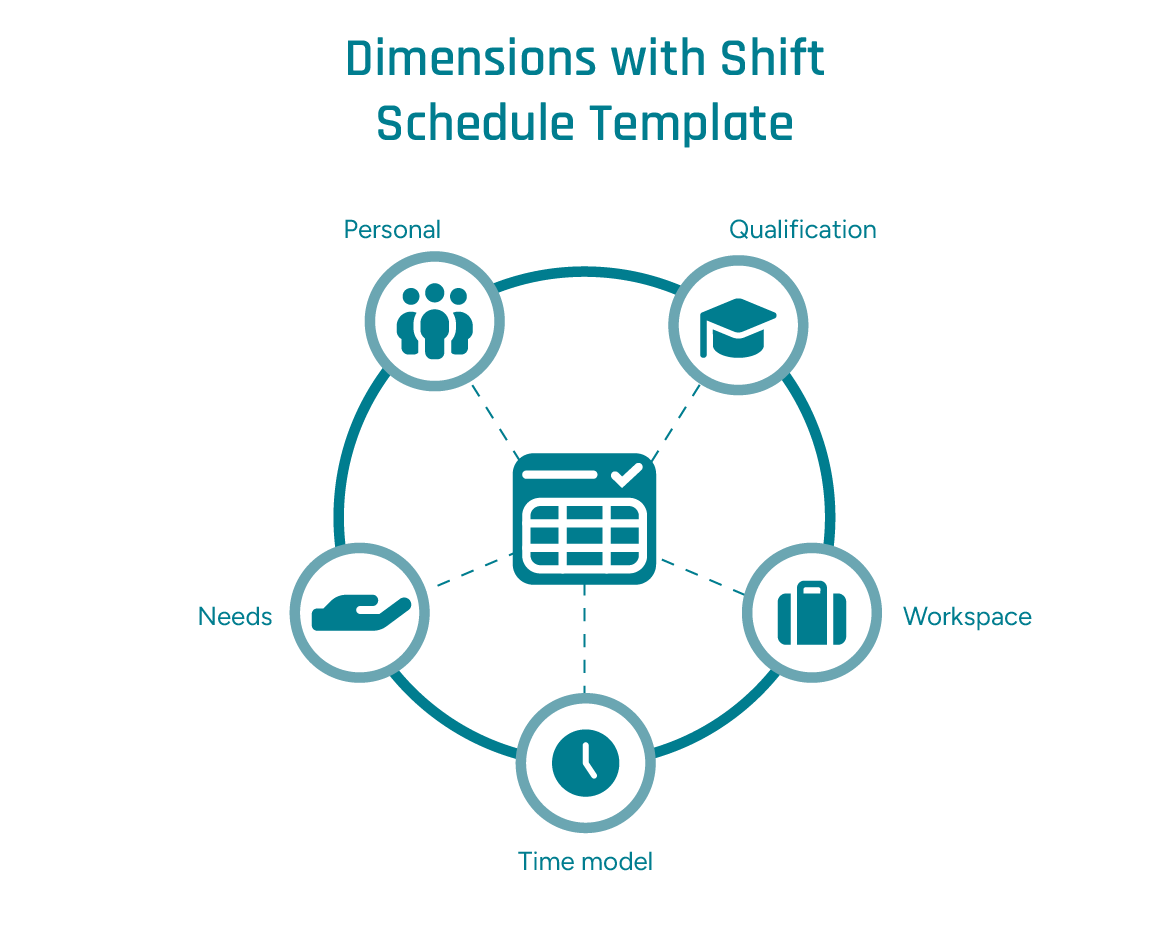
Larger industrial organizations need shift schedules with deep structure and high flexibility. Because different machines, workstations, and cycle times run in parallel, a schedule must be able to map multiple dimensions: time, work location, machine, qualifications, and team assignment. It supports not only workforce scheduling, but also production reliability and operational efficiency.
Transparency is essential. At any time, it should be clear which station is staffed with which competencies and where potential bottlenecks may arise. At the same time, schedules must be scalable enough to cover multiple lines, departments, or plants and robust enough to respond to short-notice changes such as machine breakdowns, demand spikes, or sick leave without having to rebuild the entire plan.
What a Shift Schedule Must Include for Parallel Warehouse Operations
In warehouse environments with parallel work across multiple zones, it is not enough to capture only working hours and employees. The schedule must clearly define which team is assigned to which zone or process, because receiving, picking, replenishment, and shipping have different requirements and peak-load patterns.
In addition, qualifications and authorizations (for example, for industrial trucks or hazardous materials) are part of planning to ensure safe, uninterrupted operations. Breaks must be compliant and staggered so that no zone is understaffed. The schedule should also account for key interface times such as deliveries, pickup windows, or downstream processes, since these directly affect required staff availability.
Integrating External Staff and Temporary Workers
Using external staff and temporary workers adds additional requirements to shift scheduling in logistics. The schedule must clearly label external employees and define their assignments with clear time and organizational boundaries.
Because temporary workers are often qualified for specific tasks or zones only, precise assignment to work areas is necessary to maintain productivity and safety.
Onboarding and training time should also be reflected explicitly in the schedule, because it directly affects available net working time. For larger organizations, it is also important to integrate external staff in a way that makes costs, performance, and attendance traceable.
Clear team ownership and named contacts help integrate external staff into established workflows quickly and reduce friction in day-to-day operations.
The Limits of an Excel Shift Schedule Template
An Excel-based shift schedule template can be a helpful tool for simple scenarios. However, it quickly reaches its limits as soon as processes become more complex or dynamic.
- No live checks of qualifications, absences, or sick leave: Excel does not automatically connect to skills matrices, absence data, or short-notice sick leave. Updates must be maintained manually, which increases effort and risk of errors.
- No automated demand planning based on workload or forecasts: Excel cannot dynamically derive staffing needs from order volume, production plans, or forecasts. Adjustments tend to be reactive and based on experience instead of current data.
- Lack of synchronization: Excel schedules are usually standalone files without real-time synchronization across systems or users. Parallel edits quickly lead to version conflicts and inconsistent plan states.
- Higher risk of understaffing, misplanning, or overtime: Without automation and with limited transparency, it is easier to staff shifts incorrectly or incompletely. This can result in unplanned overtime, short-notice staffing shortages, or operational performance losses.
In addition, comprehensive time tracking for shift work would require an additional tool. Employees would have to record their time in a separate spreadsheet.
Digital shift planning can be easily implemented with the right requirements specification and brings significant long-term benefits for employees and employers alike; image © GFOS Group
Workforce Management Software as an Enabler of Digital Shift Scheduling
Whether in retail, healthcare, or manufacturing, reliable shift scheduling is the foundation of smooth operations. However, maintaining schedules manually in spreadsheets quickly becomes a bottleneck. Modern workforce management software addresses this challenge by enabling digital, data-driven shift planning that significantly reduces planning effort while improving schedule quality.
Instead of building schedules manually, shifts can be generated automatically based on demand forecasts, machine utilization, or logistics process data. Staffing requirements are derived from orders, forecasts, or production plans and continuously updated. At the same time, an integrated qualification and compliance check ensures that only employees with the required authorizations, training, and working-time eligibility are scheduled.
Another major advantage is real-time transparency: absences, sick leave, and availability are reflected live in the system and flow directly into planning. This enables planners to respond faster and avoid understaffing. For organizations with multiple sites or plants, multiple locations can be managed in one system, including centralized reporting, comparable KPIs, and cross-site control.
Digital shift scheduling is complemented by mobile apps and employee self-service. Employees can enter availability, swap shifts, or request open shifts, without additional coordination effort for planners. Time tracking in Software as a Service is also available, offering easy scalability and seamless integration into existing systems.
Make Your Shift Scheduling Digital With GFOS
GFOS modular software is designed specifically for industries that rely on shift work. Our workforce management software provides the foundation for faster, more transparent, and significantly more efficient shift scheduling than any traditional shift schedule template.
