
For employers and HR teams, pay transparency is far more than a compliance requirement. It is a strategic lever to build trust, promote fairness, and enable data-driven people decisions. Organizations that address salary transparency and pay equity early gain a competitive advantage in recruiting and long-term retention.
Definition: What Is Pay Transparency?
Pay transparency (also referred to as pay equity transparency) describes how openly an organization shares information about compensation, pay components, and the logic behind pay decisions, internally and externally. The goal is to make compensation understandable and explain which factors influence pay levels.
Internal vs. External Pay Transparency
At a high level, organizations typically distinguish between two forms of pay transparency:
- Internal pay transparency focuses on sharing compensation information within the organization. Employees gain visibility into pay structures, pay bands, and the criteria used for salary adjustments.
- External pay transparency means publishing compensation information externally, such as in job postings or on career pages. It is becoming increasingly important, especially for recruiting.
Partial vs. Full Disclosure
Organizations can implement pay transparency at different levels. With partial disclosure, they may communicate pay bands or average ranges. Full disclosure means that the specific pay for individual roles or employees is visible. The right approach depends on company culture, industry expectations, and the legal framework.
Legal Foundations of Pay Transparency
Pay transparency is no longer purely voluntary. Increasingly, it is shaped by clear legal requirements. EU-level regulations and national laws require organizations to disclose pay structures, ensure pay equity, and provide evidence of compliance.
EU Pay Transparency Directive
The EU Pay Transparency Directive aims to reduce the gender pay gap and ensure equal pay for equal work or work of equal value. Among other requirements, it calls for greater transparency in pay information, expanded reporting obligations, and stronger employee rights to access compensation information.
Pay Transparency Act in Germany
In Germany, the legal basis is the Act to Promote Pay Transparency Between Women and Men. It gives employees the right to request information about comparable compensation and requires larger organizations to conduct regular reviews and reporting. With the implementation of the EU directive, these requirements will expand significantly in the coming years.
Deadlines and Need for Action
A solid understanding of the legal foundations of pay transparency is essential for implementing the right measures while minimizing risk. Organizations should also address implementation timelines early. EU member states must transpose the directive into national law by 2026.
In this context, the following deadlines are relevant:
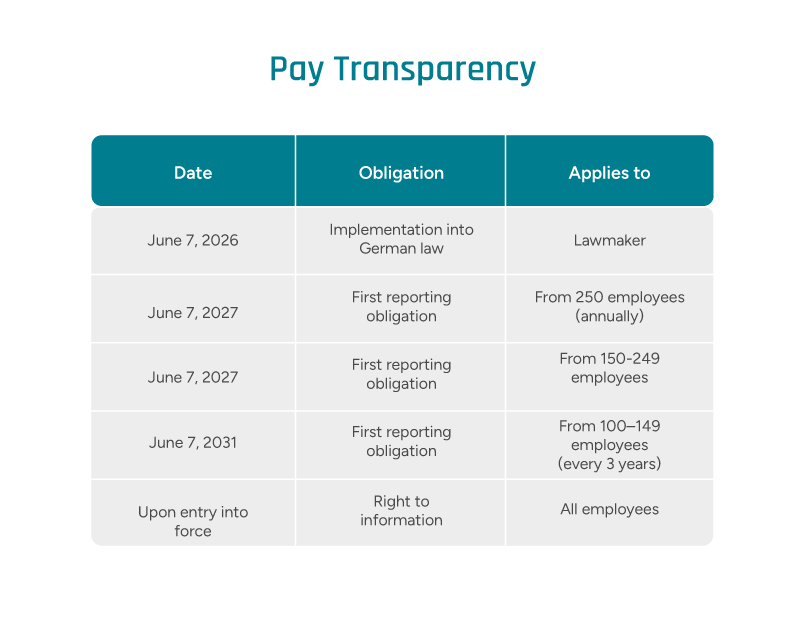
Company size is a key factor in determining how often pay transparency reports must be created. © GFOS Group
For HR teams, this means analyzing existing compensation models in time, adapting them where needed, and establishing processes that systematically increase transparency.
Goals of Pay Transparency
A core goal of pay transparency is to reduce gender-based pay differences. Eurostat statistics on the gender pay gap highlight the need for action: in 2023, women’s gross hourly earnings across the EU were, on average, 12.0 percent lower than men’s.
Depending on the country, the gender pay gap is significantly higher than the EU average; Latvia leads with a 19 percent difference. Transparent pay structures make disparities like these visible and create the foundation for fair, evidence-based adjustments.
Beyond that, pay transparency strengthens the overall sense of fairness across the organization. When employees understand why certain pay decisions are made, trust in the organization, leaders, and HR processes increases.
Benefits of Pay Transparency for Organizations
Transparent pay structures have a positive impact on employee satisfaction. When people perceive their compensation as fair and understandable, they are more likely to demonstrate higher motivation and loyalty.
Externally, organizations that communicate compensation openly are often perceived by customers, partners, stakeholders, and candidates as modern, fair, and trustworthy. Including pay ranges in job postings can strengthen employer branding and improve both the quality and volume of applications.
Because pay transparency requires clearly defined criteria and objective standards for compensation decisions, it supports data-driven HR decisions, for example for salary increases, promotions, or bonus payouts. In turn, subjective influences are reduced.
Challenges When Implementing Pay Transparency
Not every stakeholder views pay transparency positively. Leaders may anticipate increased pressure to justify decisions, while employees may draw comparisons that can create dissatisfaction if context is missing.
In addition, compensation data is among the most sensitive categories of personal data. Organizations must ensure that data privacy and confidentiality are protected at all times, especially when sharing compensation information internally.
Implementing pay transparency also requires significant communication effort: compensation models must be explained, questions answered, and misunderstandings proactively prevented.
Open discussions about pay also carry risk: once differences become visible, internal conflict can arise. Without transparent criteria and clear rationales, organizations may face demotivation, envy, and loss of trust.
Payroll Processing: automated & legally compliant
Digitize payroll processes with GFOS and permanently reduce manual effort. For error-free and timely payroll processing.
How to Create and Strengthen Pay Transparency in Your Organization
Successful pay transparency takes more than meeting legal requirements. It is a strategic effort that depends on clear structures, consistent criteria, and open communication.
Organizations that invest in pay transparency lay the groundwork for fair compensation programs, strengthen trust across the business, and increase buy-in from both leaders and employees.
The following steps can serve as practical guidance:
Define Clear Compensation Models
Effective pay transparency requires structured, consistent compensation models that employees can understand. This includes transparent pay bands, systematic job evaluations, and clearly defined growth opportunities.
In practical terms: each role should have clearly documented pay levels, including starting pay, typical ranges, and upper limits. For performance-based models such as incentive pay, all conditions must be defined in detail upfront.
At the same time, career paths and the associated pay progression should be made transparent. This helps employees understand which steps are required to move to a higher pay level. Additional criteria such as scope of responsibility, expertise, and market benchmarks can also be incorporated to create an objective foundation.
Using workforce management software, including payroll software, can help you map compensation models digitally, keep them up to date, and make them accessible to all relevant stakeholders.
Establish Consistent Criteria for Pay Decisions
Salary increases, variable pay components, and one-time payments should be based on consistent, objective criteria such as qualifications, experience, performance, responsibility, or market benchmarks.
The goal is to minimize subjective decisions and make compensation decisions easy to understand. In practice, this can be supported through standardized evaluation forms, regular compensation reviews, or industry benchmarking.
All leaders should apply the same evaluation standards to prevent discrepancies and perceived unfairness. Digital tools can also help document pay decisions transparently and ensure that every compensation change is traceable and audit-ready.
Communicate Transparently
Pay transparency is a long-term change journey. Professional change management, paired with open and consistent communication, is critical to build acceptance and reduce uncertainty.
This includes communicating planned changes early, explaining the reasons for greater transparency, and offering regular feedback sessions. Communication formats may include workshops, internal information portals, or structured Q&A sessions.
It is important to explain not only the new compensation models, but also how pay decisions are made and which benefits transparency creates for employees and the organization. Clear, consistent communication strengthens trust in leaders and HR while reducing speculation and uncertainty.
Train Hr Teams and Leaders
HR teams and leaders play a central role in introducing pay transparency. Training helps them communicate compensation models clearly and handle questions about salary transparency with confidence.
Training should cover both technical topics (pay structures, legal requirements, benchmarking) and communication skills, enabling leaders to respond appropriately to employee questions or concerns. Practical exercises, role plays, and case studies help reduce uncertainty and prepare leaders for real conversations.
In addition, digital tools can provide standardized information and support leaders in the day-to-day execution of pay transparency.
How Workforce Management Software Supports Pay Transparency
Modern workforce management software enables detailed analysis of working time, compensation, and pay components. This gives HR teams a reliable data foundation to implement pay transparency and meet statutory reporting requirements efficiently.
In addition, digital solutions such as workforce management software help ensure that overtime, premiums, and working hours are captured transparently, calculated correctly, and visible to the relevant stakeholders.
Conclusion: Pay Transparency as a Strategic Opportunity
Pay transparency and pay equity transparency are not short-term trends. They are essential building blocks of a future-ready people strategy. Organizations that address the topic early build trust, promote fairness, and prepare for upcoming legal requirements. With clear compensation structures, transparent communication, and the support of modern workforce management software, pay transparency becomes a sustainable driver of long-term business success.
