Key Takeaways: How AI Is Changing Shift Scheduling for Enterprises
- AI-powered shift scheduling analyzes historical data and demand drivers to forecast staffing needs much more accurately than manual methods.
- Automated scheduling recommendations can factor in skills, availability, collective bargaining agreements, and legally required rest periods at the same time.
- Intelligent workforce management software creates compliant, demand-driven schedules.
- Employee self-service features allow employees to enter availability and swap shifts independently.
- Predictive analytics help identify staffing shortages early and avoid both overstaffing and understaffing.
What Is AI-Powered Shift Scheduling?
AI-powered shift scheduling uses algorithms and machine learning to optimize workforce deployment based on data. Unlike traditional scheduling methods, the system analyzes historical data and identifies patterns in workload, absences, and fluctuations in demand.
This creates forecasts that account for seasonal peaks or changes in order volume, as well as concrete scheduling recommendations that automatically consider qualifications, working time models, and legal requirements.
The technology does not make decisions on its own. It prepares data and provides recommendations, while final approval remains with the scheduling managers.
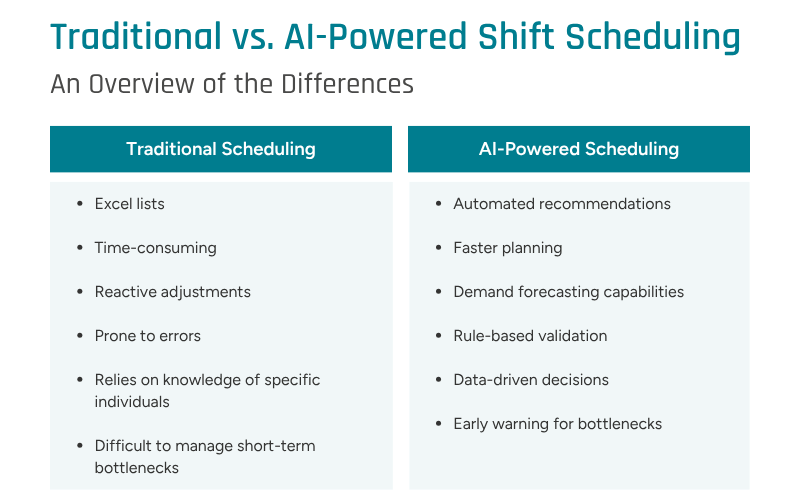
The more relevant data sources are included, the more precise and fair AI-enabled shift scheduling becomes; Image: © GFOS Group
How Does Automated Workforce Scheduling Work in Large Enterprises?
In larger organizations, shift schedules need to account for numerous variables at the same time. These include multiple locations, different working time models, collective bargaining agreements, and changing order volumes. AI systems process these factors in parallel and generate optimized scheduling recommendations.
The process begins with data collection: the system collects information on availability, qualifications, overtime balances, and planned absences. The algorithm then compares this data with the forecasted labor demand.
The result is a shift schedule that reflects all relevant requirements. When changes occur, such as short-notice sick leave, the system adapts the schedule and suggests suitable replacement employees based on the information stored in the system.
What Is the Difference Between AI Assistance and Fully Automated Scheduling?
A common misconception is that AI replaces human decision-making. It does not. AI supports scheduling managers with data, analytics, and recommendations. Final approval remains with the human decision-maker.
This combination of artificial intelligence and human expertise delivers the best results. The algorithm helps ensure that defined system rules are followed and identifies optimization potential. Scheduling managers contribute contextual knowledge, override AI-generated recommendations when needed, and make the final decision.
The Benefits of AI in Shift Scheduling for Enterprises
When analyzing AI-powered shift scheduling, three benefits stand out in particular:
- Time savings: Creating duty rosters and shift schedules becomes significantly faster. Research indicates that automated scheduling systems can deliver substantial time savings for planning tasks. For example, a 2022 study in the medical field showed potential savings of an entire workday. Scheduling managers can then use this reclaimed time for other priorities, such as strategic workforce planning.
- Improved scheduling quality: Automated systems minimize scheduling errors because all rules are checked consistently. This helps prevent manual processing errors at scale, including issues related to system rules such as working time limits, break regulations, and qualification-based requirements.
- Scheduling fairness: Employees benefit from fairer schedules. The system distributes unpopular shifts evenly and takes individual preferences into account. This fairness in scheduling increases satisfaction and strengthens retention across the team.
Data Analysis in Automated Shift Scheduling
Automated scheduling systems evaluate multiple data sources to create precise scheduling recommendations. The most important inputs include historical working time data, which reveals patterns in workload and absences.
In addition, operational metrics are included, which vary by industry: order intake, customer traffic, or production volume. This information enables demand forecasts for upcoming scheduling periods. The longer the system collects data, the more accurate the predictions become.
Employee information such as qualifications, certifications, availability, and working time preferences is also relevant. AI-powered shift scheduling uses this data together with skills management, ensuring that only suitable employees are scheduled for specific tasks.
[H3] How Does AI Support Compliance With Legal Requirements?
Compliance with working time laws, collective bargaining agreements, and works council agreements is especially complex for enterprises. The larger the organization, the more individual rules must be considered. AI-powered systems automatically check all predefined rules and alert users to potential violations.
This includes maximum working hours, mandatory rest periods between shifts, and break regulations. Every scheduling change triggers another check. This helps scheduling managers reduce compliance risks and document adherence to all requirements directly in the system.
What Does the EU AI Act Mean for AI Shift Scheduling?
The EU AI Act classifies HR software as high-risk AI depending on its functionality, for example when it supports decisions in an employment context, such as recruiting or performance evaluation. According to Annex III, No. 4, this category also includes AI systems that perform an “allocation of tasks based on individual behavior or personal traits or characteristics.”
This means that, depending on the specific functionality, AI-powered shift scheduling software may also fall into the high-risk category, namely when it is used for evaluation, workforce management, or decision support.
That is why qualified professionals remain necessary to monitor the system and intervene when needed. From August 2026, stricter requirements for documentation, human oversight, and transparency are expected to apply. Companies must be able to demonstrate how decisions are made.
The EU AI Act defines documentation obligations for software providers and deployers. Automatically generated logs must be retained for at least six months. Employees and works councils must be informed before the system is used.
These requirements are not a disadvantage. They create trust and legal certainty. Systems that already operate transparently and enable human control often meet upcoming requirements without extensive adjustments.
How Does AI Improve Employee Satisfaction in Shift Scheduling?
Employees today expect more influence over their working hours. Rigid scheduling models are no longer competitive. Workforce management systems that integrate AI often also use employee self-service features or self-rostering. Through apps or portals, team members can enter availability and preferences directly.
The system takes this information into account during automated scheduling. Shift exchange platforms allow employees to swap shifts independently with colleagues. This significantly reduces coordination effort for supervisors.
Fewer overtime hours and less frequent rescheduling can have a positive impact on employee retention. A 2024 study on nursing staff scheduling showed that scheduling software can improve satisfaction with the employer. The ability to participate in scheduling therefore strengthens engagement and measurably reduces turnover.
How Does AI Shift Scheduling Integrate With Existing Systems?
Modern workforce management software does not operate in isolation. It connects with the company’s existing IT landscape: ERP systems, payroll software, and HRIS solutions exchange data automatically through interfaces and APIs.
This integration creates a unified data foundation. Changes in shift scheduling directly affect time tracking and payroll, eliminating duplicate data entry and reducing sources of error.
How to Get Started With AI-Powered Shift Scheduling
AI-powered shift scheduling delivers measurable benefits for large enterprises and mid-sized companies alike: less scheduling effort, higher quality, better compliance, and more satisfied employees. The key is proper implementation.
Start with an assessment of your current scheduling processes. Identify bottlenecks and optimization potential. Involve the works council and employees early to build acceptance.
Choose a vendor that understands industry-specific requirements and has a proven track record of delivering solutions that fit your organization’s specific use case.