
According to Germany’s Federal Institute for Occupational Safety and Health (BAuA), around six million employees in Germany work rotating shifts, in some cases including night shifts.
A long-term BAuA research project shows that shift work can have health implications for employees: “What we can say with confidence is that it is not good for the body when someone constantly has to work against their internal clock,” says Frank Brenscheidt of BAuA.
The human body is designed for daytime activity. That means frequent night shifts work against our natural circadian rhythm. This makes it even more important to document every shift accurately and, ideally, to consider employees’ individual preferences when building schedules.
Definition: What Is Shift Work?
Shift work is a working-hours model in which employees work at different times of day. Typically, organizations differentiate between morning, evening, and night shifts. Tasks are completed in consecutive time blocks to maintain continuous operations.
Shift Work in Logistics: Key Considerations
Shift work in logistics comes with several distinct requirements. Areas such as warehousing, cross-docking, and transportation each have their own operational demands, which require flexible workforce scheduling. Many organizations also rely on complex shift patterns with morning, evening, and night shifts to keep goods moving smoothly around the clock.
Because of the physical workload and irregular hours, turnover is often high. This is why temporary staff play an important role in offsetting capacity gaps and keeping operations running.
Why Is Time Tracking Important in Shift Work?
Especially in shift environments with changing schedules, digital time tracking creates transparency around worked hours and overtime. It supports fairness and traceability for employees and managers alike, while also providing a reliable basis for payroll and premium pay calculations.
Incorrect or manual timekeeping can create legal risk. In some industries that frequently rely on shift work, time tracking is mandated by law. This applies, for example, to professional drivers and other roles that work in road transport.
In these settings, time tracking can be handled through digital time clocks at the workplace or other systematic recording methods. Employers are also required to record hours worked beyond the agreed schedule, and this applies to shift operations as well.
Make Compliance Easy
Germany’s Working Hours Act (ArbZG) also applies to shift work. Its goal is to balance companies’ economic interests with the protection of employees’ health and well-being, since shift work and especially night work can create additional strain.
Examples of legal requirements include:
- A 30-minute break must be taken no later than after more than six hours of work, in shift work as well as in standard schedules.
- There must be a rest period of at least 11 hours after the end of work. A direct change from an evening shift to a morning shift the next day is therefore not permitted.
- Any work that takes place for more than two hours during night hours (between 11:00 PM and 6:00 AM) is defined as night work.
- Employees who work night shifts are entitled to an occupational health examination, paid for by the employer.
- Pregnant and nursing mothers, as well as employees under 18, are generally excluded from night work.
In addition, there is a clear documentation obligation: Working hours must be recorded completely and accurately to demonstrate compliance with legal requirements. Digital time tracking systems and automated shift scheduling as part of a workforce management platform help organizations reliably meet legal, operational, and collective bargaining requirements. Needs-based Software as a Service (SaaS time tracking) also supports these requirements.
Violations of the Working Hours Act can increase the risk of workplace accidents and absenteeism. They can also result in fines, regulatory requirements, and employment-law consequences. That is why proactive, legally compliant shift scheduling is essential.
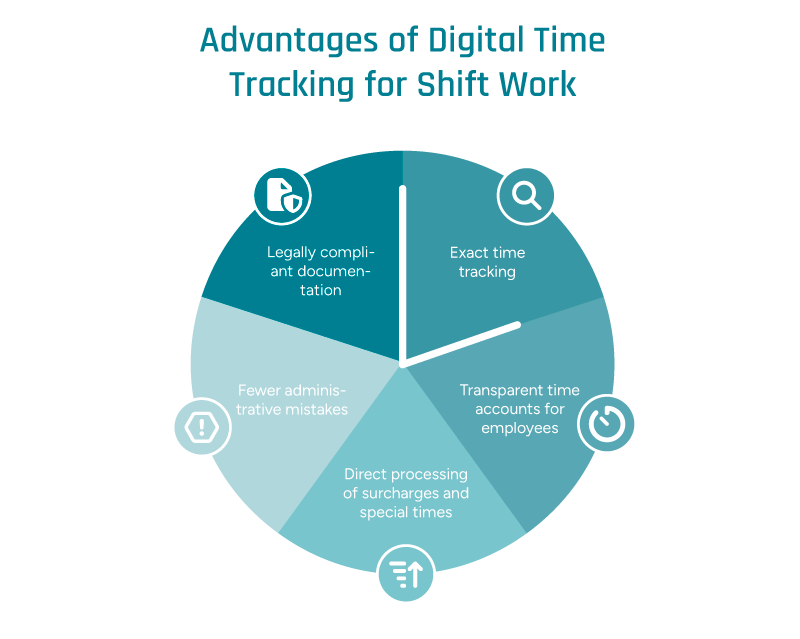
When organizations move from manual to digital tracking, it becomes easier to document shift work precisely and in a legally compliant way. © GFOS Group
Benefits of Digital Time Tracking in Shift Work
Digital time tracking offers clear benefits, including in shift operations. It supports efficient processes and compliant workflows, for example:
- By accurately capturing clock-in and clock-out times as well as breaks, worked hours are documented down to the minute, regardless of which shift an employee works.
- Another benefit is the automatic handling of premium pay and special time categories. Night, weekend, and holiday premiums as well as overtime are recognized automatically and calculated correctly, which significantly simplifies payroll.
- With transparent time accounts, employees can view their working time, overtime, and remaining balances at any time. This builds trust and reduces follow-up questions for HR.
- At the same time, digital capture leads to fewer administrative errors by eliminating manual transfers and spreadsheet-based processes. Workflows become standardized and more efficient.
- Finally, digital time tracking provides audit-ready, legally compliant documentation. Working hours are recorded seamlessly and in line with legal requirements, making them traceable at any time, for example during inspections. This helps organizations meet shift-work requirements reliably.
Use Cases for Digital Time Tracking in Logistics Shift Operations
Below are a few examples of what digital time tracking for individual employees can look like in practice:
Time Tracking in 24/7 Warehouse Operations
In a warehouse running 24/7, teams work rotating morning, evening, and night shifts. Digital time tracking records working time accurately around the clock, regardless of shift start or end times. Night, weekend, and holiday hours are detected automatically, and the applicable premiums are calculated correctly.
Rest periods and breaks are monitored by the system, helping ensure compliance with legal requirements. At the same time, employees have ongoing access to their time accounts, while HR can rely on trustworthy, compliant data for payroll and reporting. These figures can also feed into end-to-end analyses of logistics KPIs.
Time Tracking for Short-Notice Staffing Increases During Seasonal Peaks
During seasonal peaks, such as the holiday season, organizations often supplement their core workforce with temporary and agency staff on short notice. Digital time tracking makes it fast and straightforward to onboard these employees into shift operations.
Working hours are recorded correctly from day one, even with changing assignments or last-minute shift changes. Special time categories, overtime, and premiums are applied automatically, preventing payroll errors.
At the same time, end-to-end documentation helps ensure that all legal requirements are met even with high turnover, while keeping administrative effort low despite increased volume.
Automated Shift Scheduling via Software
The demands of shift work are undeniable. To reduce the burden as much as possible, schedules can be designed in ways that better support employees’ need for personal time and recovery.
For example, forward rotation of shifts, moving from morning to evening to night, is often recommended because it aligns more closely with our circadian rhythm. In addition, the number of night shifts per employee should be kept as low as possible, and the longest possible recovery time should be provided after a night-shift phase.
With workforce scheduling software, working hours can be aligned optimally with employees’ needs. Availability, qualifications, legal requirements, and personal preferences are considered automatically, enabling fair, efficient, demand-driven staffing. Data from inventory management or ERP systems can also be integrated, and features such as shift swap marketplaces increase flexibility when unexpected absences occur.
