
What Does Workforce Planning in Shift Work Mean?
Workforce planning in shift work means organizing and assigning employees to defined shifts within a specified time model.
Shift-based planning differs from general workforce planning because staff deployment does not only take place during standard working hours, but across several coordinated shifts.
When planning, companies must therefore ensure that every shift is staffed according to demand while also complying with legal requirements.
An overview of typical shift models:
- Fully continuous shift model (24 hours, 7 days a week)
- Semi-continuous shift model with night work (24 hours, 5 days a week)
- Semi-continuous shift model without night work (daytime operation)
Challenges in Workforce Planning for Shift Work
In shift operations, several factors come together that make workforce planning more difficult. The following challenges are among the most common in everyday work:
Fluctuating Staffing Requirements
Staffing requirements in shift work fluctuate constantly. Order peaks require an increased number of skilled workers at short notice, while quiet days can quickly lead to overcapacity. Efficient employee planning helps deploy staff exactly when they are needed.
Short-Notice Absences
Illness or vacation often leads to unplanned staffing shortages. These absences must be compensated for at short notice by other employees, which often results in extra work, overtime and additional strain on the existing team.
Complexity of Shift Planning
Different qualifications, availabilities and shift models increase planning complexity. To avoid qualification bottlenecks, responsible teams must schedule enough qualified staff for every shift while also taking operational and individual requirements into account. A shift schedule template is a good starting point for creating initial structures. In complex shift operations, however, administrative effort quickly increases, meaning manual planning methods reach their limits and digital solutions become more important.
Media Discontinuity
Using Excel spreadsheets or paper-based processes often leads to errors and inconsistencies. Data has to be transferred manually, information gets lost or is not available in an up-to-date form—making efficient and transparent planning more difficult.
Requirements for Workforce Planning in Shift Work
Shift work places various requirements on workforce planning:
- Transparent shift planning: Complex shift models must be mapped transparently so that they are visible and understandable for all employees.
- Ensuring legal compliance: Especially in around-the-clock operations, working hours and rest periods must be observed to protect employees. Time tracking software helps record working hours accurately and relieve employees.
- Considering employee needs: To enable employees to maintain a healthy work-life balance, planning that takes individual availability into account is important.
- Flexible shift planning: Planning must be adaptable quickly in the event of short-notice absences so that employees are not overburdened and the company’s productivity does not decline.
- Mapping qualifications and roles: If there is an overview of employees’ respective skills, they can be deployed effectively and support the areas where they are needed most.
- Scalability: Long-term, future-oriented workforce deployment planning that takes order peaks, bottlenecks and idle times into equal account helps a company work efficiently even when demand changes.
Success Methods for Workforce Planning in Shift Work
Successful shift planning is based on clear processes, reliable data and sufficient flexibility. The following methods have proven effective in practice:
- Demand assessment: To determine which staffing resources will be needed in the long term, a corresponding demand assessment based on forecasts and historical data is required.
- Considering qualifications: If employees’ individual skills are taken into account during planning, they can be deployed in a targeted way. This helps avoid qualification bottlenecks and improve workflows.
- Involving skilled workers: Taking availability and shift preferences into account promotes acceptance of the schedule and increases employee satisfaction. Transparent swap options within the team create additional flexibility. Digital self-service solutions support the efficient mapping of preferred shifts and schedule changes.
- Building in buffers: Dynamic schedules allow companies to respond quickly and flexibly to changes. The availability of standby staff and scenario-based thinking provide support. In addition, substitution rules help maintain operations even during absences.
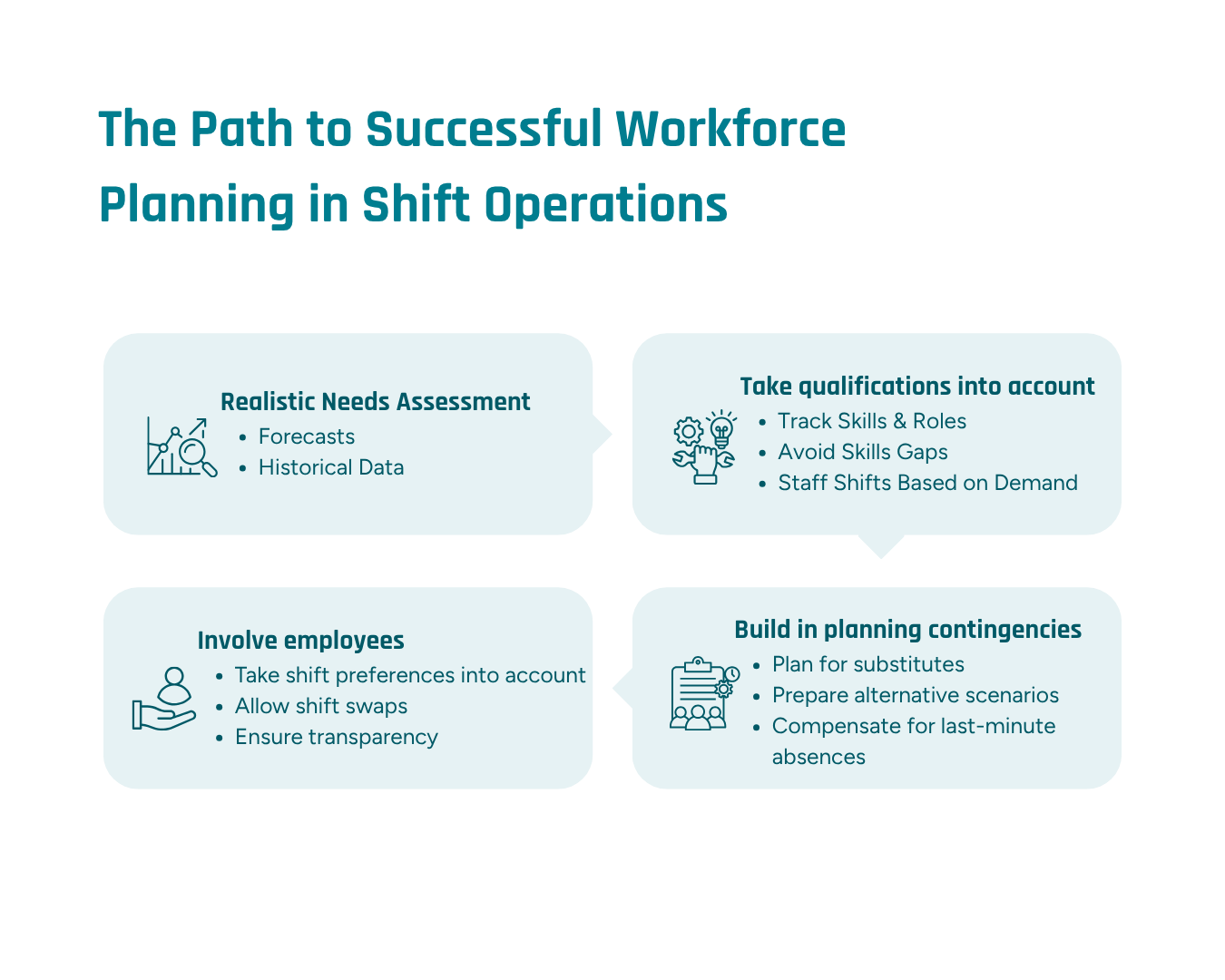
Due to its complexity, workforce planning in shift work often presents challenges for those responsible. Nevertheless, success methods are emerging that simplify the process. Image © GFOS Group
[H3] Disadvantages of Excel and Manual Planning
Many companies still create shift schedules using Excel or paper-based processes. However, as the number of employees increases and planning becomes more complex, the effort involved also rises. Changes have to be entered manually, information is transferred multiple times and shift schedules must be updated regularly.
This leads to a high susceptibility to errors, the correction of which costs additional time. In addition, there is a lack of transparency: employees outside the HR department have no insight into the planning process, which makes compliance with working time legislation more difficult.
Digital solutions for shift and duty scheduling support companies in automating planning processes, implementing changes more quickly and making shift schedules available centrally. As a result, both administrative effort and susceptibility to errors can be reduced.
Workforce Planning in Shift Work as a Strategic Success Factor
Workforce planning in shift work is a strategically important factor for companies. It creates transparency and provides both stability and flexibility, enabling long-term competitive advantages. Specialized software relieves the burden on planning teams and helps them keep track of complex planning, making it a true success factor.
Shift Planning Made Easy with GFOS
Save time through automated planning processes and actively involve your employees in HR decisions.
