
From benefits packages and organizational charts to recruiting and salary matters: the HR department is involved in all personnel-related issues and therefore plays a decisive role in the company’s success. But how can an organization ensure that everything in HR is running as it should? How do improvements make their way into Human Resources? To do this, it is necessary from time to time to question the status quo — and an HR audit makes this possible.
Definition: What Is an HR Audit?
An HR audit is an objective review of a company’s HR department, processes, and tasks. Its aim is to reveal optimization measures and identify challenges in order to improve. This can be carried out externally by a consultancy or internally by management and the HR department itself.
What Benefits Does an HR Audit Offer?
An annual HR audit strengthens both employee retention and compliance by creating transparency around HR processes and identifying optimization potential at an early stage. Regular reviews promote fair, consistent, and legally compliant practices, which increases employees’ trust and satisfaction.
At the same time, HR audits ensure compliance with legal requirements and internal standards, reduce risks, and support a sustainable, employee-oriented HR strategy.
This is how an HR audit helps systematically identify the causes of employee turnover — for example, weaknesses in leadership, the working atmosphere, or compensation — and derive targeted improvement measures from them. By reviewing HR processes, feedback systems, and development opportunities, factors that strengthen retention can be reinforced.
At the same time, the transparency and optimization of HR structures ensure a professional, consistent presence both internally and externally, which strengthens the employer brand and increases employee retention in the long term.
What Disadvantages Can Companies Face If They Do Not Conduct an HR Audit?
If companies fail to conduct regular HR audits, they face legal risks such as violations of labor laws, anti-discrimination regulations, or data protection requirements. This can lead to fines, claims for damages, or reputational damage and can make HR decisions more difficult to trace.
Which HR Metrics and KPIs Should Be Prioritized in an HR Audit?
As part of an HR audit, particular attention should be paid to those HR metrics and KPIs that provide insight into the efficiency, quality, and strategic effectiveness of HR processes.
Important metrics include:
- Headcount and workforce structure: shows organizational structure, age distribution, and diversity
- Turnover rate: measures employee movement
- Sickness absence / absenteeism rate: indicator of health and working climate
- Personnel cost ratio: share of personnel costs in total expenses or revenue
Key KPIs:
- Time-to-hire: efficiency of the recruitment process
- Cost-per-hire: cost-effectiveness of recruitment
- Training rate / training hours per employee: level of skills development
- Employee satisfaction or engagement score: retention and motivation of the workforce (People Analytics)
- Performance and potential assessment (e.g., high-potential rate): effectiveness of talent management
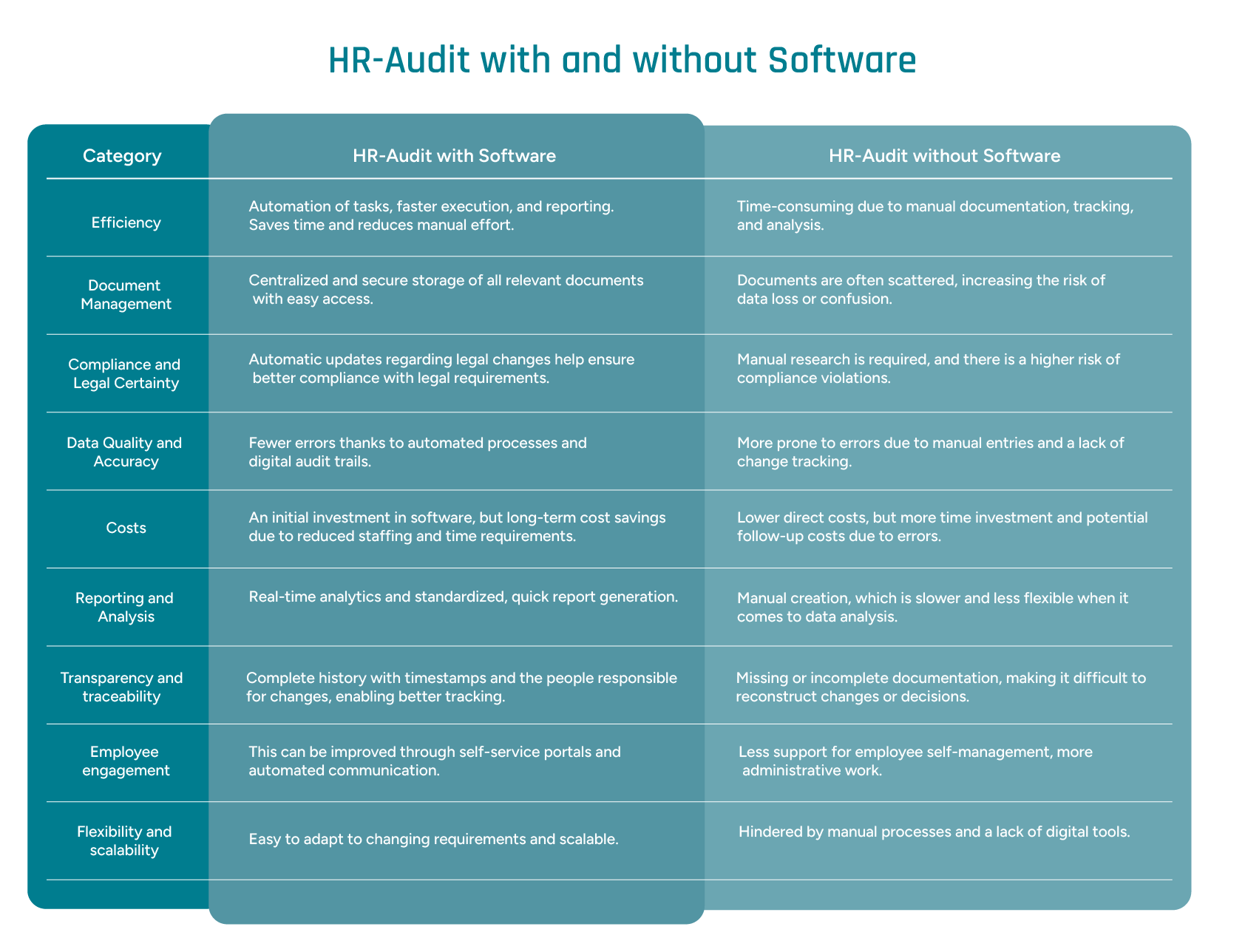
Regular HR audits are important and useful – suitable software solutions offer even better and more detailed insights. © GFOS Group
An Audit of the HR Department — How Can It Succeed?
The approach to the upcoming evaluation should begin, for example, with an audit checklist for the HR department. Important questions, procedures, and audit objectives can be recorded in it.
Creating a questionnaire for an internal HR audit also makes it possible to use the same approach as a guide in subsequent years. This ensures consistent audit quality.
Pravin Durai, professor at Joseph’s College in India, identified various criteria in his book Human Resource Management. For him, important factors for an HR audit include the following:
- An examination of the HR department’s efficiency in introducing important processes and policies within the organization
- Determining whether HR processes are carried out in accordance with company and legal guidelines, including collective bargaining agreements, occupational health management requirements, and much more
- Identifying potential cost savings within the company
- Establishing responsibilities within the company, including with regard to conducting an HR audit at regular intervals
- Open communication with employees about the status quo, the company’s performance, and necessary improvements
HR Audit – Phase 1
During the inventory phase, the current state is critically examined based on the previously defined criteria or the audit checklist for the HR department. The aim here is to collect and present all relevant information.
This information can be listed, for example, using a questionnaire or with the help of analyses based on HR metrics from the software used in the company.
HR Audit – Phase 2
This is followed by a comprehensive analysis of all the information collected. The metrics must be evaluated in order to draw conclusions and develop optimization plans. Existing processes, procedures, guidelines, and more should be reviewed in this step.
HR Audit – Phase 3
Finally, a detailed report is prepared that summarizes the findings. Based on this, management or the HR consultancy can formulate and implement recommended actions.
These can then be used for the realignment of the company’s organizational design.
Use Our HR Audit Checklist
Assess the maturity of your HR function with this free checklist.

Which Areas Are Examined in an Audit of the HR Department?
The following questions can help make the HR audit as comprehensive as possible. All areas related to personnel matters are examined — from recruiting and onboarding to employee development.
- Are best practices being used? – It is likely that other companies or pioneers are achieving better performance in their HR departments. In this case, it is helpful to rely on best practices and, where appropriate, introduce them in the organization. This allows HR managers to ensure that all important measures are being pursued.
- How well are rules being followed? – It is important to question whether key regulations and requirements in HR are being complied with. This can concern working hours, for example, but also matters that are often forgotten, such as retention periods for application documents.
- Is the company competitive? – In HR, this question relates in particular to employee benefits, performance-based pay, and other forms of compensation that promote motivation and performance among the workforce. A comprehensive competitive analysis is therefore essential.
- How well are managers performing? – Feedback is not a one-way street. Employee appraisals are important and lead to the continuous improvement of employees’ skills. However, managers and leadership should also be evaluated at regular intervals. High-performing managers can have a positive impact on the workforce.
Outlook and Trends in HR Audits
HR audits are increasingly evolving from one-off reviews into dynamic, data-based learning processes. Artificial intelligence enables automatic pattern recognition to identify risks, opportunities, and optimization potential at an early stage. Real-time analytics and continuous audits create transparency and allow proactive management instead of retrospective control.
By linking internal benchmarks with external HR comparison data, a holistic picture of workforce performance and organizational maturity emerges. In the future, the HR audit will be understood not only as a control instrument but also as a driver of organizational transformation that enables HR to act continuously more effectively and strategically as a learning unit.
With GFOS Intelligence people analytics software as part of your HR tech stack, you can already address these developments today:
Workforce Management Tools Support HR Audits
A workforce management solution can support an HR audit of the HR department. For example, it can provide important HR metrics that can be used for analysis — conveniently via an HR dashboard.
What is the status of the workforce’s absence management? Are skilled workers frequently absent due to illness? What is the fulfillment rate of employee preferences in workforce scheduling? What is the turnover rate in the company? These and other questions need to be answered in order to formulate clear recommendations for action. Workforce management tools such as an employee self-service portal are well suited for this purpose.
Software-based time tracking, workforce scheduling, or workforce demand planning record a wide range of data every day. This data can be evaluated using HR metrics as part of business analytics, as well as people analytics. As a result, the analysis in step two of the HR audit becomes significantly easier and more reliable.
Rely on clear facts for your next HR audit. New Work should no longer have to wait for your company — now is the right time to move toward digital transformation. Our IT experts will be happy to advise you in a non-binding consultation.
Conduct HR Audits more effortlessly with software from GFOS
Now is the right time to embark on your digital transformation journey. Our IT experts would be happy to advise you during a no-obligation consultation about our HR software.
