
Definition of On-Call Duty
On-call duty is a working arrangement in which employees can stay at a location of their choice, such as their home. They can go about their everyday activities, but must remain reachable during on-call duty and be available for a potential work assignment.
Definition of Standby Duty
During standby duty, employees remain at a location specified by their employer, such as a hospital ward. As long as no work is required, they can rest or pursue other activities there. However, they must be ready to work immediately when needed.
Differences Between On-Call Duty and Standby Duty
On-call duty and standby duty differ in more than just where employees stay. There are also significant differences in working time, pay, flexibility, scheduling and documentation. Here is an overview of the key distinguishing features:
Location
On-Call Duty: Employees choose their own location and can change it during their duty period.
Standby Duty: The employer specifies the location. Employees are generally provided with a room for the duration of their duty.
Classification under working time law
On-Call Duty: As a general rule, the duty period is not classified as working time, but as rest time. If employees are called upon to work, only the work actually performed counts as working time.
Standby Duty: The entire duty period counts as working time. This also applies when employees are not called upon to work.
Pay
On-Call Duty: Hours actually worked must be documented and paid in accordance with the applicable rules.
Standby Duty: Pay is likewise governed by the applicable collective agreements or employment contracts.
Flexibility
On-Call Duty: Employees have comparatively greater flexibility during their duty period. They can go about their everyday lives as long as they remain reachable and ready to work if needed.
Standby Duty: Staff must be ready to work immediately when needed. Their presence at the designated location is therefore essential, significantly limiting their flexibility during the duty period.
Scheduling effort
On-Call Duty and Standby Duty: Both working arrangements can involve considerable scheduling effort. Those responsible for scheduling must comply with requirements and allocate duties fairly among staff. They should also schedule on-call and standby duties well in advance and notify the assigned employees in good time.
Documentation requirements
On-Call Duty: All hours actually worked during on-call duty must be documented. Interruptions to rest periods must also be taken into account.
Standby Duty: The entire standby duty period counts as working time and must therefore be documented in full.
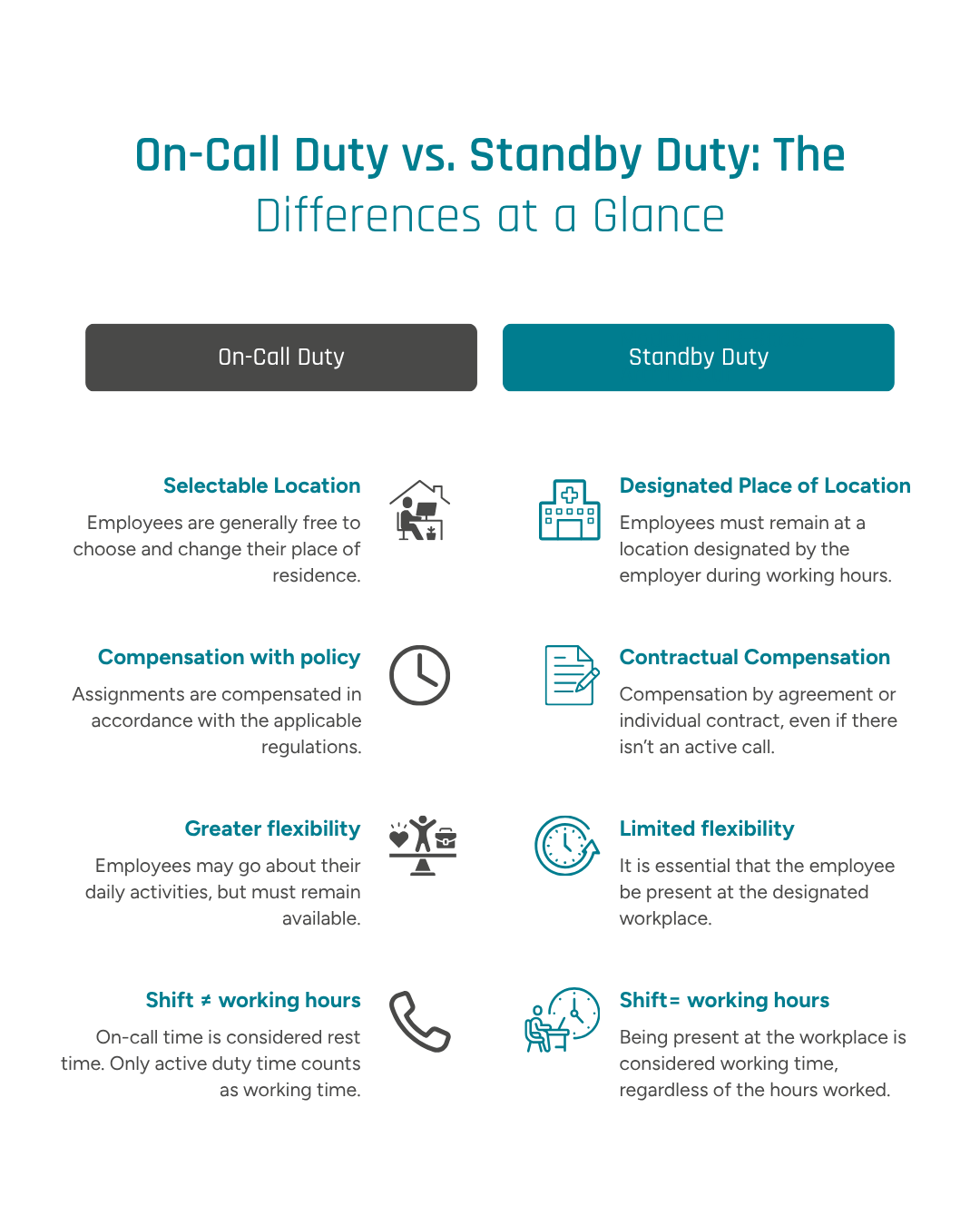
On-call duty and standby duty differ in several aspects. © GFOS Group
Which Model Is Suitable When?
On-call duty is particularly suitable when specialists do not necessarily need to be present at a specific workplace and are not required to act immediately when called upon. Areas where the on-call duty model can be useful include:
- IT support
- Skilled trades or facility management
- Energy supply
With standby duty, by contrast, the presence of qualified employees at the work location is essential. When specialists are called upon, they must be able to act at short notice. Common areas where standby duty is used include:
- Hospital wards
- Care facilities
- Emergency medical services or fire services
Scheduling Challenges
Scheduling on-call duties and standby duties can be complex and present challenges for those responsible. These include accommodating employee preferences when allocating duties, complying with collective agreements and organising cover for short-notice absences. Various aspects need to be considered when creating duty rosters:
Fair Allocation of Duties
On-call duties or standby duties should be allocated fairly among employees. Regular rotation, along with consideration of preferred shifts and employees volunteering for duties, can contribute to a balanced allocation and a better work-life balance.
Taking Rest Periods into Account
Rest periods must be taken into account in staff scheduling. As a general rule, the German Working Hours Act requires an uninterrupted rest period of at least eleven hours after the end of the daily working period. However, different rules may apply to certain industries and working arrangements.
Compliance with Collective Agreements and Contractual Requirements
When scheduling on-call and standby duties, requirements under collective agreements and employment contracts must be taken into account. These may specify, among other things, how the respective duties are paid and assessed, or which compensatory arrangements apply.
Covering Short-Notice Absences
Short-notice absences can make duty scheduling even more difficult. Those responsible for scheduling must ensure that suitable employees with the required qualifications are available as replacements when needed. In nursing, float pools can help cover short-notice absences and ease the burden on employees.
Meeting Documentation Requirements
If working time is not recorded systematically, gaps in documentation can arise. This makes it difficult to establish when employees actually worked or when rest periods were interrupted. In turn, this makes it harder to prepare payroll calculations and duty rosters in a transparent and traceable manner.
How Can On-Call Duty and Standby Duty Be Managed Digitally?
From scheduling software to mobile employee apps, there are various ways to manage duties digitally. Digital solutions can also support those responsible for organising on-call and standby duties:
- Duty Scheduling: Employee qualifications can be stored in a digital system and taken into account directly during scheduling. Requirements under collective agreements and workplace agreements can also be incorporated, and potential conflicts in the duty roster made visible. Employees can also specify preferred shifts and offer their duties for exchange.
- Digital Time Recording: Depending on their assignment, employees can record their working time using a terminal, web application or app. Working time data is then available centrally and can be used immediately for further assessment and review.
- Checking Working Time Rules: The system automatically checks working time for deviations from applicable rules, such as those governing working hours or rest periods, and informs employees and supervisors of potential violations. Deviations are identified early and can be taken into account in subsequent duty scheduling.
- Automatic Time Evaluation and Premium Calculation: Working time can be recorded digitally and evaluated based on stored rules. Pay premiums and special time categories are automatically taken into account, and relevant data is passed on to payroll.
Conclusion
The differences between on-call duty and standby duty are wide-ranging. Which working arrangement is used depends on the particular requirements of the company and the area of operation. Various challenges, such as requirements under collective agreements, mandatory rest periods and the fair allocation of duties, can make scheduling complex. Digital workforce management systems can help those responsible for scheduling plan duties more transparently, take working time rules into account and cover short-notice absences more efficiently.
Duty scheduling, time recording, people analytics and more.
Discover workforce management in healthcare with GFOS.
