
Workforce scheduling in retail is one of the most demanding operational tasks. While other industries often plan from a relatively stable baseline, retail is defined by fluctuating demand, long opening hours, and a highly flexible workforce model.
Retail as a Sector Defined by Temporary Staff and Frequent Absences
One of the main drivers of scheduling effort in retail is the high share of part-time and temporary employees. According to the German Retail Association (HDE), the current part-time rate in retail is 62 percent.
On top of that, unplanned absences are a daily reality. Recent analyses show that, at times, more than 7 out of 100 retail employees are out sick at the same time. For store managers, this means continuously adjusting schedules.
In addition, customer traffic fluctuates significantly throughout the day and week. Clear peaks on weekends or at specific times highlight a simple truth: if you do not plan precisely, you risk lost sales due to understaffing or unnecessary labor spend due to overstaffing.
The 5 Biggest Challenges in Retail Staff Scheduling
If scheduling often feels chaotic in day-to-day operations, it is rarely caused by a single mistake. In most cases, familiar patterns are at play, and they show up again and again in retail.
1 Overly Rigid Schedules
In many stores, a schedule is created once a week or for several weeks and then left unchanged whenever possible. What looks efficient on a printed schedule often breaks down quickly in practice.
Daily operations are anything but predictable: sick calls, last-minute vacation, or an unexpected surge in customers are all normal. A rigid schedule is therefore not viable in retail.
Common consequences include understaffing during peak times, overstaffing during slow periods, and stressed employees as well as frustrated customers. A dynamic retail environment requires an adaptable staffing plan.
2 Lack of Transparency Across Multiple Locations
As soon as multi-location workforce scheduling in retail is required, planning becomes significantly more complex. Often, there is no central view of how many people are scheduled and where.
Typical issues include:
- Employees are scheduled twice or not scheduled at all
- Some locations are overstaffed while others are understaffed
- Short-notice support through reassignments between locations is hardly possible
Especially for larger retailers and chains, this leads to inefficient use of resources. Planning remains isolated by location instead of being coordinated across sites.
3 Planning Without Reliable Demand Data
In many organizations, scheduling is still based on experience or gut instinct. Store managers look at previous weeks or years and estimate demand at a high level.
The challenge: actual customer traffic can vary widely by day of week, weather, time of day, or season. Without valid data, misalignment becomes inevitable and can lead to lost revenue or unnecessary cost from having too many people on the floor. A solid data foundation is therefore essential.
4 Ineffective Team Communication
Even the best schedule is useless if it does not reach everyone. Communication around the schedule is an often underestimated factor in retail. In many stores, updates are shared via a breakroom printout, last-minute coordination via messaging apps, or verbal handoffs.
This approach almost inevitably means changes are missed, employees show up at the wrong time, or shifts remain understaffed. With many temporary employees who are still new to the organization, the problem becomes even more pronounced due to a lack of routine.
5 No Post-Schedule Analysis
Schedules are created, but efficiency and fit are not analyzed afterward. As a result, key questions often remain unanswered:
- Where do we repeatedly run into understaffing?
- When do we generate overtime in the store?
- Which locations are consistently scheduled inefficiently?
Without answers to these questions, or without a structured review of the staffing plan, the same mistakes can repeat week after week. Planning stays purely operational instead of evolving into a strategic capability.
How to Optimize Retail Staff Scheduling: 5 Practical Levers
The challenges described above are rarely solved with a single measure. What matters is a combination of better data, more flexibility, and clear processes. The following five levers address the areas where most stores experience the biggest day-to-day issues.
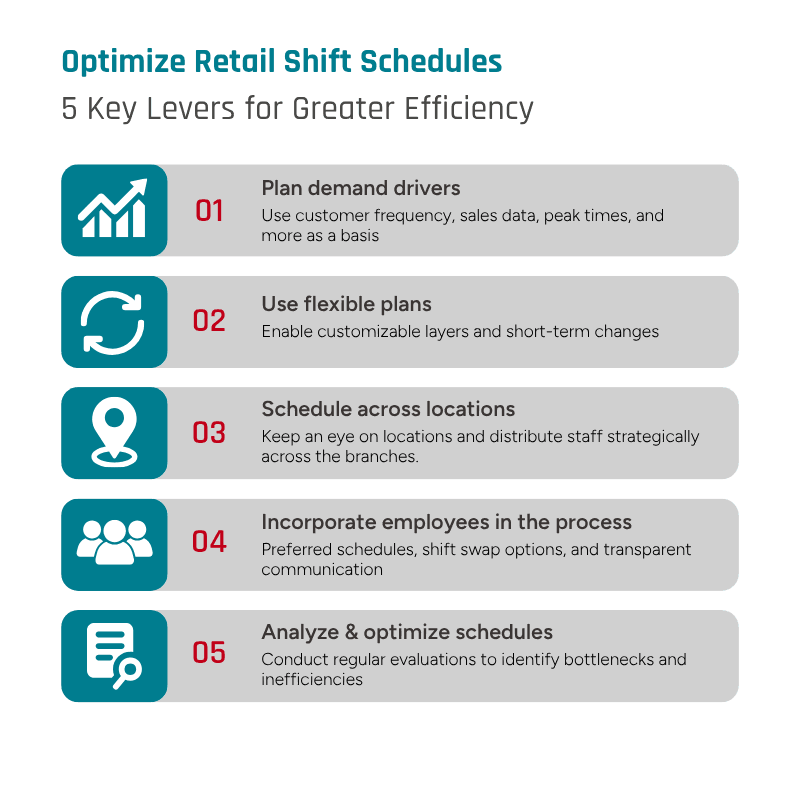
With five focused steps and specialized retail workforce planning software, daily challenges become easier to manage; © GFOS Group
1 Align Scheduling Consistently with Demand
Planning by instinct instead of actual demand does not reduce workload. A better approach is to schedule based on concrete drivers such as customer traffic, sales trends, weekdays, and peak hours, for example with a purpose-built workforce scheduling solution.
This makes recurring patterns visible, such as higher demand on Saturdays or at specific times, and allows you to incorporate them directly into the schedule.
Outcome: Less understaffing during peak periods and lower labor costs during slower periods.
2 Make Schedules Flexible and Easy to Adjust
Rigid schedules are one of the most common sources of stress in store operations. When conditions change, plans must be adjusted quickly. Practical options include intentionally planned buffer time, open shifts, and straightforward adjustments within the system.
Outcome: Store managers can respond faster to absences or unexpected customer volume without having to rebuild the entire schedule.
3 Plan Across Locations Instead of in Silos
Without a consolidated view across all sites, store and regional leaders risk inefficient allocation of resources. A central view of all locations supported by software makes it possible to balance overstaffing and understaffing between stores. You can also plan floating staff through an availability pool, improving overall utilization of skilled employees.
Outcome: Higher efficiency without adding headcount, driven by better distribution and planning.
4 Actively Involve Employees in Scheduling
Poor communication and lack of transparency are among the biggest pain points in retail scheduling. Employees should be able to submit availability through a system that incorporates staff shift preferences, swap shifts through a shift marketplace, and apply changes directly.
Outcome: Less coordination effort, fewer errors, and stronger retention while improving schedule quality.
5 Evaluate and Improve Scheduling Systematically
When schedules are not analyzed, improvement potential remains untapped. A structured review should regularly show where understaffing or overstaffing occurred and where bottlenecks repeat. In addition, HR analytics software can help visualize trends in overtime and absenteeism.
Outcome: Continuous improvement. Scheduling shifts from a reactive task to a strategic management lever.
When Manual Retail Scheduling Reaches Its Limits
Many retailers start scheduling with Excel, printed postings, or basic tools and manage well at first. However, as complexity and team size increase, these methods quickly reach their limits. At a certain point, manual planning is no longer sufficient. Do any of the manual-scheduling chaos scenarios below sound familiar?
Common Limits of Manual Retail Scheduling
- Growing complexity across multiple locations: As the number of sites increases, the central overview often disappears. Staff is not allocated optimally, and cross-location support remains unused.
- High effort to keep schedules up to date: Maintaining schedules manually takes time, especially when changes occur. Coordination increases, and store managers spend more time organizing than leading.
- Higher risk of errors during last-minute changes: Sick calls or shift swaps are hard to reflect cleanly. The result is unfilled shifts, double bookings, and misunderstandings.
- Scheduling without real demand signals: Without incorporating sales or traffic data, planning remains static and often misses actual demand.
- Lack of end-to-end processes: Working hours and premiums often have to be transferred manually into payroll, creating additional effort and increasing the risk of errors.
How a Digital Schedule Supports Retail in Practice
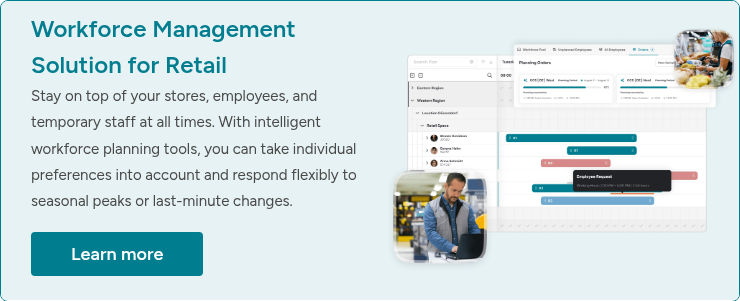
Digital solutions, such as a dedicated retail workforce management system, address these weak points directly, serving as a purpose-built tool to make daily challenges manageable.
With the right software, results often look like this:
- Centralized planning: Multi-location planning creates transparency across headcount, shifts, and utilization, enabling targeted staffing and better coordination between stores.
- Less planning effort: Automated schedule suggestions and structured planning processes reduce manual work, making retail scheduling significantly faster.
- Easy adjustments: In ongoing operations, changes can be captured and communicated more quickly without losing information, keeping everyone aligned with the latest schedule.
- Data-driven planning: Integrating planning metrics such as customer traffic and sales improves accuracy. This enables demand-based scheduling built on a reliable foundation.
- End-to-end processes: Whether it is a tailored time tracking solution for retail that seamlessly includes part-time and temporary staff or a direct connection to payroll, integrated workflows eliminate manual transfers and reduce administrative effort.
Optimize Retail Staff Scheduling With GFOS
Move beyond manual planning and rely on automated schedule recommendations, shift swapping, and more.
