
What Is Omnichannel Retail?
Omnichannel retail refers to a sales strategy that seamlessly connects all contact, sales, and service channels of a store. The goal is to create a consistent shopping experience across all touchpoints - both online and in the physical store. This creates new task structures: as part of click & collect or returns processing, employees now take on cross-channel responsibilities. As a result, the store evolves from a pure point of sale into a central service and logistics hub.
Why Traditional Shift Planning Is No Longer Sufficient in Omnichannel Commerce
Traditional workforce scheduling quickly reaches its limits in omnichannel retail. The main reason is constantly fluctuating customer traffic. Conventional shift planning is based primarily on store opening hours and does not take dynamic customer flow into account. When a certain level of online volume is added during peak times, this can quickly lead to overload. In omnichannel retail, additional short-notice tasks also regularly arise: returns, pickups, or product shipping require employees’ attention. Errors in shift planning - for example, due to a failure to calculate peaks - can therefore lead to understaffing. At the same time, scheduling too many employees on quiet sales days can quickly result in idle time.
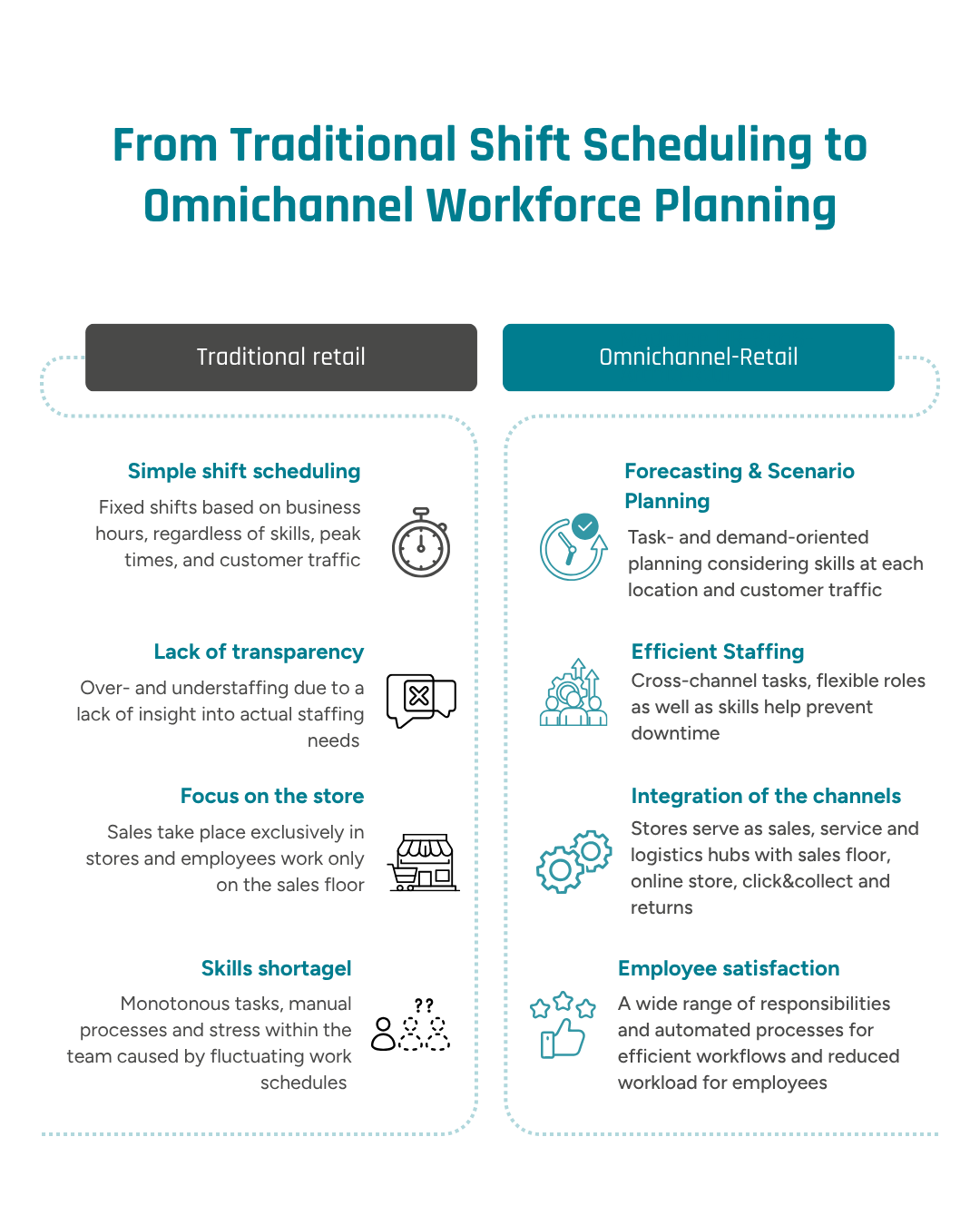
Workforce planning in omnichannel retail differs significantly from traditional planning. © GFOS Group
Operational Challenges in Omnichannel Retail
The omnichannel model presents retailers with a wide range of operational challenges that need to be addressed. The key aspects at a glance:
- Simultaneous demands from stores and online channels: Orders coming in through different channels at the same time make inventory coordination more difficult. Products that appear to be available on the sales floor may already be reserved or sold out due to online orders.
- Short-term peaks: Unexpected spikes in demand, for example caused by promotions or waves of returns, often lead to a sudden increase in staffing requirements that can hardly be mapped with traditional planning.
- Skilled labor shortage: In addition to traditional commercial skills, everyday omnichannel operations increasingly require technical understanding. Fluctuating schedules also put strain on the team, which can lead to higher turnover.
- Lack of transparency regarding staffing needs: Changing customer frequencies and customer behavior on online channels make reliable workforce planning more difficult. Short-notice absences or adjustments to the shift schedule further intensify this challenge.
What Planning Logic Is Needed in Omnichannel Retail?
In omnichannel retailing, purely time-based planning is no longer sufficient. Instead of scheduling employees solely according to store opening hours, task- and demand-oriented planning is required. This approach considers the specific on-site requirements as well as the qualifications and roles available within the team. For shift scheduling, this means employees are assigned specifically where their skills are currently needed - on the sales floor, in shipping, or in returns processing. This requires a robust data foundation as well as the ability to simulate different scenarios and forecast future developments. This creates the transparency needed for forward-looking and efficient planning.
What Data Does Omnichannel Planning Logic Rely On?
Efficient planning in omnichannel retail is based on a solid data foundation. Stores rely on historical data such as customer traffic or sales figures. These metrics make it possible to better forecast customer flows and manage staffing according to actual demand. Order volumes and return rates also provide important insights into the real workload so employees can be deployed efficiently. Promotions and seasonal calendars also help to anticipate typical fluctuations at an early stage. In addition, employee-related data plays a central role: qualifications and availability form the basis for assigning employees according to their skills and organizing processes efficiently.
Benefits of Omnichannel Retail
Alongside new challenges and a changed planning logic, omnichannel retail offers many significant benefits. We have summarized the most important advantages here:
- Better service quality: Customers benefit from a seamless shopping experience across all channels. They can gather information online, shop flexibly, and decide for themselves whether they want products delivered, picked up in-store, or returned there.
- More productive employee deployment: Transparency across online and in-store activities makes it possible to identify peak times early and schedule staff according to demand. At the same time, linking the channels creates versatile deployment options, reducing idle time.
- Reduced overtime and personnel costs: Automated processes, such as in inventory management or order processing, create more efficient workflows and noticeably relieve employees.
- Higher employee satisfaction: Digitalized processes make day-to-day work easier and create a more varied range of tasks. At the same time, increased transparency, for example regarding inventory, improves the quality of customer consultations.
Trends and Current Industry Highlights
Three key trends are emerging in omnichannel retail. One particularly clear development is that time-intensive tasks in shift planning - such as short-notice rescheduling or creating schedules in general - are increasingly being supported and accelerated by digital solutions.
Mobile usability, high user-friendliness, and intuitive operation are at the very top of the requirements list for those responsible for planning.
It is also becoming clear that software solutions are becoming increasingly established in retail. Around one-third of the companies surveyed by EHI already use digital systems for workforce scheduling.
How Does HR Software Act as an Enabler in Omnichannel Retail?
Workforce management solutions for retail form the foundation for a scalable omnichannel model and enable efficient management of cross-channel processes. As a central data foundation, the software connects all relevant information and creates the conditions for forward-looking forecasting and scenario planning. At the same time, HR software automates shift and deployment planning in retail and enables targeted task- and demand-oriented workforce management. This creates greater transparency for managers and employees and forms the basis for well-founded decisions in day-to-day operations.
