In a Nutshell - Staff Planning
- Employee scheduling assigns skilled workers exactly where they are needed.
- Different disciplines of staff planning are distinguished.
- Digital planning systems offer numerous advantages over manual planning methods.
- Structured planning can increase productivity and relieve employees.
What Is Staff Planning? – Definition
Staff planning refers to the systematic, forward-looking planning and management of workforce deployment in companies. The aim is to deploy the required number of employees with the right qualifications at the right time and in the right place in order to ensure operational processes according to demand.
In contrast to administrative HR processes such as personnel administration or payroll accounting, employee planning focuses on operational and strategic deployment management.
Disciplines of Staff Planning
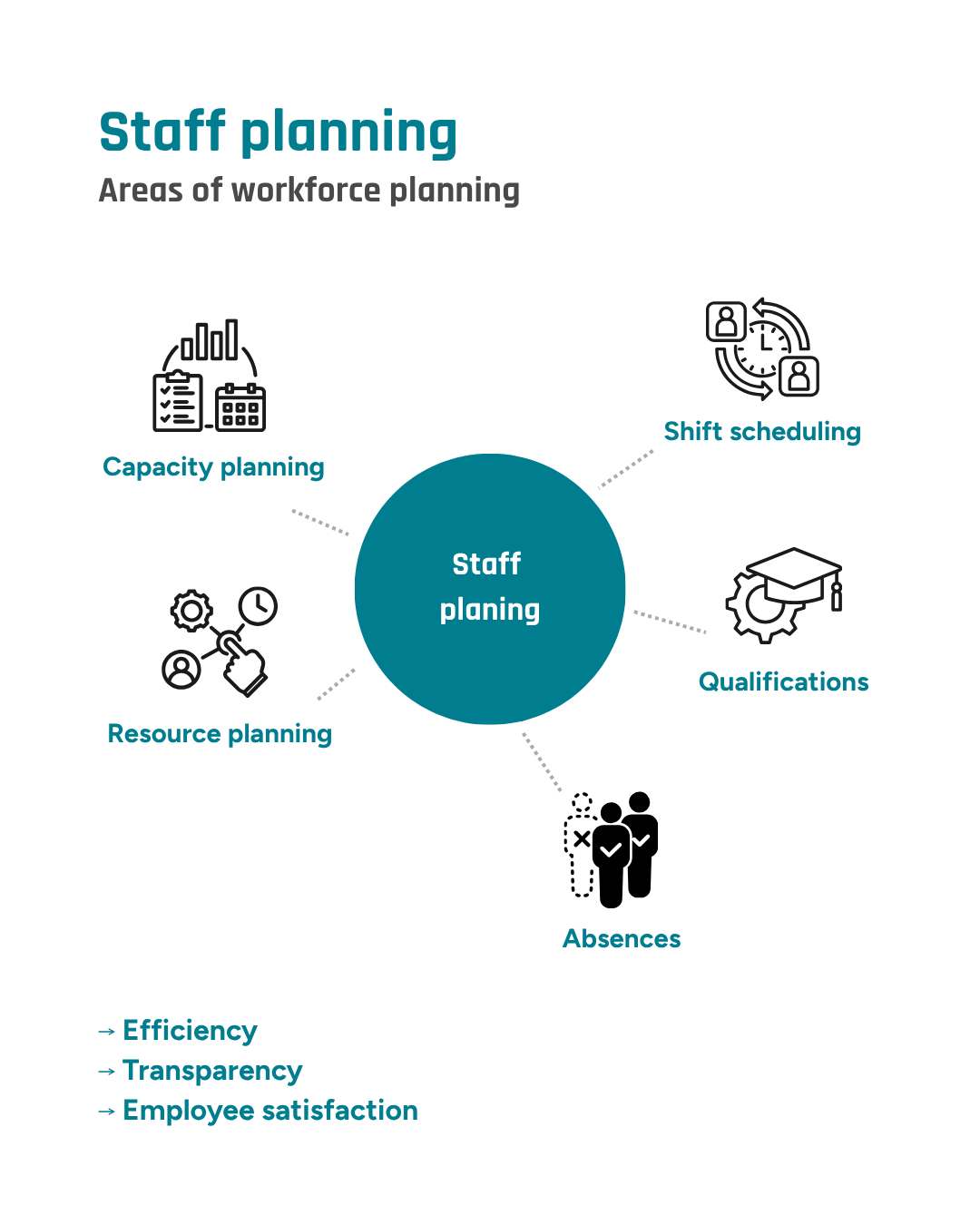
Employee planning consists of various interconnected disciplines that enable workforce deployment to be planned according to demand. These include:
Workforce Capacity Planning
Workforce capacity planning considers a company’s long- and medium-term personnel requirements. Taking order fluctuations into account, it ensures that sufficient qualified personnel are available at the right time. This helps compensate for bottlenecks, prevent idle time, and consistently ensure excellent service quality.
Staff Scheduling
Employee scheduling assigns specific shifts, tasks, or work locations to skilled workers. Assignment is based on their qualifications while also taking availability and individual working time models into account. This makes it possible to flexibly compensate for staffing fluctuations and use existing competencies in a targeted manner.
Shift Planning
As part of staff planning, various shift models are used to define specific working hours and ensure compliance with labor law requirements. Shift planning allows personnel resources to be managed according to demand and tasks to be staffed optimally.
Absence and Vacation Planning
To efficiently record employee absences and vacation days, integration with time tracking is necessary. This allows staff shortages, for example due to vacation, illness, or training, to be considered early and balanced within planning. In this way, forward-looking planning helps avoid understaffing and relieve employees.
Qualification and Skill Management
Qualification and skill management ensures that required competencies and specialist knowledge are available wherever they are needed in the company. To make optimal use of employees’ individual skills, it is important to continuously maintain and update them. Targeted training supports the expansion of existing qualifications and the development of new competencies.
Digital Staff Planning
Online staff planning differs significantly from traditional analog, Excel-based, and isolated solutions. The main distinguishing features are a central data basis, automated processes, greater transparency, and better scalability. Digital employee planning enables companies to deploy their workforce resources according to demand and flexibly adapt to requirements. The key benefits at a glance:
Benefits of Digital staff Planning
- Increased planning reliability: Automated management and documentation of working hours make planning more efficient. The resulting transparency enables forward-looking planning and allows companies to respond flexibly to short-term changes.
- Reduced manual effort: Digitizing traditionally manual activities significantly relieves employees. At the same time, automated processes reduce planning errors.
- Optimized utilization: Digitized staff planning increases productivity within the company by assigning employees exactly where they are needed. In addition, digital planning systems detect understaffing and overstaffing at an early stage so that schedules can be adjusted in a targeted way.
- Greater transparency: A central data basis gives managers and employees alike insight into relevant planning information. This improves not only internal communication but also the traceability of processes and decisions.
- Increased employee satisfaction: Skill-based deployment planning as well as relieving and automated processes contribute to better planning quality and can positively influence employee satisfaction.
- Support for compliance and working time rules: Unlike analog solutions, digital planning systems enable precise recording and documentation of working hours. All data is securely stored and managed so that data protection guidelines are consistently observed. Relevant information is also available digitally at any time.
Industry Examples
Effective employee planning provides support across various industries. Here are a few industry examples at a glance:
Staff Planning in Retail
Manual employee planning in a branch-based company presents particular organizational challenges. Customer flows and peak times often vary and can quickly lead to understaffing or overstaffing without suitable planning. On the one hand, this can increase employees’ workload; on the other, it can negatively affect service quality. Digital employee planning helps companies deploy personnel resources according to demand and respond flexibly to changes. Automated processes relieve day-to-day planning and create more time for strategic tasks in branch management. Further information on workforce management in retail is available here.
Staff Planning in Production
Production companies also face challenges when it comes to staff planning. In production, multi-shift systems are usually used to ensure maximum productivity and efficient machine utilization. Production is strongly dependent on the qualifications of individual employees, as certain machines and systems can only be operated by appropriately trained personnel. Forward-looking planning over longer periods is therefore required. Such long-term planning can work through the combination of shift models and transparency regarding availability and absences. This not only creates greater operational stability but also makes it possible to maintain continuous production.
Conclusion and Classification
In summary, staff planning represents a strategic core function in various industries. Digital staff planning is particularly important because it increases transparency, efficiency, and planning reliability while also helping to relieve employees. Especially in complex organizations with extensive planning logic, structured staff planning is crucial for using resources optimally. It enables companies to plan in a forward-looking, task-oriented, and demand-based way and increases productivity by deploying employees and qualifications exactly where they are needed.
