
Protection is most effective when those responsible know the different types of hazards and carry out risk assessments in a clearly structured way. Modern workforce management tools can also help identify, evaluate, and sustainably reduce risks.
Definition: What Is a Risk Assessment?
A risk assessment is a structured process for identifying, evaluating, and eliminating workplace hazards. In a risk assessment, all relevant activities and work areas are examined to determine where hazards may arise – whether physical, psychological, or ergonomic – and which measures are necessary to protect employees.
Risk assessments therefore form the basis for systematically organizing occupational safety and health protection and for identifying risks to employees at an early stage.
Legal Basis: Occupational Safety and Health Act
The legal basis for the obligation to conduct risk assessments is derived from the German Occupational Safety and Health Act (ArbSchG). Under this act, employers are required to assess risks to the safety and health of their employees, derive suitable protective measures, and review their effectiveness. This process must not only be documented, but also updated regularly – for example, when working conditions change.
Who Must Conduct a Risk Assessment?
In principle, all employers – regardless of industry and company size – must conduct risk assessments. It does not matter whether the workplace is a workshop, an office, or a production facility: every activity carried out by employees must be reviewed for possible risks.
Types of Workplace Hazards
As part of the workplace risk assessment, different types of hazards are distinguished and should be systematically identified during the assessment process:
- Physical (noise, heavy work, machinery)
Physical hazards include risks associated with noise, vibrations, hazardous substances, heavy physical work, and the use of machinery. These hazards are often easy to measure and are a classic component of every risk assessment. - Psychological (stress, working time models, shift work)
Psychological strain is becoming increasingly important in occupational safety. Factors such as high performance and time pressure, insufficient recovery, and disadvantageous working time models and shift work can impair employees’ health in the long term. According to the 2023/2024 company and employee survey conducted as part of the Joint German Occupational Safety and Health Strategy (GDA), psychological strain such as stress or time pressure is now taken into account by around 65% of companies that conduct risk assessments – and therefore to a similar extent as other hazards. - Ergonomic
Ergonomic hazards arise where physical work processes or work environments lead to health-related strain, for example due to ergonomically poorly designed workplaces, intensive screen work, or repetitive manual tasks. - Industry-specific
Depending on the industry, additional hazards may be relevant – for example chemical hazards in laboratories, biological hazards in healthcare, or specific risks in construction. These must be analyzed and taken into account individually.
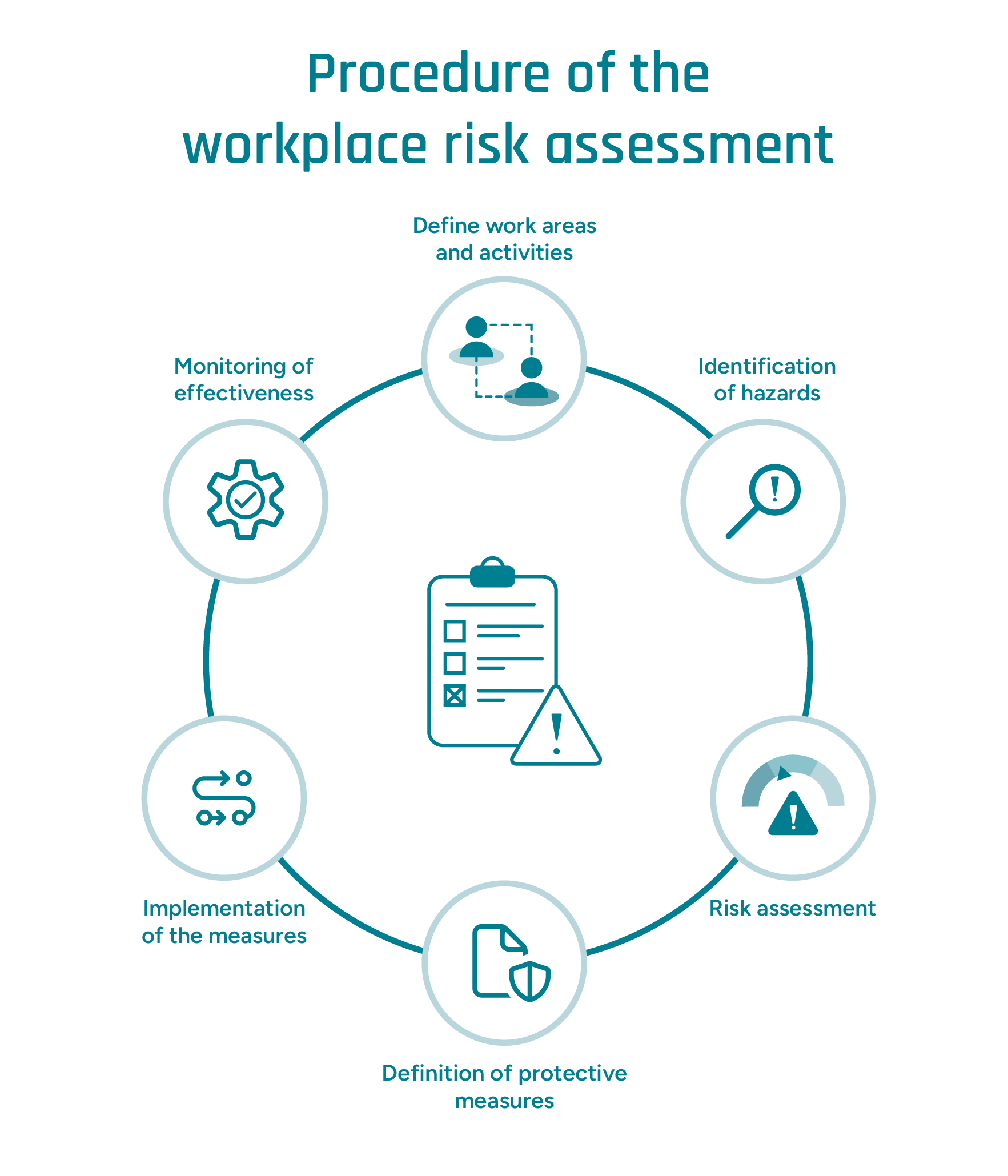
A systematic risk assessment follows clearly defined steps and should be understood as an ongoing process. © GFOS Group
Risk Assessment Process
The risk assessment process can be divided into the following steps:
1. Define Work Areas and Activities
First, all activities and areas in which work is performed are identified – from production areas and office workplaces to mobile activities in field service or on changing construction sites. Indirect work areas such as storage areas, break rooms, traffic routes, or home office workplaces must also be taken into account. The aim of this subtask is to systematically record every individual work area and ensure that no relevant activity area is omitted from the risk assessment.
This includes documenting not only the spatial conditions, but also the specific work tasks, the machines and work equipment used, as well as working hours and shift models. In addition, special groups of people such as trainees, pregnant employees, or employees with health restrictions are included. A careful and complete inventory forms the basis for all further steps.
2. Identify Hazards
Using observations, structured workplace analyses, employee interviews, workshops, site inspections, and checklists, all potential hazards are systematically recorded. These include physical hazards such as noise, hazardous substances, mechanical impacts, and tripping hazards, as well as psychological strain caused by time pressure, work intensification, or team conflicts. Ergonomic aspects – such as unfavorable postures, repetitive movement patterns, or inadequately set up screen workplaces – are also documented.
In addition, industry-specific risks, for example in healthcare or construction, should be included in the analysis. The aim is not only to document obvious sources of danger, but also to identify less visible and long-term forms of strain at an early stage. The active involvement of employees is particularly important, as they can contribute their practical experience from everyday work.
3. Evaluate Risks
Next, the likelihood that an identified hazard will actually lead to harm is assessed, along with the severity of the possible consequences. Factors such as frequency of exposure, duration of the activity, number of affected employees, and potential health and economic impacts are included in the evaluation. Based on this structured analysis, a transparent prioritization of risks and required protective measures is created. Particularly urgent hazards with high damage potential are addressed as a priority.
Standardized assessment procedures and key indicator methods provided by the German Social Accident Insurance (DGUV) can be used for support, as they offer practical criteria for risk evaluation. Careful documentation of the assessment also increases transparency and ensures traceability for authorities and internal audit bodies.
4. Define Protective Measures
Based on the risk evaluation, concrete measures are developed to minimize hazards or, where possible, eliminate them completely – for example according to the STOP principle (substitution; technical, organizational, and personal protective measures).
It is important that all measures are realistic, practicable, and tailored to the respective work area. Responsibilities, deadlines, and required resources should be clearly defined so that implementation can be targeted and effective.
5. Implement Protective Measures
In the next step, the defined measures are implemented consistently. This may include acquiring new and safer work equipment, making technical retrofits to existing machines, or carrying out structural changes at the workplace. Workflows may also be reorganized, responsibilities adjusted, or binding operating instructions introduced. Training and instruction ensure that all employees understand the new rules and apply them correctly in everyday work.
What matters is that implementation is not only formally documented, but also embedded in daily work processes. Clear communication of the measures and the role-model behavior of managers make a significant contribution to ensuring that protective measures are accepted and followed on a lasting basis.
6. Check Effectiveness
Finally, it is checked whether the measures introduced are actually effective and whether the previously identified hazards have been noticeably reduced. This can be done, for example, through renewed site inspections, measurements of exposure values, feedback discussions with employees, or the evaluation of accident and sickness statistics. If deficiencies are still identified or working conditions change – for example due to new machines, adjusted work processes, or legal requirements – the risk assessment must be updated accordingly.
This continuous improvement process ensures that occupational safety does not remain a one-off project, but is permanently integrated into operational processes. Only through regular review, updating, and documentation does the risk assessment remain an effective component of sustainable occupational safety management.
Risk Assessment and Workforce Management
In modern companies, workforce management plays a central role in effective occupational safety. Especially when it comes to topics such as working hours, shift planning, or overtime, a direct influence on hazards can be identified.
Long working hours, frequent shift changes, or irregular shifts can lead to physical and psychological fatigue or exhaustion – and therefore to a higher risk of health complaints or workplace accidents. A systematic risk assessment should take these factors into account in order to plan suitable countermeasures at an early stage.
Only when working hours, breaks, and overtime are recorded precisely can potential risks be assessed objectively. Digital time tracking solutions – including modern SaaS time tracking – help reliably document and evaluate working time data. This provides the data basis for identifying strain patterns and incorporating them into the risk assessment.
In addition, intelligent workforce scheduling enables working hours to be designed in such a way that overload caused by unfavorable shifts or too many working hours is avoided – thanks to a powerful cloud solution accessible from anywhere.
The following section outlines the benefits of workforce management specifically with regard to risk assessments:
- Digital time tracking as a data basis
Digital time tracking systems provide a reliable data basis for workplace risk assessments. They provide not only data on working hours, but also on breaks, overtime, and work patterns – and therefore important key figures for evaluating risks. - Analyses of working hours, breaks, overtime, and more
Time-based data analyses, which can be created for example with people analytics software, make it possible to identify peak workloads and early signs of chronic stress. This is particularly important for considering psychological hazards in risk assessments. - Transparency and traceability for audits
Clearly documented working time data makes risk assessments audit-proof and revision-proof – whether for internal audits or external inspections by supervisory authorities. - Support for documentation and improvement
Digital workforce management tools not only simplify the collection of data, but also the documentation and continuous optimization of risk assessments. Improvement potential becomes visible through automated analyses.
Risk Assessments: Best Practices
Some proven recommendations for how companies can design their risk assessments effectively and sustainably include:
Regular Review
Risk assessments should not be carried out only once; rather, they are dynamic processes. Only through regular updates can it be ensured that new hazards are identified and corresponding countermeasures are planned.
Connecting Occupational Safety, HR, and Planning
Occupational safety should not be viewed in isolation. Close collaboration between safety managers, the HR department, and workforce management ensures that risk assessments are implemented holistically and effectively.
Using Digital Tools for Greater Efficiency and Legal Certainty
Digital solutions for time tracking, planning, and analytics are indispensable today for designing risk assessments efficiently and in a legally compliant way. Well-designed software creates transparency, simplifies documentation, and helps identify risks at an early stage. Especially in a world of work with widespread flexible working models, it also provides a clear overview.
Workplace risk assessment fulfills more than just a legal obligation – it is a central instrument for systematically ensuring safety and health within the company. By using workforce management tools such as digital time tracking, workforce scheduling, and people analytics, this process can be designed efficiently and continuously optimized.
Companies that take risk assessments seriously and implement them professionally not only protect their employees, but also strengthen their competitiveness and future viability.
We would be happy to support you on your path toward greater safety and health in the workplace – simply get in touch with us.
Detect overloads before they become dangerous
We'll show you how digital tools can improve your risk assessment.
