
Because employees are central to fulfilling production orders, maintaining strong customer relationships, providing solid service and delivering services overall, it is essential for HR managers to keep an eye on the turnover rate. Reasons for turnover, measures to reduce the rate and much more can be critically reviewed after evaluation.
Definition: What Is Employee Turnover?
Employee turnover describes the departure of an individual from a company. There can be various reasons for this, such as resignation, retirement or parental leave. Turnover often leads to a recruiting process for the same position. Various forms of turnover must be taken into account when evaluating it.
Forms of Turnover in Companies
The reasons why employees leave a company can be as varied as the job itself. For a broad categorization, a distinction can be made between three general forms:
- Natural employee turnover: This includes, for example, the death of an employee, retirement or the end of a fixed-term contract.
- Internal company turnover: This includes the transfer of employees within the same company - for example, when changing position or role.
- External company turnover: This form is initiated by the employee themselves - that is, they terminate the employment contract in order to move to another employer. The influencing factors may also be driven by the labor market.
The forms of turnover that HR teams can influence themselves are especially important - ideally based on structured people analytics, which can be managed, for example, with our AI-supported software GFOS Intelligence.
If these measures improve the working atmosphere or the company’s attractiveness - for example through regular employee reviews, individual career and development paths and employee benefits - external turnover can be reduced sustainably.
Another important form is early turnover, which belongs to the external category: if employees leave within the first year of employment, this is referred to as early turnover. If this happens frequently, it may indicate problems with onboarding or the recruiting process.
Importance of the Turnover Rate as a Critical HR Metric
The turnover rate is one of the most sensitive control metrics in HR management because it provides direct insight into the stability, attractiveness and performance of an organization. It acts as a kind of early warning system for structural, cultural or leadership-related weaknesses and is therefore far more than just an operational metric - it is a strategic indicator of organizational health.
What turnover rate can be considered “healthy” in this regard cannot be generalized. Turnover also depends heavily on the industry. For example, in a survey by the northern German business association AGA among its members, a turnover rate of 17.6% was identified for wholesale and foreign trade in 2024, while the rate for industry was 5%. Differences like these reveal a significant range between individual sectors.
These Factors Lead to Employee Turnover
The reasons why employees leave a company are varied and usually differ from one individual to another. Some factors that contribute to turnover in companies include the following:
- Professional reorientation: This may have personal reasons, such as illness or events in private life, but it may also be related to starting a business or changing professional interests.
- Working atmosphere and quality of workplace equipment: If employees are dissatisfied with their workplace equipment, communication or management, this has consequences for employers. If they are unhappy or feel overburdened, this can encourage them to change employers.
- Lack of work-life balance: This is linked to workload - but a lack of remote work options or insufficient flexibility in working hours can also have an impact.
- Relocation or mobility restrictions: Moving house, losing a means of transportation or poor transport connections can lead employees to look for a job that is easier to reach.
- Lack of career prospects: If the company offers no opportunities for advancement, insurmountable hierarchies or a poor continuing education concept for lifelong, job-related learning, it is understandable that employees may seek a new direction.
- Low risk when changing jobs: In industries that do not require employees to have specialized knowledge, turnover rates tend to be high.
Opportunities and Risks When Skilled Workers Leave
Turnover in a company can offer opportunities: for example renewal and fresh impulses through new perspectives, additional expertise and increased creativity when new specialists join. This creates a kind of transfer of knowledge and experience from other companies.
Nevertheless, the departure of skilled workers is predominantly associated with risks for employers - especially when it is linked to corporate strategy, the working atmosphere or continuing education concepts.
Employee turnover primarily leads to a loss of know-how if employees leave at short notice and no suitable replacement has been found. This in turn results in a loss of productivity, rising costs and lasting delays in order processing.
Because other employees have to take on additional work, this can lead to demotivation or, in the worst case, even to former colleagues being recruited away as well. As a result, companies face the challenge of filling the gaps with suitable skilled workers.
What Is the Turnover Rate?
The turnover rate refers to the statistical recording of workforce movements within a company. It is calculated using various formulas and includes both employees leaving the company and internal transfers. A high rate may indicate problems with the working atmosphere or employee satisfaction.
Turnover Rate by Industry
The following table shows turnover rates for 2023 by industry:
| Industry | Turnover rate |
|---|---|
| Temporary employment | 127,0 % |
| Agriculture, forestry, and fishing | 73,4 % |
| Hospitality | 62,1 % |
| Information and communication | 52,3 % |
| Other business services excluding temporary employment | 46,4 % |
| Other services, private households | 35,2 % |
| Transportation and warehousing | 34,1 % |
| Construction | 33,1 % |
| Trade; maintenance and repair of motor vehicles | 30,8 % |
| Education | 26,7 % |
| Real estate, freelance, scientific and technical services | 26,5 % |
| Residential care and social work | 26,5 % |
| Health care | 23 % |
| Manufacturing industry | 17,7 % |
| Mining, energy and water supply, waste management | 17,5 % |
| Provision of financial and insurance services | 16,3 % |
| Public administration, defense, social security | 13,6 % |
Source: Federal Employment Agency
How to Calculate the Turnover Rate
Calculating the turnover rate is a very important task for HR. This can be done automatically using workforce management systems, other HR software or Excel spreadsheets and formulas.
Using the following sample figures, we present several proven ways to calculate the turnover rate:
- Headcount at the beginning of a period: 150
- Average headcount during the period: 151
- Departures within a period: 20
- New hires within the period: 22
1. Calculating the Average Headcount
The average headcount can be calculated as follows:
(Headcount at the beginning of a period (150) + headcount at the end of a period (152)) ÷ 2 = average headcount (151)
2. The Basic Formula
It is considered the simplest, but also the least accurate formula. Departures during the calendar or fiscal year are compared with the headcount at the beginning of the observation period. However, it does not take new hires into account and is therefore only of limited use for analysis. In our sample calculation, the result is 13.33%.
Especially in small teams, calculating the turnover rate using the basic formula has weaknesses that can limit the significance of the metric. Above all, each individual departure has a major impact on the turnover rate.
Example: If a team of 5 employees loses one person, the turnover rate according to the basic formula is 20%—whereas in a team of 100, one departure would amount to only 1%. In a small team, this can therefore lead to exaggerated or distorted interpretations.
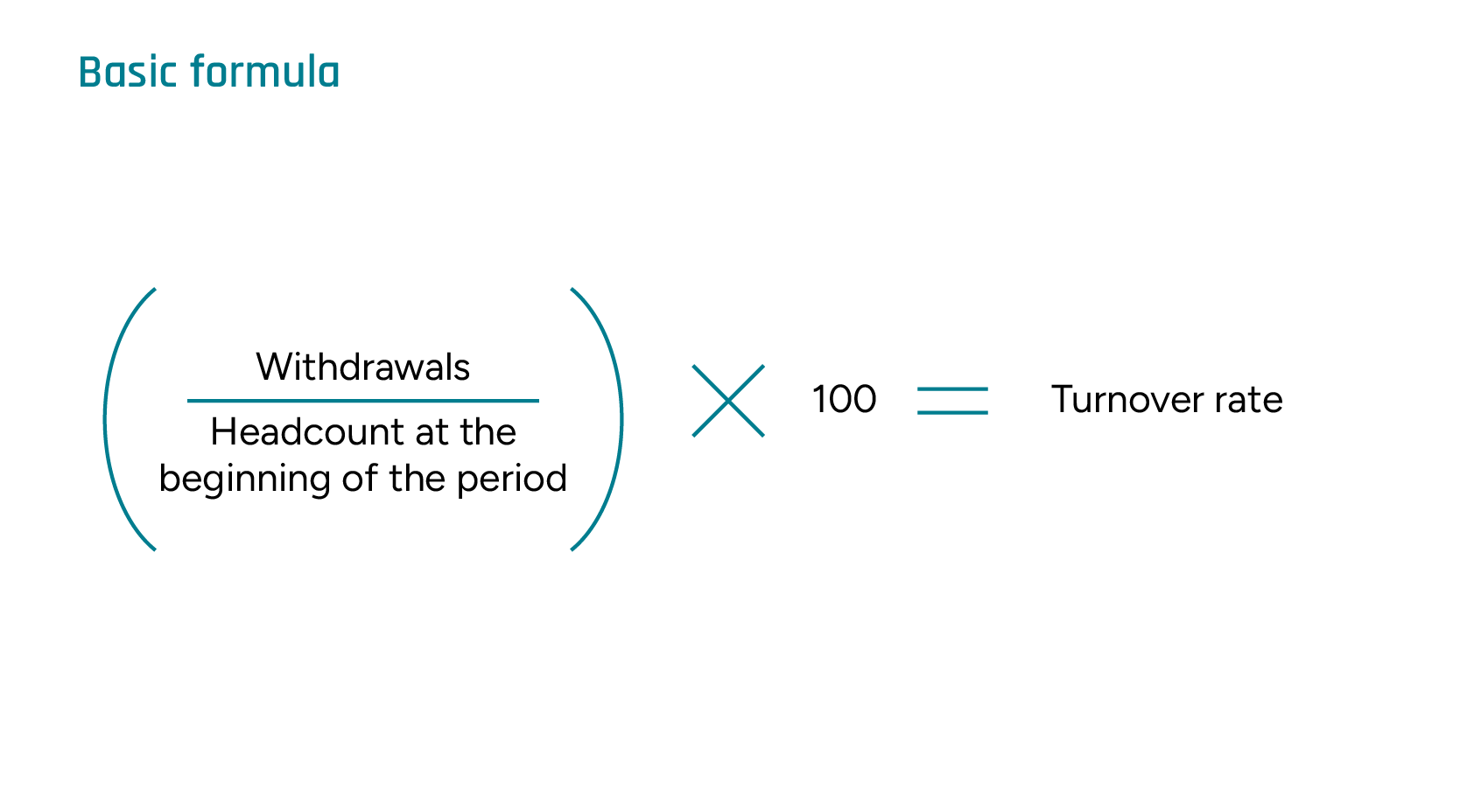
The basic formula for calculating the staff turnover rate © GFOS Group
3. ZVEI Formula
The name uses the abbreviation of the German Electrical and Electronic Manufacturers’ Association. In this calculation method, new hires are compared with the average headcount. For our example, the result is 14.57%.
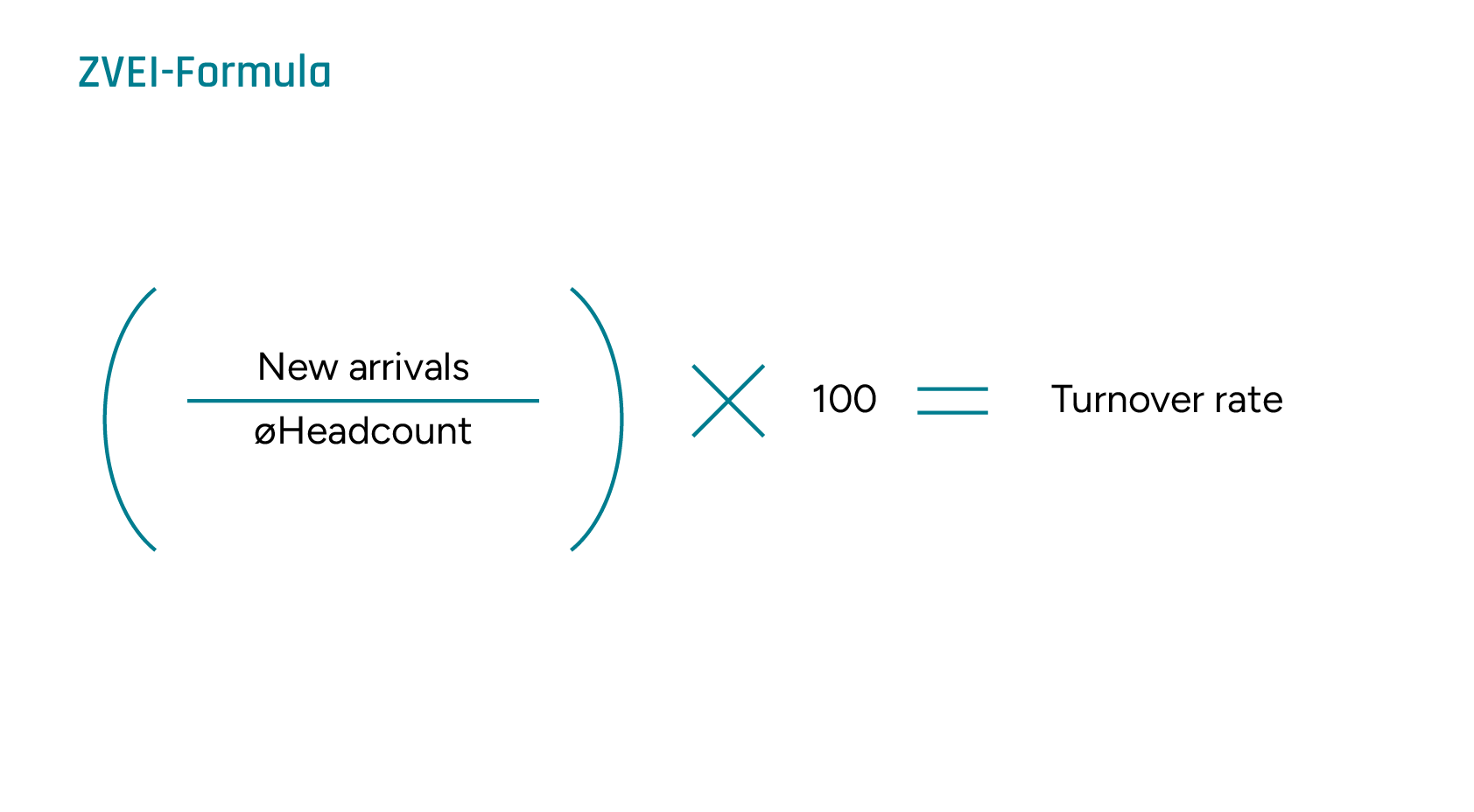
The ZVEI formula can also be used to calculate employee turnover © GFOS Group
4. Schlüter Formula
The name goes back to politician and trade unionist Helmut Schlüter, who died in 1967. It is considered a complex formula because it consists of several steps. Since it takes all employees into account, it is particularly suitable for rapidly growing or newly founded companies. Our example produces a result of 11.29%.
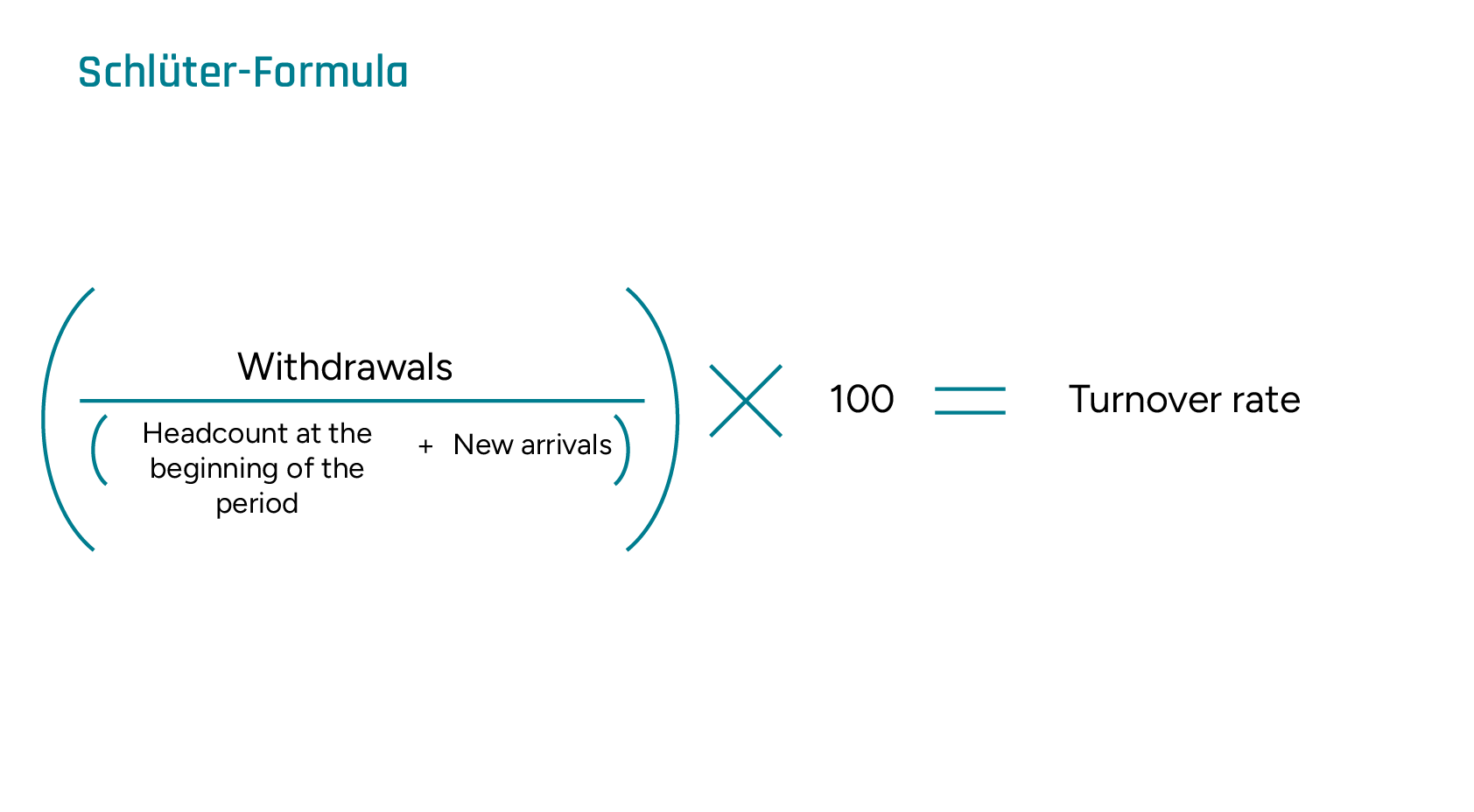
A more complex method for calculating the turnover rate in a company © GFOS Group
5. BDA Formula
The abbreviation is derived from the Confederation of German Employers’ Associations, which provided this formula. It relates departures to the average headcount. For our example, the result is 13.25%.
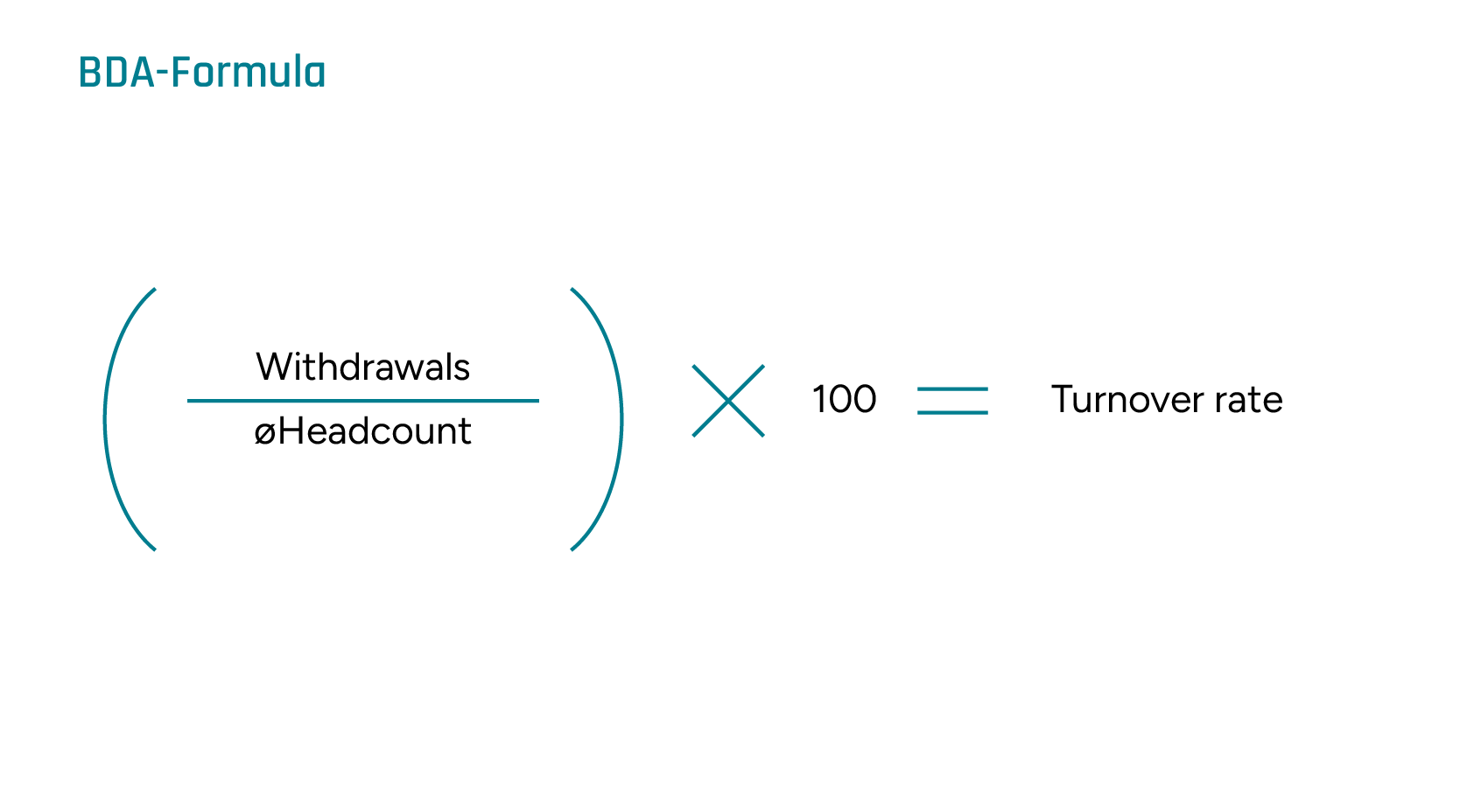
The BDA formula can also be used to calculate staff turnover © GFOS Group
If the turnover rate is high compared with other companies or the industry average, this should provide a reason to question the working atmosphere or the onboarding and recruiting process - possibly as part of a comprehensive HR audit.
Regular employee surveys and employee reviews can help companies get a sense of the prevailing mood in the organization and initiate optimization measures. Workforce management software provides ideal conditions for this because a wide range of HR metrics is evaluated automatically.
Calculating the Turnover Rate: Tools and Automation
Calculating turnover rates using Excel spreadsheets or lists quickly reaches its limits, especially when data from different sources needs to be merged, kept consistent and updated regularly. HR software solutions can support day-to-day HR work here.
Automated reports
Modern HR systems enable the automatic generation of turnover reports based on current personnel data. This significantly reduces manual effort and ensures that metrics are always up to date and accurate.
Reports can be segmented by department, location, age group or length of employment, enabling detailed analyses without additional data preparation.
Notifications when defined thresholds are exceeded
HR systems allow alerts to be configured that are triggered as soon as turnover rates exceed certain thresholds. These early warning signals enable managers to respond quickly to critical developments - whether through targeted retention measures or adjustments to workforce planning.
Central data basis with consistent metrics
A central HR database ensures that all metrics are valid, transparent and consistent. Inconsistencies caused by different data sources or manual entries are avoided. As a result, the turnover rate can serve as a reliable indicator for strategic decisions.
Visualization for management and leadership
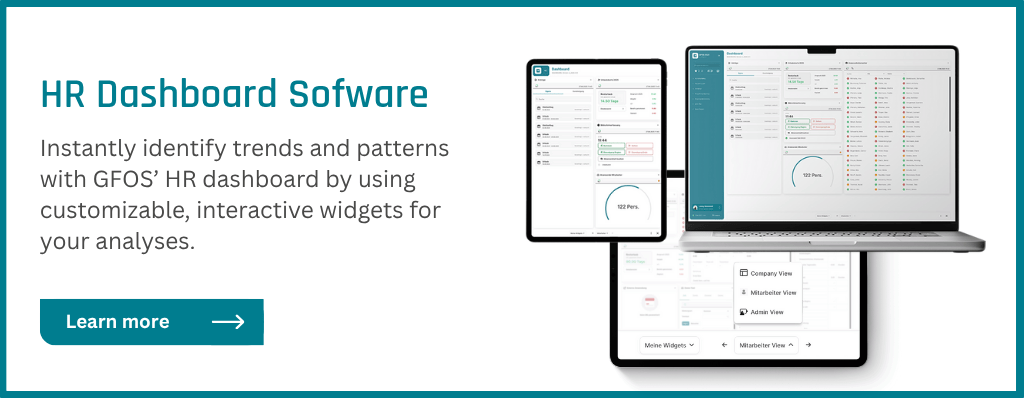
Workforce management software offers interactive dashboards and graphical visualizations of turnover rates. Management and executives can identify trends, deviations and critical areas at a glance.
Clear charts and heat maps make complex data tangible and facilitate communication between HR and company leadership.
Less effort, more time for in-depth analyses
Automated data preparation and standard reports significantly reduce administrative effort. HR teams gain room for qualitative analyses, such as root-cause analysis of turnover, benchmarking and/or the development of targeted employee retention measures.
How little effort this can involve is shown, for example, by the automatic export of the turnover rate via an HR tool: as a rule, only the relevant function needs to be selected, followed by the desired period, department and, if applicable, location. The results can be exported in various file formats and/or shared directly.
Faster decision-making through current data
The integration of real-time or near-current personnel data enables timely decisions. This is especially important when strategic HR measures or adjustments to leadership development are needed at short notice.
Basis for strategic employee retention measures
The consistently collected and visualized turnover metrics form the ideal basis for developing targeted retention strategies. HR managers can identify which areas or employee groups are particularly at risk and take targeted measures such as individual development plans, mentoring or benefits.
Automatically Calculate Turnover Rate and Avoid Losing Skilled Workers
With the help of workforce analytics, in which many HR KPIs become automatically accessible, HR managers receive a powerful tool. The tedious manual calculation of turnover rates is no longer necessary.
Assessments of the working atmosphere, work-life balance, motivation indicators, planning quality and much more: the software provides this information based on everyday use—for example through the workforce scheduling system or the time management system. This gives HR managers the opportunity to proactively counteract high employee turnover.
Finally gain clarity on HR metrics with GFOS
Make use of the potential of HR KPIs and a comprehensive workforce management system with an integrated HR analytics solution. Get non-binding advice from our IT experts on possible areas of application.
