Balancing Staffing Requirements, Last-Minute Absences, and Scheduling Frustration
Staffing Requirements with Documentation Obligations
Shift-based and monthly requirements, such as minimum nurse staffing levels, as well as facility-specific target staffing needs, must be factored into workforce planning.
Document Scheduling Data
Required documentation, including reporting to institutions such as Germany’s Institute for the Hospital Remuneration System, must be available digitally and stored at ward level.
Overlapping Rules and Regulations
Labor law, collective bargaining agreements, and internal policies often apply at the same time. Manual checks create errors that can be avoided with a healthcare workforce management system.
Qualification Gaps
Additional qualifications and proof of validity are essential for staffing hospital wards and must be visible directly in the planning process.
Last-Minute Absences
Healthcare has high absence rates. How quickly you respond has a direct impact on the quality of patient care.
High Workload
Unevenly distributed night and weekend shifts, required workload balancing, and last-minute schedule changes affect the employees who are available and create unnecessary frustration.
For nursing directors, ward managers, and HR leaders, the staff schedule is both a planning tool and a documentation instrument. Without integrated support from healthcare workforce management, this is hardly manageable. These factors influence the quality of workforce scheduling:
- Regulation on minimum nurse staffing levels in care-sensitive hospital areas (German PpUGV): § 6 PpUGV defines shift-based minimum staffing thresholds for care-sensitive areas as a patient-to-nurse ratio. Reports are submitted quarterly, and hospitals must disclose which day and night shifts fell below the required thresholds.
- Under Germany’s Statutory Health Insurance Contribution Rate Stabilization Act, a general standard for minimum hospital staffing will apply in the future. This means hospitals will need to derive staffing requirements independently and prospectively beyond the minimum threshold. Determining the target need for physicians, nurses, and therapeutic professionals requires orientation toward medical and nursing care needs.
- Absences are not an exception in hospitals. According to the Absenteeism Report 2025, the social services and healthcare sector has the highest sickness absence rate at 7.4 percent. As a result, long-term care occupations reach approximately 34 absence days per year, making demand-driven and demand-optimized staff deployment more difficult.






How GFOS Healthcare Workforce Management Software Supports Healthcare Organizations
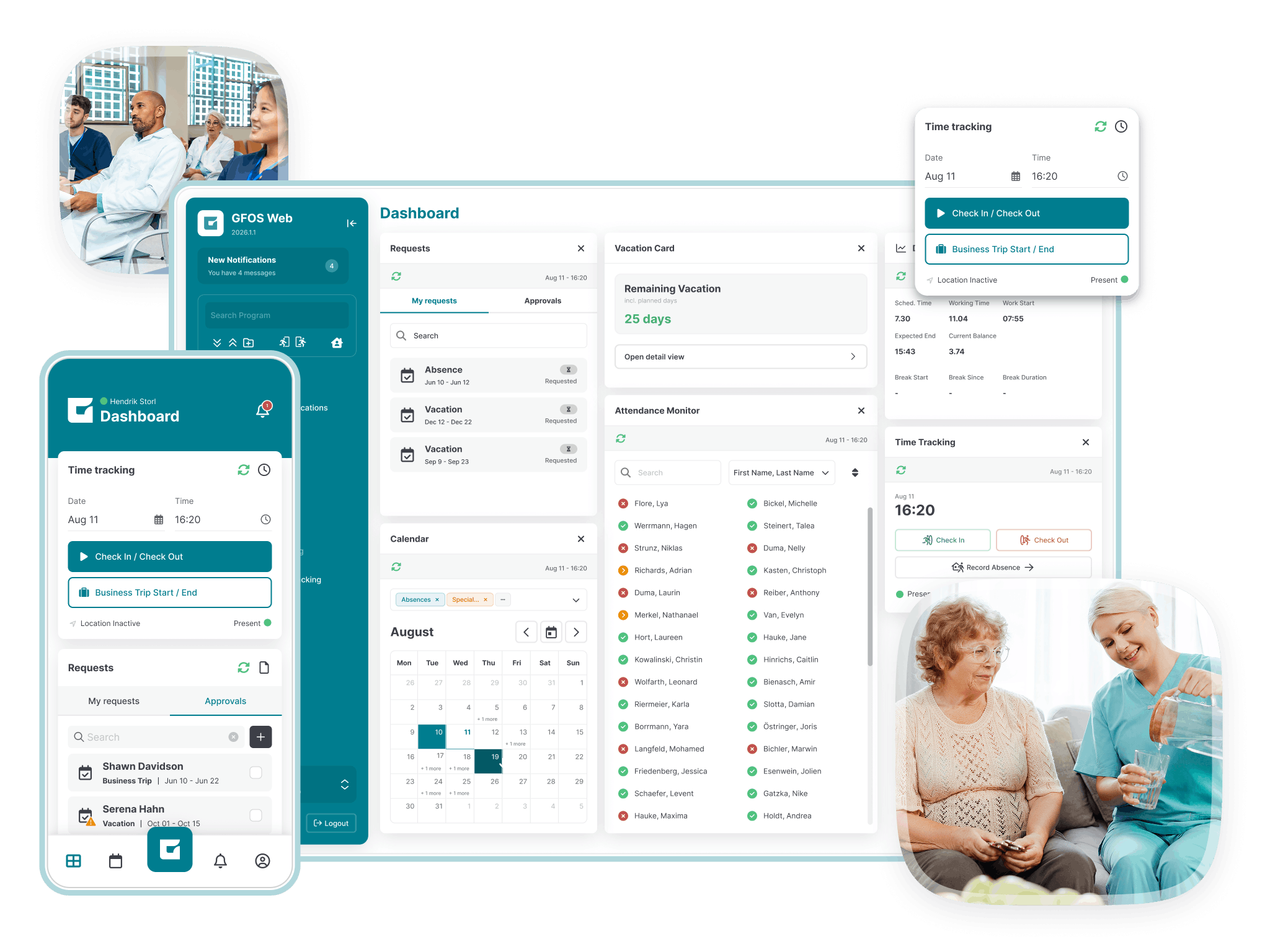
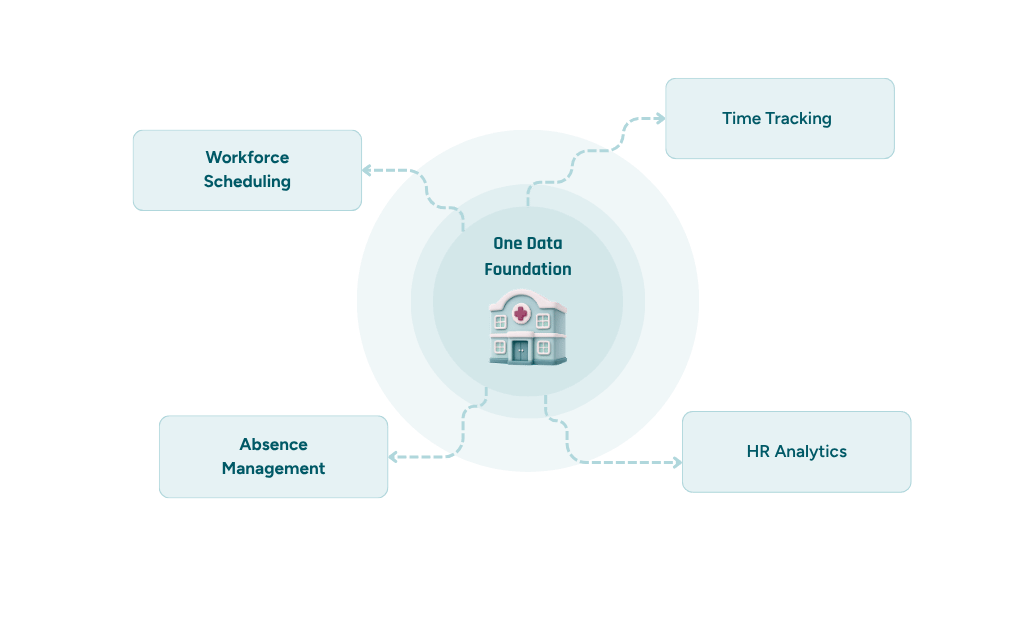
Software for the healthcare sector must be able to map complex rules, recognize qualifications, and respond to absences without forcing planners to switch between systems. The GFOS SaaS workforce management platform combines demand-optimized workforce scheduling, time and attendance, absence management, and analytics in one shared data foundation.
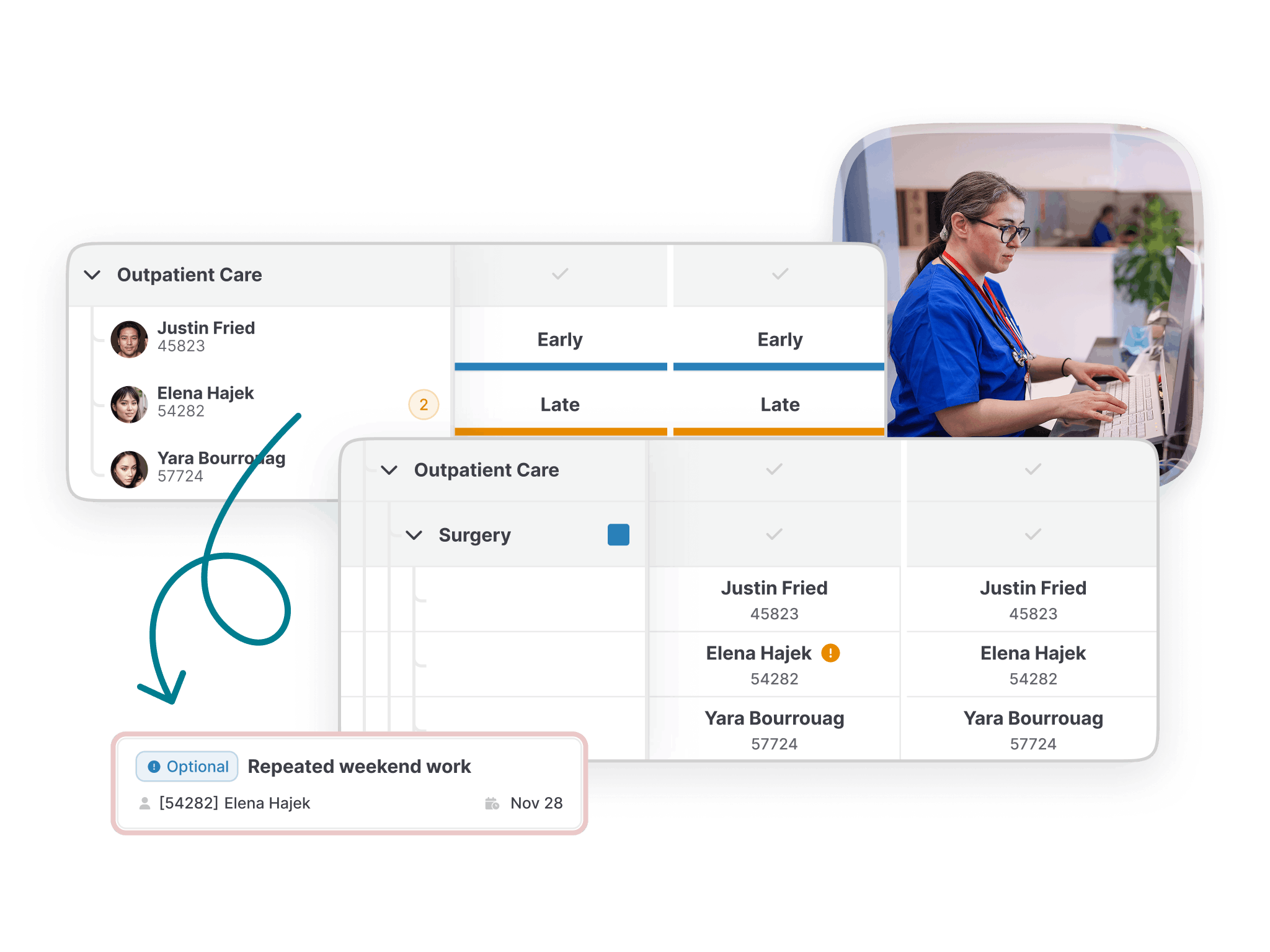
- Rule validation directly in the system: Define legal, collective bargaining, and company-specific requirements as mandatory, target, or optional rules. The system displays violations directly in the schedule.
- Qualification requirements as planning rules: Store qualifications in the planning system so you can immediately see where qualified professionals are missing.
- Time and attendance and premium pay: Record working time to the minute, automatically document premiums and special time types, and transfer them to payroll.
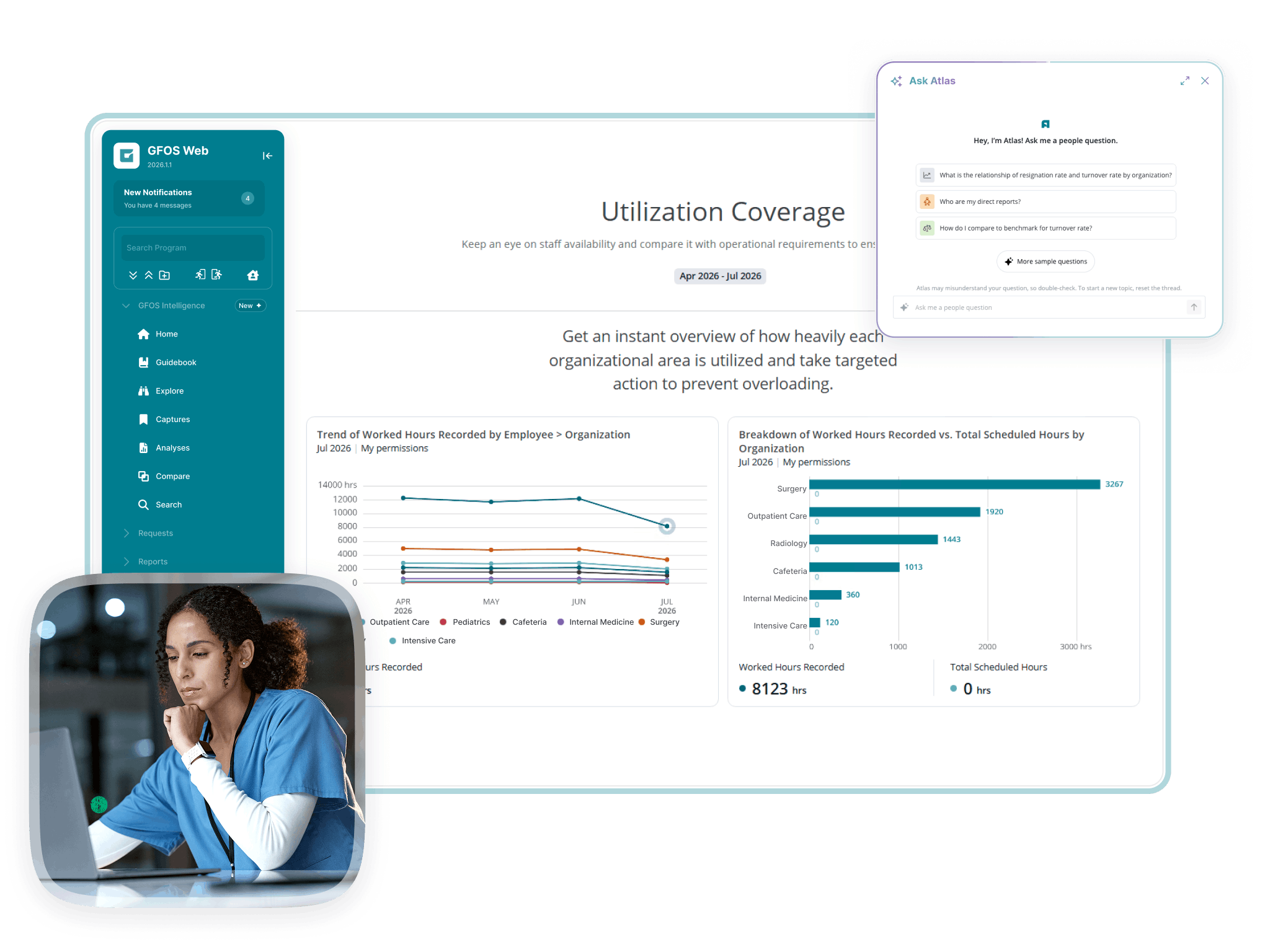
- People Analytics: Easily analyze overtime, absences, and utilization. The AI assistant answers your questions in natural language.
- Fairness principles: Collective bargaining workload limits and occupational health and safety requirements that go beyond statutory minimums can also be monitored.
Simplify Daily Shift Scheduling with Planning Rules
In hospitals, determining who can cover a shift is not a preference. It is a concrete staffing requirement. That is why GFOS.Workforce Management lets you define qualifications as planning rules and decide whether they block a shift assignment or simply trigger a planner notification.
- Define mandatory, target, or optional rules: Scheduling managers decide whether a missing qualification prevents shift assignment or only appears as a notification. This makes the requirement binding, not just documented.
- Store validity dates: This applies, for example, to certifications, resuscitation training, and continuing education records. The system reminds you when a qualification needs to be renewed.
- Visualize rule violations clearly: Deviations from stored requirements are shown directly in the planning view, eliminating time-consuming manual checks.
- Generate automated schedule suggestions: Healthcare workforce management software accounts for absences, planned time off, employee preferences, qualifications, and more to accelerate workforce planning.
Planning and Time Data That Stand Up to Documentation Requirements
Actual staffing per shift, absence data, and required qualifications are already processed during every scheduling cycle. Healthcare documentation requires this data to be structured, reportable, and available in one place without forcing teams to consult multiple sources.
This is where GFOS healthcare workforce management software comes in:
- Central data foundation: Combine scheduling, time and attendance, and absence management instead of relying on disconnected point solutions that cost valuable time.
- Structured reporting options: Analyze staffing, absence times, and qualifications by ward and shift in just a few clicks or automatically at defined intervals.
- Role-based permissions: Make GFOS Intelligence reports available in a targeted way for nursing directors, ward managers, or employees.
- More than 70 interfaces: Certified interfaces to SAP, DATEV, and other systems, as well as documented API integrations, support seamless integration into existing IT landscapes, including your hospital information system.
A Schedule Your Team Can Rely On
Reliable scheduling is one of the factors that can influence whether employees remain in nursing and healthcare roles. When demanding shifts are distributed transparently and schedules are released early, workforce conflicts decrease. This turns scheduling into a direct lever for stronger employee retention.
Your Benefits at a Glance:
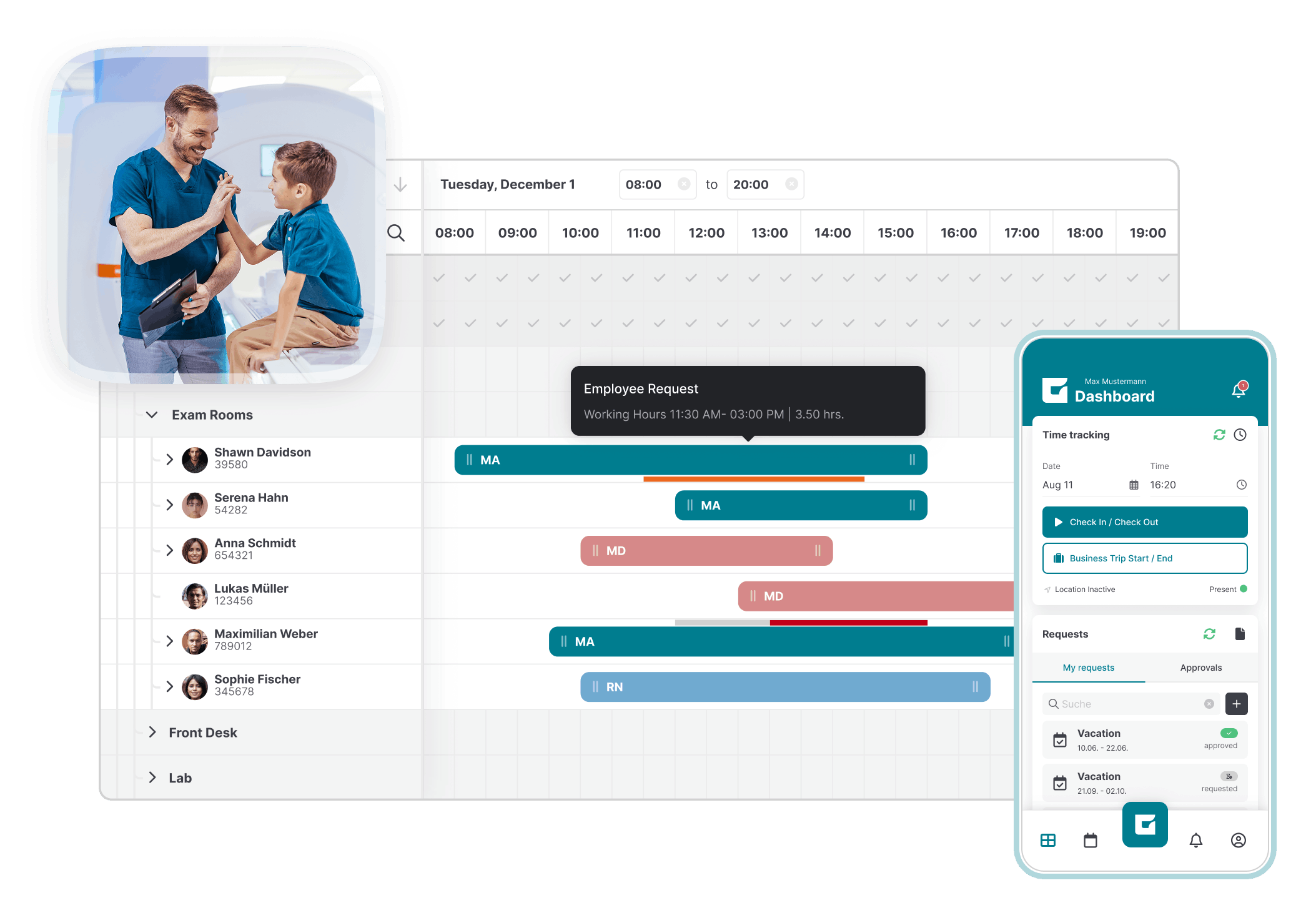
- Planning book and availability: Make skilled professionals an integral part of the planning process and automatically account for preferences and availability.
- Employee Self-Services and GFOS App: Time accounts, balances, and requests are available at any time in healthcare workforce management. This reduces unnecessary inquiries and paper-based processes.
- Fair and transparent scheduling: Distribute night, weekend, and holiday shifts based on rules and make planning logic understandable for everyone.
Healthcare Workforce Management in Practice
Every hospital and healthcare organization plans differently, depending on department, shift model, collective bargaining agreements, and many other factors. At the same time, strong regulation creates a high degree of standardization. Our use cases show how typical requirements can be mapped in GFOS.



Our success stories
Explore the GFOS Software Suite





Answers to Your Questions
The relevant staffing metrics are created during shift scheduling: actual staffing per ward and shift, assigned qualifications, and employee absence times. An integrated system ensures that this data is structured and centrally available. This allows all required information to be collected in one system instead of analyzing multiple data sources for different reporting requirements.
Yes. Required qualifications, such as registered professional status or specific certifications, can be stored as mandatory rules. If a required qualification is missing, the system prevents the shift from being assigned. Validity dates also allow the system to remind users in good time when renewals or expiring records need attention.
Yes. GFOS healthcare workforce management software is operated in ISO 27001-certified data centers with servers located in Germany. All personal data is processed in compliance with the GDPR. A role-based authorization concept lets you control who can view and edit specific data.
Legal, collective bargaining, and company-specific requirements can be defined directly in the system. Scheduling automatically checks the predefined rules so violations can ideally be avoided or displayed directly in the planning view. Premium pay and special time types are documented automatically by the healthcare time and attendance software, making them easy to transfer to payroll.



Would you like to learn more about GFOS software or receive additional information? Please feel free to contact us so we can discuss your needs together.
Contact