
What is digital employee communication?
Digital employee communication is internal corporate communication via digital tools such as messenger apps or a company intranet. This enables information and news to be communicated to the workforce quickly and in a targeted way. The aim is transparent information exchange that actively involves employees and strengthens collaboration regardless of location.
Why are companies digitizing their communication?
The use of digital employee communication tools supports decentralized and flexible working models and is therefore an important component of modern corporate culture. Speed is a decisive success factor: information, for example about short-notice absences, shift changes, or the introduction of new processes, can be shared with all employees at the push of a button. This shortens communication channels so that employees always stay up to date.
Challenges of internal communication
Internal communication always brings challenges with it. Here is an overview of important points to consider:
- Reachability: Especially in hybrid work models or shift work, messages do not always reach all employees. If employees work in the field or in production, for example, delays can occur when important information is passed on.
- Transparency: If documentation is lacking—for example for meetings and presentations - or if communication channels are decentralized, current changes may not be available to all employees in time.
- Loss of information: Companies often use different communication channels through which employees receive numerous messages every day. Filtering this volume of information not only takes a lot of time; information overload also often means that important content is overlooked.
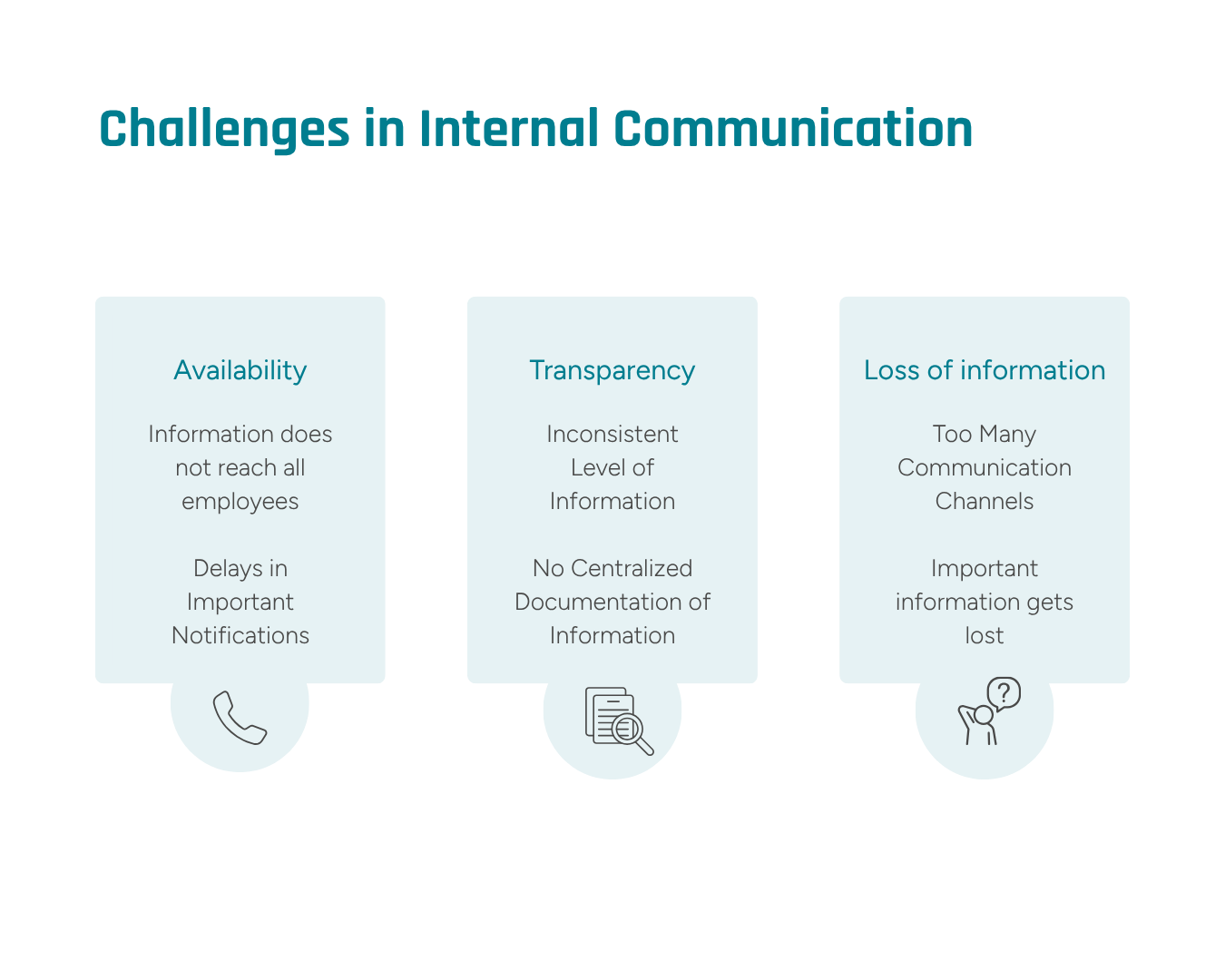
Internal communication brings challenges that need to be considered. © GFOS Group
Employee Communication Tools
The use of digital tools creates an innovative working environment and can make employee communication easier. If companies take potential challenges into account, the entire workforce can benefit from the advantages of digital communication tools.
Employee apps and employee self-services
Mobile apps make it possible to bundle information: documents, processes, organizational changes, and announcements can be communicated directly. Additional functions enable accurate time recording or access to shift schedules.
With an integrated ESS portal, employees can also carry out HR processes independently. For example, the status of leave requests or working time records can be viewed on mobile devices. This creates efficient HR processes, shortens information pathways, and facilitates communication between employees, managers, and HR departments.
Challenge: Apps and ESS systems store sensitive data and therefore place high security requirements on a company.
Push notifications
Push notifications inform the workforce in real time. Employees receive notifications about shift changes, new duty rosters, availability requests, or the status of applications directly on their devices. This allows time-critical information to be communicated quickly and precisely, ensuring it does not get lost in day-to-day work.
Challenge: Push notifications can be distracting and therefore often interrupt work. They can also be turned off at any time.
Messenger
Internal messenger services enable fast communication through various functions such as chats, video conferences, or phone calls. They support direct exchange and also involve employees working remotely in communication.
Challenge: Constant reachability, even after work or during vacation, makes it more difficult to maintain a healthy work-life balance.
Digital noticeboards
Digital noticeboards provide a central place for announcements, notices, and important documents. These can be accessed by all employees at any time, across locations, and independently of a fixed workplace.
Challenge: Content needs to be updated regularly and prepared in a clear, well-structured way.
Digital Employee Communication in Practice
Whether for communicating absences, providing documents, or maintaining regular exchange with the workforce: employee communication tools are used in many areas of everyday work:
- Communicating shift changes: Digital tools create platforms where changes to shift schedules can be viewed on mobile devices. Employees can also specify preferences for desired shifts and offer shifts for exchange with qualified employees via shift swap marketplaces.
- Short-notice absences and replacements: With the help of digital tools, employees can quickly inform the company about short-notice absences. This makes it possible to find replacements early, avoid bottlenecks, and ensure smooth operations.
- Company news: Announcements—for example about current goals, changes, or successes—can be shared with the entire workforce regardless of location. This ensures that all employees have the same level of knowledge, even in a hybrid work model.
- Training and instruction: If special training is required for the introduction of new tools, it can be made available to employees digitally, for example as a video. Employees can access the content regardless of time and location and integrate it flexibly into their everyday work.
- Document provision: Documents, for example for onboarding, company policies, or application processes, are available to employees digitally and can be accessed at any time when needed.
- Employee surveys: Employee communication tools make it possible to conduct employee surveys quickly and anonymously. The results are available immediately and provide valuable insights into the needs and opinions of the workforce.
Success Factors for Introducing Digital Employee Communication
The switch to digital means of communication can present companies with challenges. However, several success factors emerge that make the introduction of digital employee communication easier in the long term:
- Mobile usability: Mobile communication tools give employees access to information regardless of time and location. This means that employees without a fixed office workplace also remain informed at all times.
- Data protection and IT security: Protecting personal data has top priority. Security measures therefore need to be reviewed regularly, and GDPR requirements must be consistently observed.
- Clear communication rules: Corporate communication should be targeted, understandable, and traceable. Clear communication rules provide orientation, promote professional exchange, and strengthen trust within the workforce.
- Relevant information: To protect employees from information overload, content should be distributed in a target-group-specific way. This ensures that employees receive the information relevant to them and can prioritize important messages more easily.
Conclusion
The introduction of digital employee communication is an important building block of modern corporate culture. Organizations have access to a variety of employee communication tools that simplify information exchange and support collaboration across multiple locations. Through fast, transparent, and targeted communication, employees stay up to date. At the same time, important information reaches the relevant recipients without unnecessary delay.
Digital processes available on mobile devices
Access time recording, request management, push notifications, and duty rosters with the GFOS app on your smartphone at any time. This helps you support decentralized work models, reduce paper-based processes, and effectively shorten communication channels.
