
What is human resources?
Human resources — often also referred to as HR management or personnel management — encompasses the management of all people-related processes in a company and is therefore a core function. The task and goal of human resources is to align employee availability with long-term corporate goals and to deploy workforce effectiveness in a targeted way.
Tasks of human resources: An interconnected system
All HR tasks within a company are interconnected: the goal is to use employees’ individual skills in such a way that defined corporate goals are achieved. Corporate goals therefore create personnel requirements, which in turn give rise to HR tasks. Typical areas of responsibility for an HR department include:
- Planning: HR managers review corporate goals and determine which personnel resources are needed to implement them.
- Recruiting: The next step is to attract new, qualified employees to successfully implement the corporate goals.
- Workforce scheduling: The newly acquired personnel resources must then be deployed exactly where they are needed in order to increase the company’s productivity.
- Reviewing development: HR employees, in cooperation with managers, continuously review progress toward defined goals. They examine how processes can be further optimized and which resources — such as employee training or skilled workers — need to be obtained.
- Administration and control: To enable successful planning, HR managers maintain all personnel data and handle payroll, time tracking and absence management.
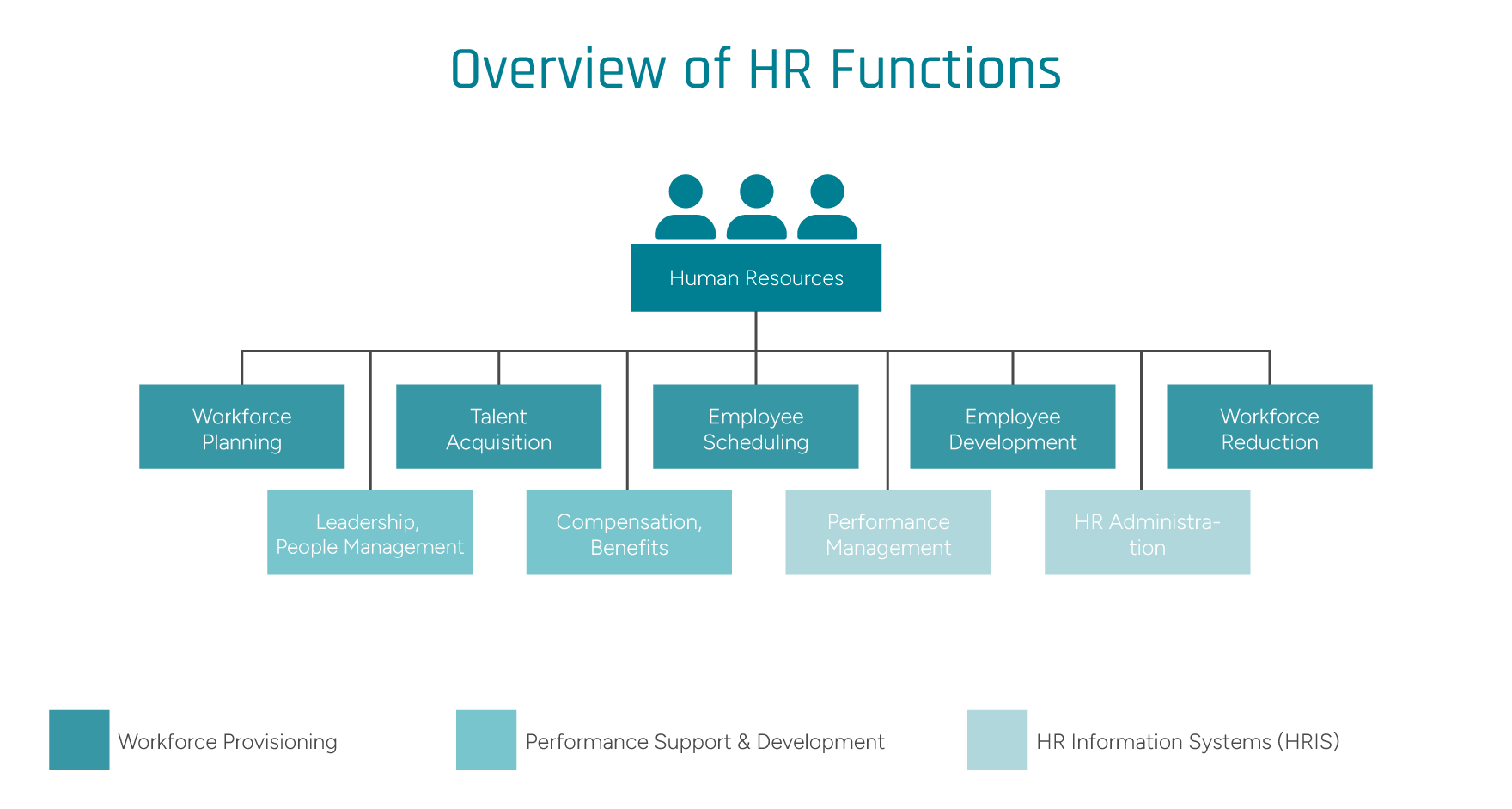
The tasks of human resources are connected as an interconnected system. © GFOS Group
The tasks of human resources along the employee lifecycle
A company’s HR department supports the entire employee lifecycle — also known as the employee journey. This means it is involved in every phase an employee goes through during their time at a company. These phases are as follows:
- Attraction / Recruiting: In the first step, HR managers must make people aware of the company. They must communicate transparently to the outside world what requirements they have for potential new employees. In interviews, the next step is to determine whether applicants have the skills currently needed for the company’s progress and to leave a lasting positive impression in order to inspire them to work with the company.
- Integration / Onboarding: Once a new employee has been recruited for the company, HR staff plan the onboarding process in the second step. They provide the necessary documents — such as employment contracts or access credentials — and familiarize the new team member with the corporate culture. The task of human resources is to establish contact with relevant points of contact and introduce employees to their new role. The goal is for new employees to find their way around independently, become involved in corporate processes early on and support them.
- Development: The HR department continuously monitors employee development and performance. It has an overview of what the team needs to be provided with. In doing so, it also identifies support and training opportunities to increase employee motivation.
- Retention: A company invests a great deal in onboarding and developing new employees. That is why it is important to retain them in the company over the long term. At this point, HR managers are responsible for engaging in dialogue with employees, gathering feedback, acknowledging employee wishes and implementing them where possible. This strengthens satisfaction within the company and retains employees for longer.
- Exit / Offboarding: In the final step of the employee lifecycle, the employee leaves the company. This step must also be planned and supported by HR employees. They inform the team about the employee’s departure and any related changes. In addition, they ensure that knowledge is passed on to successors and obtain all necessary data and forms for the exit process.
Goals of human resources
Human resources generally pursues two overarching goals: economic efficiency and social responsibility.
Economic goals include:
- Increasing efficiency and productivity
- Ensuring the right deployment of personnel
- Optimizing costs
The aim is to deploy employees exactly when and where they are needed while achieving the best possible financial result for the company. This means expenses should be kept as low as possible. At the same time, employees must be compensated fairly — this is where the social goals of human resources come into play.
Social goals include:
- Employee satisfaction and motivation
- Development and qualification
- Good working conditions
Employees should feel comfortable. This includes an appealing workplace design as well as consideration of individual development opportunities and wishes. HR managers often face a conflict at this point, because social and economic goals are mutually dependent: if employees are dissatisfied because they are not individually supported due to a lack of budget, their motivation decreases, and so does the company’s productivity. HR managers must therefore find a balance between the company’s financial requirements and employees’ needs in order to align the social and economic goals of human resources.
[H3] Making HR goals measurable
HR should be viewed as a data-driven steering function, because HR goals are measurable. Through HR metrics, companies can quantitatively capture personnel-related information and gain a basis for deciding on appropriate strategies. KPIs such as the turnover rate or sickness absence rate give HR managers an overview of whether defined targets have been achieved and in which areas further management action is needed. When evaluating KPIs, it is important that HR managers know exactly which data they collect and why they collect it. HR analytics software helps to understand core HR questions and supports the analysis of personnel-related data. This allows core functions to be tracked automatically, negative developments to be identified early and industry-relevant trends to be taken into account.

The future of human resources: Current trends and developments
HR is increasingly taking on a key strategic role in companies. Driven by digitalization and artificial intelligence, HR is becoming more and more of a steering function. Studies show that the future lies in the combination of technology and people:
According to the Gallup Engagement Index Germany 2025, only around 10% of employees in Germany are highly emotionally attached to their employer. Low engagement alone therefore causes productivity losses of more than 119 billion euros per year. The study shows how important HR managers and their work are for increasing a company’s revenue and productivity.
A DGFP study from 2026 shows that cost pressure, digitalization and AI are the main drivers behind HR’s development from an operational function into a strategic steering role within the company. In order for HR tasks to become even more transformation-driven in the future, HR must therefore manage efficiency, transformation and talent management at the same time.
The McKinsey HR Monitor 2025 examined around 1,900 companies and found that currently only 19% of core processes in European HR are being further developed with the help of generative AI. The digitalization of HR through AI is therefore still in its early stages. There is still significant potential for optimization and for HR managers to support these new technologies.
All HR metrics at a glance, thanks to GFOS
Start using advanced AI solutions now: optimize your HR processes and keep an overview of core HR data with tailor-made software.
