In a Nutshell – HRIS
- The abbreviation “HRIS” stands for “Human Resources Information System”
- In German-speaking countries, the term “Personalinformationssystem” (PIS) is also commonly used
- Depending on the provider, tools offer a wide range of functions
- Ideal for standardizing processes and simplifying workflows
- Cloud-based HRIS solutions are becoming increasingly important for modern HR
What is an HRIS? – Definition of the Term
A Human Resources Information System (HRIS) is a platform that makes it possible to centrally store, process and manage all employee data for all members of staff. From initial onboarding and information on qualifications and training through to offboarding, a well-maintained HRIS ideally maps the entire employee lifecycle of an employee.
Such an HR information system is usually deliberately designed as a holistic solution, enabling it to support a wide range of HR processes. After all, the goal is to standardize or automate the most important HR workflows as effectively as possible.
Using an HRIS can help to significantly streamline HR processes, eliminate inefficiencies and thereby also increase the productivity of various departments. Thanks to modern, cloud-based HR systems, it has also never been easier for companies to integrate a Human Resources Information System into their own workflows.
HRIS, HRMS or HCM – What Are the Differences?
At first glance, an HRIS has a great deal in common with a Human Capital Management (HCM) solution or a Human Resources Management System (HRMS). The terms are often used synonymously as well – but whether this is justified depends on the respective software solution:
- An HRIS is usually used for administrative tasks, such as managing core employee data, but also for payroll data and general organizational data.
- An HRMS covers the typical areas of an HRIS but usually includes several additional functions, such as applicant and talent management. Operational and strategic HR tasks are also incorporated into such a system.
- HCM is more commonly used to describe an overall approach to human resources management. This includes various methods and processes from the field of workforce management, such as HR controlling, and many other topics.
The key difference between the individual solutions lies primarily in their respective “depth” and range of functions. With this in mind, the following section takes a detailed look at which functions an HRIS should actually cover.
Key Functions of an HRIS
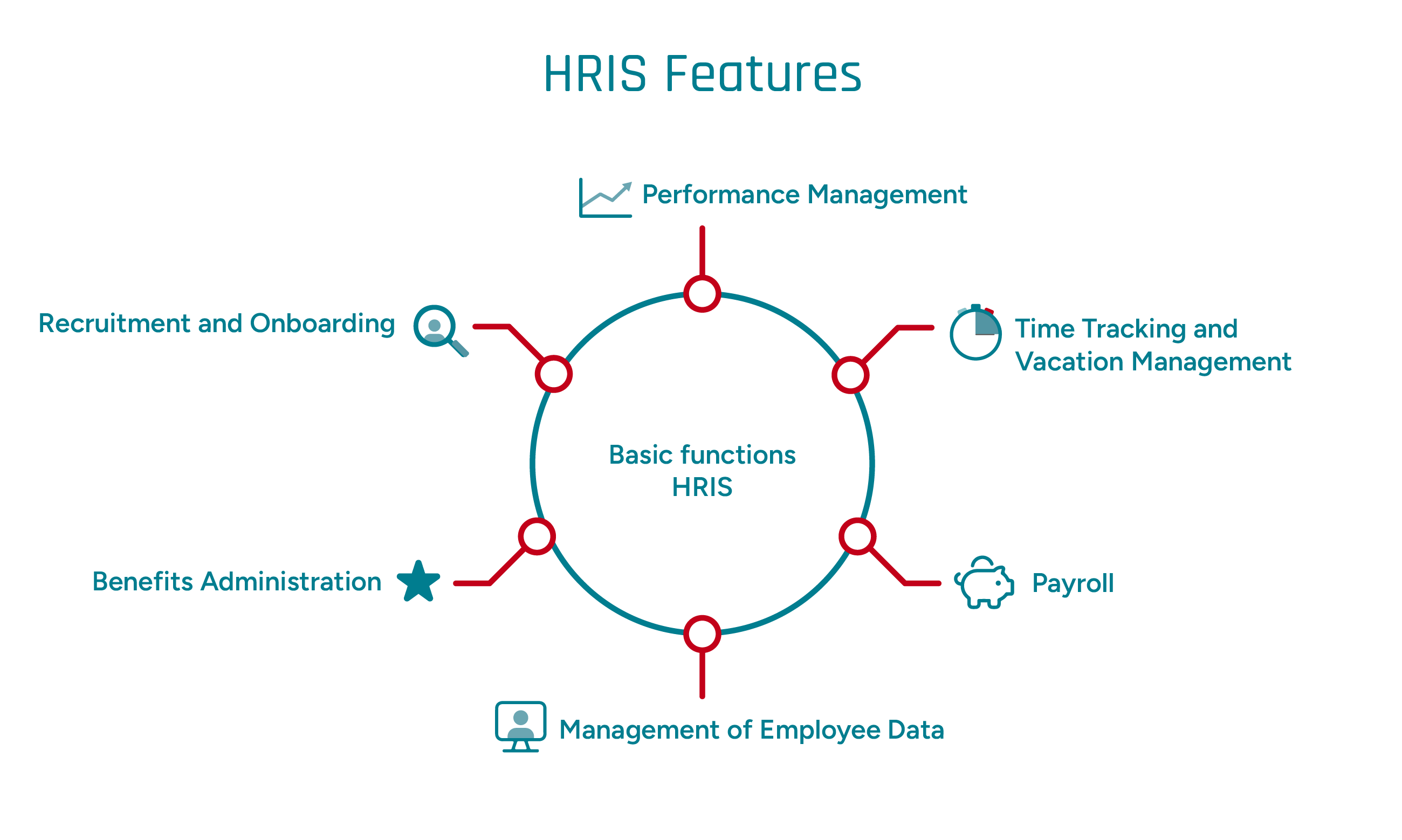
Depending on the configuration and capabilities of the respective software solution, an HRIS can offer both basic and many advanced functions. A typical Human Resources Information System, however, includes the following core functions:
- Employee management / personnel administration: Central recording and maintenance of all employee data (workforce planning), options for preparing / further processing wage and salary data (payroll), and an overview of the entire organizational structure
- Time recording / attendance and absence management: Simple recording of working hours, overtime and absences. At the same time, it also includes all information on vacations, sick notes (eAU), shift schedules and deployment plans. This makes it possible to map different working time models.
- Applicant management / recruiting: Clear management of applications / applicant data in one place – while also serving as a central platform for job postings. In many cases, it also offers the option to accept or reject applicants directly and automatically.
- Management of employee benefits: Clear management of all employer benefits or corporate benefits / coordination of company social benefits / simple administration of benefits, often also possible by employees themselves.
- Reporting / analytics: Creation of standardized HR reports and individual personnel statistics / simple provision of comprehensive analyses at the touch of a button / modern HRIS solutions usually also include an integrated dashboard for easy viewing.
- Performance management: Support for internal talent management / options for exchanging information on annual reviews, feedback and performance evaluations / everything centrally documented and easily accessible to those involved.
- Self-service functions: HRIS with support for employee self-service functions / employees can submit vacation requests directly, as well as manage their own core employee data.
These are some of the core functions of an HR information system. A well-equipped HRIS therefore provides a single source of truth for almost all employee data – available to both the HR department and employees. But the list of benefits offered by such a system goes much further.
The Benefits of an HRIS
For companies and their employees, using or introducing a Human Resources Information System usually pays off in every respect. The strengths of such a solution are especially evident in the following areas:
- Centralized data access: All employee data can be accessed via one system at any time. Instead of being spread across multiple lists, all relevant information about each employee is now stored in one central place. This also makes it easier to maintain this employee data automatically.
- More efficient processes: Numerous HR workflows can be fully automated with the help of an HRIS, such as payroll. In addition to eliminating these routine tasks, employees can also submit vacation requests and more themselves thanks to self-service functionality. This significantly reduces the workload for the HR department.
- Better decision-making: The simple and comprehensive availability of employee data through a Human Resources Information System helps managers obtain important data for decisions quickly. Real-time reporting can be clearly visualized in dashboards, making decision-making easier.
- Full transparency: With the help of an HRIS, department heads and supervisors can easily compare important key figures for their employees across departments. This creates the basis for people analytics and provides essential insights into business-critical aspects such as employee satisfaction.
- High level of security
When it comes to employee data, companies must comply with strict compliance requirements. By working with a reliable provider for their HRIS solution, companies can be confident that all data is managed in accordance with the GDPR. At the same time, central storage also makes it easier to control access rights and implement data protection requirements.
In addition, using an HRIS also underscores a company’s own ambition to be a modern and innovative employer. Alongside the benefits already mentioned, an HRIS can therefore also serve as an effective employer branding tool.
How Companies Can Introduce an HRIS – a Guide
After implementation, an HR information system is deeply rooted in a company’s own IT infrastructure – but getting to that point is a long journey at first. Companies that want to introduce such a system should use the steps in the following guide as a reference:
Clarifying Requirements
First, it should be determined which processes and areas the HRIS is intended to cover. Questions such as the following can help: Which functions are absolutely essential (e.g. time recording / payroll / reporting)? What is optional, and what budget is effectively available for which features? This analysis is crucial for finding both the right provider and the right system.
Evaluating Providers & Solutions
Once the key requirements have been clarified, suitable providers can be identified and compared. This includes deciding whether a cloud-based SaaS solution or an on-premise system is preferred. The desired level of support, options for customization and implementation assistance should also be included in the evaluation. Ideally, providers will offer relevant references and test access – both of which help with decision-making.
Migrating Existing Data
Once the fundamental decision in favor of an HRIS solution has been made, the next step is the migration of the current existing data. Before migration, the data records from legacy systems should be thoroughly checked and standardized. After all, business-critical information must be securely preserved, while redundancies should also be avoided. The goal is to end up with a well-structured and complete data set.
Training Employees and Users
Managers and employees alike must be trained on how the HRIS can and should be used in the future. Workshops or digital support resources, for example, are suitable for this purpose. It is important that all users are familiarized with the tool comprehensively and according to their respective tasks. Close coordination with the employees involved, including clear feedback loops, ensures that all users are appropriately involved in the process and that any issues are identified before go-live.
Go-Live & Further Development of the Tool
Ideally, the go-live should take place in several phases. A pilot phase with selected areas / departments makes it possible to identify further potential for optimization. After the successful initial go-live, the system is then gradually expanded with additional enhancements (further modules / new interfaces). Throughout the entire process, the HRIS should be continuously developed and, if necessary – and in coordination with the respective provider – adapted.
Experience shows that when selecting a company’s own HR tech stack, the flexibility of the available solutions is a particularly important decision-making factor for companies. Cloud-based HRIS solutions have proven especially effective in this area. They are also ideal when it comes to fast rollout and uncomplicated implementation. Suitable solutions & products for your company’s success are available directly from GFOS.
HRIS in Practice – a Fictional Example from Everyday HR Work
The fictional company in our example is a medium-sized company based in Dortmund. Until now, employee administration has been handled entirely manually using Excel spreadsheets. Responsibility usually fell to whichever employees happened to have time – which in turn led to poorly maintained schedules that were often updated hastily between other tasks.
The result was frustrated employees whose vacation requests, for example, were not approved or were approved only late. Likewise, employees were repeatedly unavailable for customer appointments as planned because they themselves did not know they had been scheduled for that day. This led to dissatisfied customers and several complaints, both about employees and about the company itself.
To bring order to its workforce planning, the company owner decides to purchase a cloud-based HR SaaS solution. After familiarizing himself with the topic, he discusses his requirements with providers and ultimately decides on a suitable HRIS solution.
Shortly after the successful implementation of the software, the first positive results are already visible: thanks to the self-service function, employees can now submit vacation requests themselves. Their supervisors can also manage these directly via the tool. In addition, attendance can now be planned better overall.
In the long term, the Dortmund-based company now finds that reports on employee performance – or on many other KPIs – are just one click away. The previous payroll solution is replaced by the HRIS and now runs largely automatically. And because business is now running better than ever before, the company plans to specifically expand its recruiting efforts – also via a suitable module for the Human Resources Information System provided by the vendor.
HRIS in the Cloud – On-Premise as a Discontinued Model
System solutions such as HRIS are not only in ever greater demand; they are also becoming increasingly digital. Especially as powerful HR SaaS models, they offer a number of advantages that are relevant for both small and large companies.
The advantages of cloud-based HRIS solutions at a glance
- Scalability: As a cloud version, every HRIS can grow flexibly with the company. Additional resources are available within a very short time. Additional employees or even new company locations can also be integrated into the system without difficulty.
- Frequent updates: Providers of HR SaaS solutions usually update their systems very regularly. Through this centralized updating of the tools, all connected companies automatically have access to every new update. The same applies to closing exploits or security vulnerabilities – without any internal effort.
- Mobile use: Cloud solutions can be used regardless of location – whether in the office, working from home or on the move via a company smartphone. Employees can therefore submit inquiries or vacation requests at any time while on the go – and their supervisors can process these requests just as flexibly.
- Low IT workload: The entire responsibility for operating, maintaining and updating the systems lies with the HRIS provider. The company’s own IT team can focus entirely on its other tasks.
- Data security and compliance: Reputable providers operate their data centers according to the highest security standards – ideally in Germany or the EU – and ensure compliance with relevant data protection regulations such as the GDPR.
- Faster rollout + lower implementation costs: Cloud deployment means no hardware needs to be installed. Many HRIS modules are also already preconfigured, so they can be used almost as a “plug and play” solution. This enables both a flexible and very timely rollout of the most important features.
- Higher reliability: Since specialized providers usually deliver their cloud HRIS solutions via their own data centers, they can generally guarantee very high reliability. This is achieved through redundancies and failover clusters as well as, where applicable, individual SLAs according to customer requirements.
- Continuous development: HRIS solutions available on the market are continuously developed by the respective providers – whether in terms of user experience, design or functional scope.
HRIS is already a very powerful HR tool in its own right – but when combined with the cloud, it is not merely powerful, but also future-proof.
