
What Is Predictive Maintenance?
Predictive maintenance is a data-driven approach to maintaining machines, systems or technical equipment. It continuously records condition data, such as sensor values, operating parameters and environmental information, and evaluates it using analytics, statistical models and/or AI methods.
The goal of predictive maintenance is to forecast the optimal time for maintenance measures and prevent failures through appropriate action.
Development of Predictive Maintenance
The development of maintenance strategies in industry can be divided into three stages: reactive, preventive and predictive. Each stage reflects a technological and organizational level of maturity and has significantly influenced how companies operate equipment, prevent failures and control costs.
Reactive Maintenance – “Runto Failure”
In the early phase, reactive maintenance dominated. Machines were used until they actually failed. Only then was a repair carried out.
Characteristics:
- No planned interventions before a defect occurs
- High dependence on employees’ experience and expertise
- Unplanned downtime and high consequential costs
- Suitable only for non-critical, easily replaceable components
For a long time, this strategy was the only option due to a lack of data and technologies, but it led to production processes that were difficult to plan.
Preventive Maintenance – Scheduled Maintenance
With increasing technological progress and the growing complexity of equipment, preventive maintenance became widespread. Here, maintenance is performed at fixed intervals, regardless of the actual condition of the equipment.
Characteristics:
- Time- or usage-based maintenance schedules
- Fewer unplanned failures
- Better planning of service assignments
- Risk of unnecessary maintenance (“over-maintenance”)
- Not all defects can be detected in advance
This strategy improves equipment availability, but often leads to unnecessary maintenance because standardized intervals rarely reflect actual wear.
Predictive maintenance of machines requires reliable real-time data on the condition of equipment on the shop floor. © GFOS Group
Predictive Maintenance – Data-Driven Forecasts
The next stage of development is predictive maintenance. Through sensors, connectivity and AI-supported data analysis, the actual condition of equipment is continuously monitored.
Characteristics:
- Use of IoT sensors (Internet of Things; for example, vibration, temperature, power consumption)
- Use of historical and real-time data
- Machine learning models predict failure probabilities
- Maintenance is performed only when it is actually necessary
- Reduced downtime and maintenance costs
- Higher technical and organizational requirements
Predictive maintenance makes it possible to detect faults early and initiate measures before a failure even occurs. This makes maintenance dynamic, precise and highly predictable.
Practical Example of Predictive Maintenance: Bearing Failure on a Production Machine
In a metalworking company, a CNC milling machine (Computerized Numerical Control) is crucial for daily production. One central component of the machine is a spindle bearing. It is in use for many hours each day and is exposed to high loads.
Scenario 1: Unplanned Machine Failure
Without predictive maintenance, the machine is serviced at defined intervals. In this case, however, the spindle bearing begins to wear unnoticed; early signs such as increased vibration or temperature remain undetected. The bearing overheats and eventually blocks during production, causing the milling machine to fail immediately.
Consequences:
- Production downtime lasting several hours or days until spare parts are delivered
- High costs for express deliveries, repairs and employee downtime
- Delivery delays for customers and potential reputational damage
- The machine often has to be laboriously recalibrated after the damage
Scenario 2: Predictive Maintenance
The machine has been equipped with IoT sensors that continuously measure vibrations, temperature and power consumption. A machine learning model detects typical patterns of an emerging bearing defect.
The sensors register increasing imbalance and deviations in the temperature profile. In response, the system reports an increased probability of failure within the next 120 operating hours. The maintenance department receives the warning in the dashboard, and a planned maintenance appointment is coordinated with production planning.
Consequences:
- The bearing is replaced in good time and in a controlled manner.
- Production downtime is avoided because the machine is serviced during a planned stop based on the machine occupancy schedule.
- Significantly lower repair costs because no consequential damage has occurred
- Consistent quality and adherence to all delivery dates
How Predictive Maintenance Works
The innovative concept behind predictive maintenance uses information, machine data and operating data that are recorded and processed directly at the place of use.
This requires sensors and measuring devices that collect the necessary data in a structured way, both qualitatively and quantitatively, real-time digital data analysis, and the general networking of machines and processes in line with IoT and Industry 4.0.
Using specialized software solutions, the collected data provides a digital representation of productivity, disruptions and failures and creates models of cause-and-effect relationships. This, in turn, enables very precise forecasts that include all relevant factors and whose data basis and effectiveness improve through continuous recording and evaluation: machine learning.
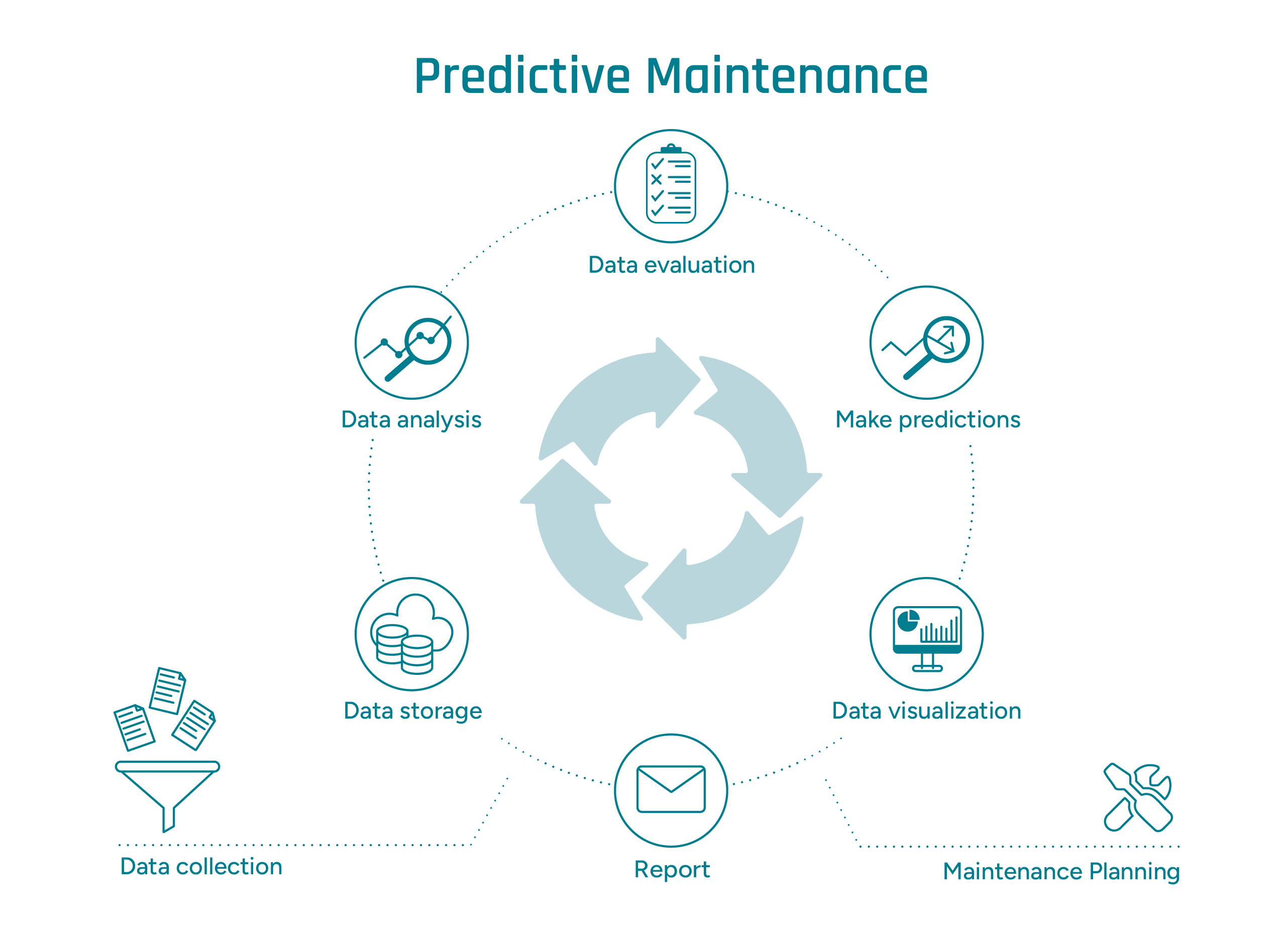
The functionality of predictive maintenance can be divided into three key steps: data collection, data analysis, and visualization including notification.
1. Data Collection: The Basis for Reliable Forecasts
The first step is the systematic recording of machine condition and usage data. Modern equipment or retrofitted IoT sensors continuously provide measured values such as:
- Operating hours and utilization
- Temperature trends at critical components
- Vibration patterns of bearings, motors or spindles
- Additional sensor data such as power consumption, pressure or noise level
This data is collected in real time and stored in central systems or cloud platforms. The more comprehensive and context-related the data, the more precise later forecasts can be.
2. Data Analysis and Models: Algorithms Detect Patterns
In the next step, analytical methods and machine learning models are used. They process large volumes of data and identify typical patterns that indicate impending defects.
Key functions:
- Anomaly detection: The system notices deviations from normal operating behavior.
- Trend analyses: Algorithms identify gradually progressing wear.
- Prediction models: AI models calculate the remaining useful life (RUL) of components and forecast failure probabilities.
- Self-learning systems: Models continuously improve themselves through ongoing data collection.
In this way, raw measured values become reliable indicators of when a component is likely to fail.
3. Visualization and Notification: Added Value for the Maintenance Team
The insights from data analysis are then prepared in a way that allows the maintenance team to act quickly and purposefully.
Typical functions:
- Dashboard views with machine conditions, forecasts and trends
- Early warnings when defined thresholds are exceeded
- Concrete recommendations for action, for example “Replace bearing in machine A in approximately 80 hours”
- Integration into maintenance planning systems to automatically generate work orders
Through this clear and structured presentation, technicians receive not just data but real added value: they know exactly which machine requires attention and when, and can plan maintenance optimally.

Benefits of Predictive Maintenance
Compared with conventional maintenance at strictly defined time intervals, predictive maintenance offers companies and their employees a range of benefits:
Reduced Downtime
The greatest benefit of predictive maintenance lies in the significant reduction of unplanned failures. By detecting anomalies early, the maintenance team can intervene in time before damage occurs.
Production stops are deliberately moved into predictable time windows, and spontaneous, costly emergency repairs largely become a thing of the past.
Lower Maintenance Costs
Because maintenance is only carried out when it is actually necessary, many unnecessary routine operations are eliminated. At the same time, consequential damage that often causes high costs in the event of an unplanned failure is avoided. This sustainably reduces both material and labor costs.
Longer Service Life of Machines and Equipment
By addressing wear and critical conditions in good time, machines remain in optimal condition for longer. Predictive maintenance ensures that small problems do not escalate into major damage. This protects equipment, extends its service life and reduces investment in replacements.
Greater Planning Reliability
With precise forecasts about the condition of components, maintenance becomes predictable, as does a significant part of machine utilization. Production planning, spare parts procurement and staff deployment can be better coordinated. Companies gain security and transparency and avoid sudden interruptions in operations.
Resource Efficiency
Predictive maintenance not only helps save time and costs, but also increases resource efficiency. Targeted maintenance reduces the consumption of spare parts, energy and operating materials. In addition, employees are deployed where they are truly needed. Overall, the efficiency of the entire operation increases.
Conclusion: Predictive Maintenance for Maximized Production
By applying the predictive maintenance concept, the focus is no longer only on analyzing the current operating condition and how an error occurred. Instead, production- and process-specific data is used to create a forecast of when another error can be expected. In addition, simulations created with the help of the collected data can provide recommendations for inspection and maintenance measures, enabling production to continue as productively as possible.
Through machine learning, the complex relationships between structural and wear parts, disruptions and failures, machine specifications and guideline values, as well as the effects of deviations and entire production chains, can be recorded and analyzed. The system is enabled to identify and report risk potential and impending disruptions before machine downtime occurs. Productivity can be increased many times over in this way because action is no longer merely reactive, but active and preventive.
Make use of the expertise of GFOS mbH’s IT experts in the design and implementation of maintenance and comprehensive Industry 4.0 concepts. We would be happy to advise you — schedule an appointment directly today.
