Definition of Digital Worker Guidance
Digital worker guidance is a system that guides production employees step by step through manufacturing processes on a digital device at the workplace. Employees’ individual work steps are documented in detail. In addition, the system is connected to a feedback system (RMS, ERP, MES) so that errors can be recorded quickly.
Why are traditional work instructions reaching their limits?
Traditional, paper-based documentation of work steps involves a great deal of effort. Employees have to create multiple copies of documents by hand, and changes are distributed manually. As a result, information is often available in different locations and is not provided to workers at the right time and at the right workstation. Work steps are difficult to trace, meaning that, in the worst case, identical processes may be performed differently.
Digital Worker Guidance in Practice
In practice, production employees are provided with digital work instructions directly at the appropriate workstation. A step-by-step guide with images, videos, and checklists then guides them through the entire manufacturing process, while their completed work steps are documented in detail. Feedback and deviations — for example via an RMS system — are recorded. Content can therefore be maintained centrally and updated regularly.
Benefits of Digital Worker Guidance
Using digital worker guidance in industry offers many benefits. Here is an overview of the most important points:
- Standardized workflows: Digital worker guidance provides clear structures so that identical processes are always carried out in the same way. This helps new employees, for example, understand complex tasks more quickly.
- Greater process reliability: Through the digital documentation of every work step and the traceability of feedback, errors can be identified more quickly and avoided in the long term. In addition, the processing status of tasks is transparently visible.
- Central management of work instructions: Responsible teams maintain content centrally so that process changes can be implemented faster and made available to all workers in good time. This reduces manual paper-based documentation effort.
Areas of Application
Digital worker guidance can be used in various areas, including:
- Machine setup: Such a system supports the preparation and setup of machines by showing workers exactly which tools or resources are needed for a process and where they must be available.
- Assembly processes: Manufacturing processes are often complex. Digital worker guidance provides employees with permanently accessible expert knowledge and can therefore help simplify multi-layered processes and reduce errors.
- Quality inspections: Worker guidance systems detect deviations early and report them quickly. Production employees can therefore correct errors faster. The effort required for rework is reduced, increasing productivity in production.
- Maintenance & servicing: Machine inspections are integrated into the workflow with digital worker guidance. Maintenance results are documented automatically so employees can access them at any time. This enables long-term improvement of production quality.
- Shift handover: Digital worker guidance makes shift changes easier. Transparent documentation of work steps allows employees starting their shift to quickly understand work progress and continue seamlessly.
What should be considered during implementation?
The implementation of digital worker guidance should be viewed as a process. We have summarized the individual steps here:
- Analyze existing work instructions: Before introducing such a system, all existing work instructions must be checked for accuracy and timeliness. Incorrect or outdated instructions should be revised.
- Standardize processes: To keep production quality consistent, processes should remain uniform. It is therefore important to standardize workflows with production control, as this helps create fixed structures in work organization and makes comprehensive processes easier to understand.
- Involve employees early: Transparency about process changes is important in order to familiarize workers with the new system in good time. This enables employees to work with it more quickly and ensures a smoother transition.
- Define responsibilities: To ensure content is always up to date, responsibilities should be assigned for regularly reviewing and updating it. This helps maintain workflows and minimize errors, for example those caused by outdated processes.
- Integrate digital worker guidance into existing systems: Once all information is available, the system can be integrated into the existing IT landscape. A worker guidance system can be connected, among other things, to RMS, MES, or ERP systems.
- Select a pilot area: To test the solution in practice without interrupting ongoing production processes, a pilot area is recommended. From there, the system can be gradually expanded to other areas.
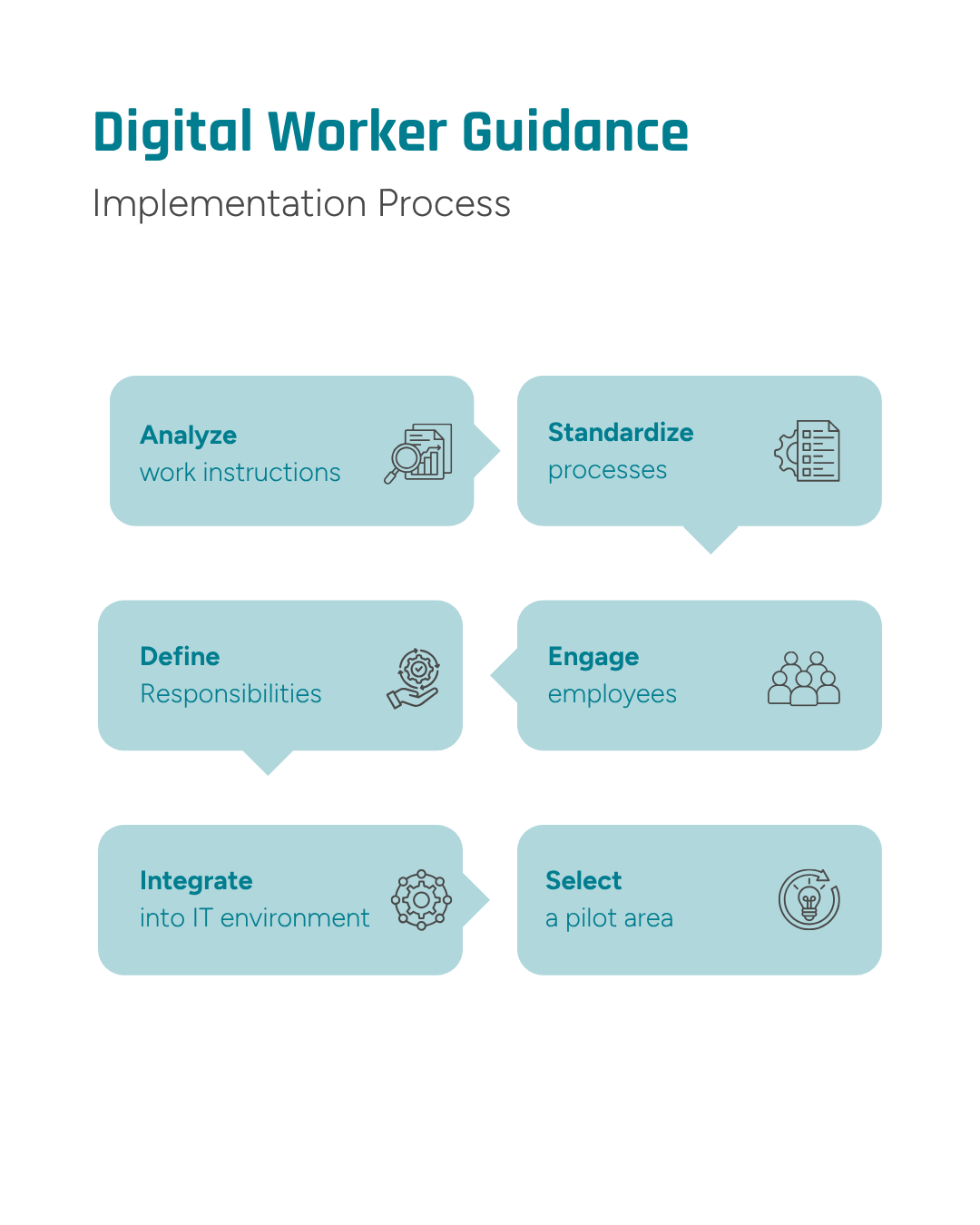
The implementation of digital worker guidance takes place step by step as a multi-stage process. © GFOS Group
Digital Worker Guidance as a Building Block of Digital Production
Digital worker guidance connects employees, processes, and data. This makes it an important part of digitalized production environments. Instead of manually created paper documentation, information is immediately available to all employees. Digitalized worker guidance therefore not only forms the basis for transparent processes, it also standardizes them. This enables more efficient onboarding of new employees and helps keep production productive in the long term.
Evaluation at the touch of a button and instant feedback with GFOS
Forget manual paper-based documentation and increase the efficiency of your production with digital solutions.
