
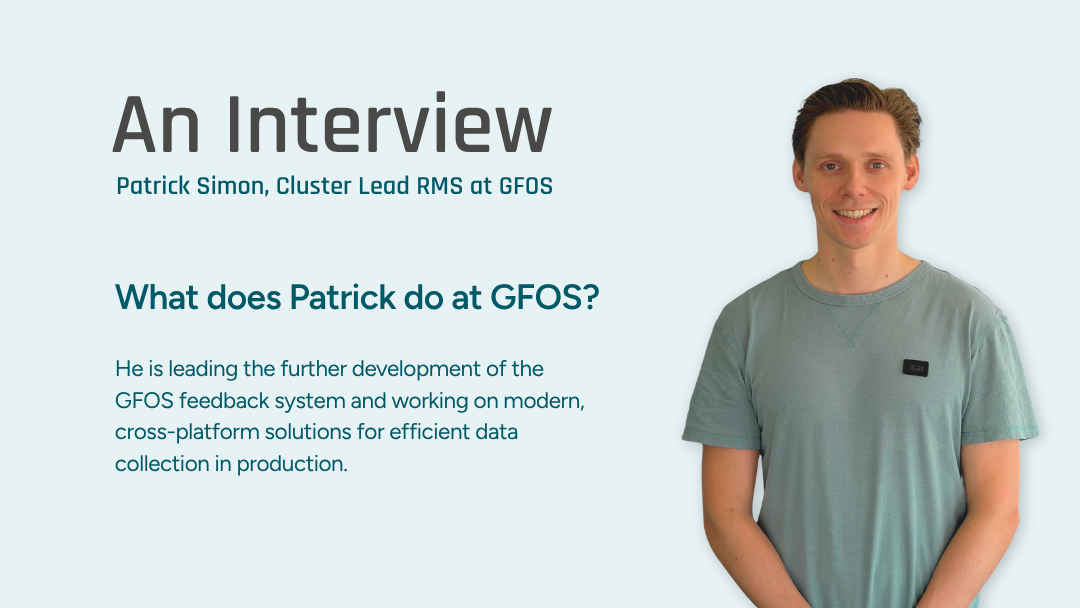
Patrick Simon is Cluster Lead for the Feedback System (RMS) area at GFOS and Deputy Team Lead in Delphi Development. As the lead developer of RMS 3.0, Patrick plays a key role in advancing the solution from a technological perspective. His focus is particularly on modern platform approaches that enable consistent use across Windows, Android, and iOS devices.
You work extensively with our new feedback system. What exactly is behind RMS 3.0?
Patrick: The feedback system is a central component of GFOS Production Data Acquisition. RMS is used to record all feedback from production, such as entries relating to orders, times, or statuses.
With the new 3.0 version, we have fundamentally advanced the system from a technological standpoint and, above all, made it significantly more flexible.
What Is Production Data Acquisition?
Production data acquisition refers to the systematic recording of relevant data, such as order information, machine statuses, or quantities, that is generated during a production process. Within Manufacturing Execution Systems such as GFOS.Smart Manufacturing, production data acquisition is an integral component. It ensures that data is captured, processed, and made available for analysis directly on the shop floor using terminals, scanners, or mobile devices. The goal is to create transparency in manufacturing, provide a basis for informed decisions, and sustainably optimize production processes.
What Is a Feedback System?
A feedback system is a function that enables employees to record production data on the shop floor. It serves as the user interface for production data collection and allows feedback on orders, times, or disruptions to be entered in a structured way and transferred to other systems.
What specifically differentiates RMS 3.0 from the previous version?
Patrick: The biggest difference is its multiplatform capability. While older versions were designed exclusively for Windows, RMS 3.0 runs on Windows as well as Android and iOS. That was one of the biggest challenges in development.
For companies, this means they can freely decide which devices to use, from traditional industrial PCs to tablets or smartphones. At the same time, different views are provided and can be assigned depending on resolution and device. This allows us to ensure that use in every environment is supported in the best possible way.
Which practical challenges does RMS 3.0 solve for companies?
Patrick: A major topic is the increasing variety of devices in production. Many companies today no longer want to rely exclusively on fixed terminals. They want to work more flexibly and use mobile devices. At the same time, the devices themselves are changing: traditional handheld scanners, for example, are increasingly being replaced by modern Android-based devices. This is exactly where our RMS 3.0 feedback system comes in.
The system also offers extensive status and monitoring functions. Users can see at any time what condition their devices are in, whether updates are pending, whether there are connection issues, whether errors have occurred, and much more. This makes controlling ongoing operations significantly easier.
Another important point is flexibility in use: Extensive configuration options allow companies to adapt the system very precisely to their processes.
You already mentioned configurability. How flexible is the system really?
Patrick: Very flexible. With RMS 3.0, users can configure almost the entire interface individually, from simple labels to complete input screens. What makes this special is that customers can implement many adjustments themselves or with the support of our consulting team in RMS Studio. For more complex requirements, Development can also provide support, for example with the basic implementation, which can then be further refined together with Consulting and the customer. This creates a system that is tailored precisely to the respective requirements without time-consuming tickets or the need to purchase additional software solutions. In addition, familiar dashboard widgets from GFOS.Smart Manufacturing and GFOS.Workforce Management can also be used in the feedback system, allowing the range of functions to be expanded in a targeted way depending on the use case.
Reliability is crucial in production. How does RMS 3.0 ensure that no data is lost?
Patrick: A central feature of RMS 3.0 is its offline capability. If a device temporarily has no connection to the GFOS server, all recorded data is stored locally and synchronized automatically as soon as the connection is restored. This ensures that entries can be made at any time, regardless of network quality, and that no information is lost.
How is RMS 3.0 implemented in a company?
Patrick: We placed great emphasis on simple commissioning. Users are guided through the setup step by step, so the system is ready for use quickly. In addition, devices such as smartphones can be provided preconfigured through mobile device management. This eliminates a large part of the manual setup effort.
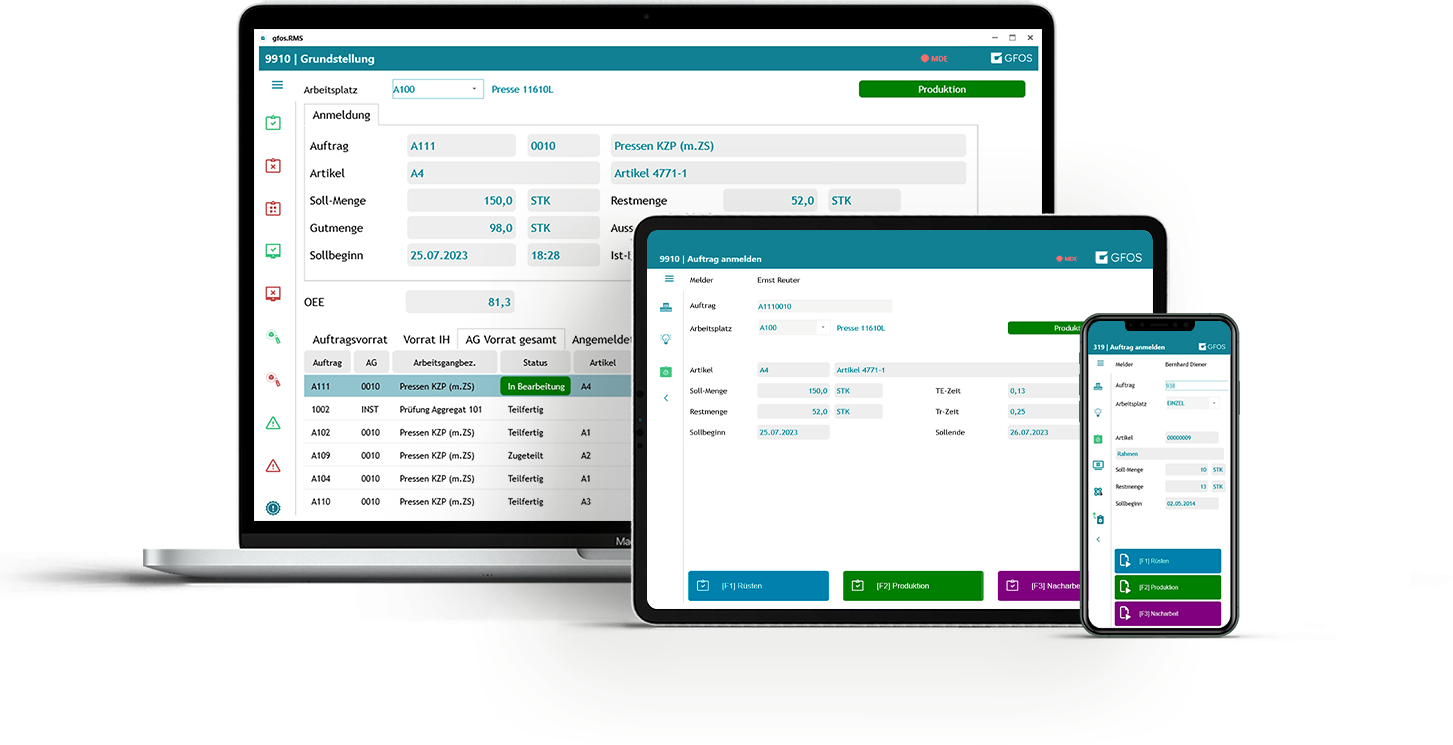
The RMS 3.0 feedback system supports flexible data collection across various devices. © GFOS Group
Is the feedback system used exclusively in production?
Patrick: The focus is clearly on the MES environment, meaning production. At the same time, the system is flexible enough to support other use cases as well, such as time and attendance functions like clock-in, clock-out, or off-site work entries, as well as specific scenarios such as evacuation lists.
If you had to summarize the value for users in a few points, what are the key benefits?
Patrick: In short: flexibility in use, less effort thanks to centralized configuration options, high operational reliability through offline capability, and intuitive use through consistent user interfaces regardless of the device being used.
To conclude, what makes RMS 3.0 special to you personally?
Patrick: For me, it is above all the combination of modern technology and strong practical relevance. We are creating a solution that is technologically up to date, addresses specific production requirements, and provides users with real value in their day-to-day work.
Discover GFOS's flexible production data acquisition
Our production data acquisition system is device-independent and efficient, helping you capture your production data and creating transparency on the shop floor.
