
What is Internal recruitment? – Definition
In internal recruitment (also referred to as recruiting), companies rely on their own employees to fill vacancies. Employees already in the firm are developed to fulfill a new (additional) role in another department.
On the other hand, there is external recruitment, in which organizations try to attract capable employees from outside the company. Here, positions are advertised externally and filled with suitable applicants from outside the company's own talent pool. This is logically referred to as external recruiting.
As a rule, organizations do not exclusively pursue an external or internal staffing policy, but rely on a mix of both models. In this way, they create opportunities for advancement within the workplace and at the same time benefit from fresh impetus and skills from external applicants.
Internal vs. External Recruitment – the Differences
Internal and external recruitment differ significantly - both in terms of the advantages and disadvantages that result from them, as well as the people who carry them out and the workflows that result from them. There are two types of internal and external recruitment.
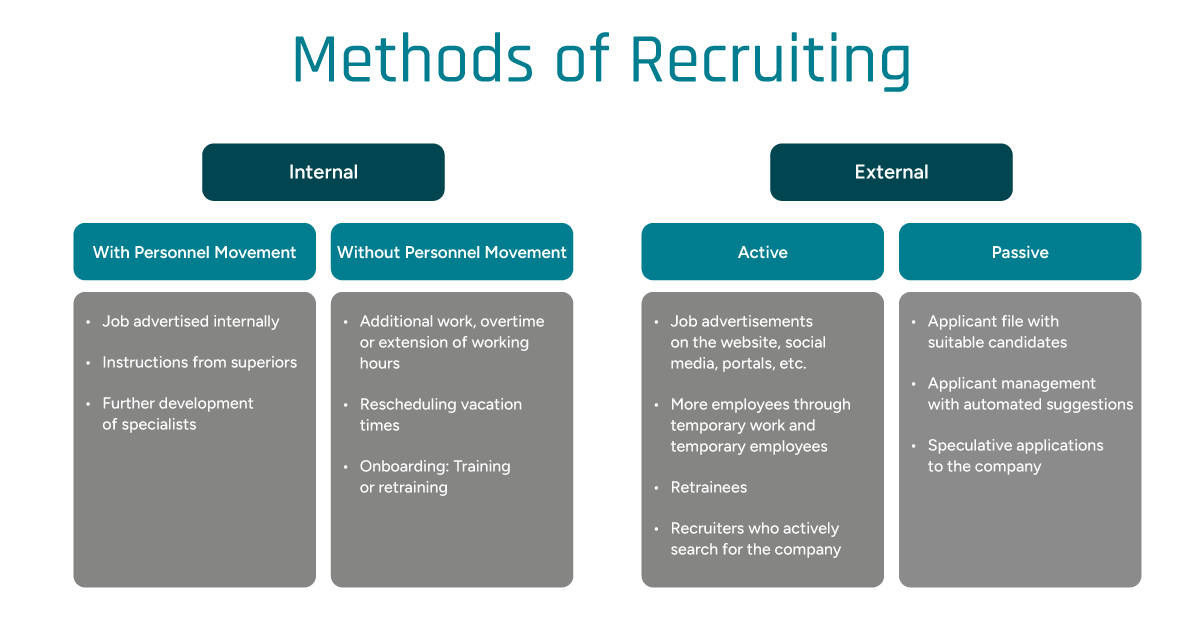
Overview of internal and external recruiting methods, which are categorized by personnel movement and recruitment activity level. Image © GFOS Group
Internal Recruitment with Personnel Movement
In the case of internal recruitment methods with personnel movement, the person is usually transferred to another department and given a completely new set of tasks - this can take place after an internal job advertisement, for example. Other options include direct approaches to employees, transfers or internal recommendations.
Internal Recruitment without Personnel Movement
If the position is filled without staff movement, this usually results in additional work and overtime. At this point, the employee in question takes on additional tasks to supplement their current work. Training in these new topics is of course urgently required.
External Recruitment – Passive
In the case of passive staffing, companies rely on their own internal applicant management system to fill vacancies. This may involve speculative applications, for example, which - in compliance with the GDPR - are stored internally and matched to possible positions in the firm at a later date.
External Recruitment – Active
As part of active staffing, organizations place advertisements on job boards, online portals or on their own website. Recruiters / headhunters can also be used to find capable people for the required criteria.
A Direct Comparison of Recruitment Strategies
The question always arises as to whether there is one optimal strategy for recruiting capable employees. To evaluate this, we take a look at the key factors in recruiting in direct comparison with each other.
Costs
If internal staffing takes place, the costs are low - all processes run internally, with or without job advertisements. The costs for training employees are also usually manageable, as they are already familiar with the organization.
If specialists are recruited externally, there are corresponding costs for placing advertisements, working with recruiters or other measures. Onboarding costs are also likely to be higher if new employees have just joined the organization and have no prior knowledge of the work processes.
Time Required
The internal recruitment process is often much faster, as the strengths (and weaknesses) of the respective applicants are already known internally. This can also save on training costs, as the specialists should already be familiar with basic processes.
Every external applicant is initially unknown and must be evaluated accordingly. Reviewing documents and checking the necessary skills for the position in question is usually quite time-consuming. And once a suitable candidate has been found, existing employment contracts usually have to be terminated. This results in a waiting period until the new person is available for a new assignment.
Risk
If the job is allocated through internal recruitment strategies, there is typically only a low risk - an employee's previous performance, skills and competencies are known and therefore a good reference. At the same time, internal rivalries cannot be ruled out if, for example, if employees feel left out.
In the worst-case scenario, it only becomes clear whether there is a cultural fit in external staffing long after an employee has been hired. It is also often difficult to reliably assess the actual skills of a new external employee at the beginning or on the basis of work samples.
At first glance, the internal staffing process seems like the logical consequence - but there are plenty of cases in which external employees are the better choice. For example, when a company is actively looking for a “breath of fresh air”, when vacancies need to be filled urgently or when serious internal disputes are to be feared.
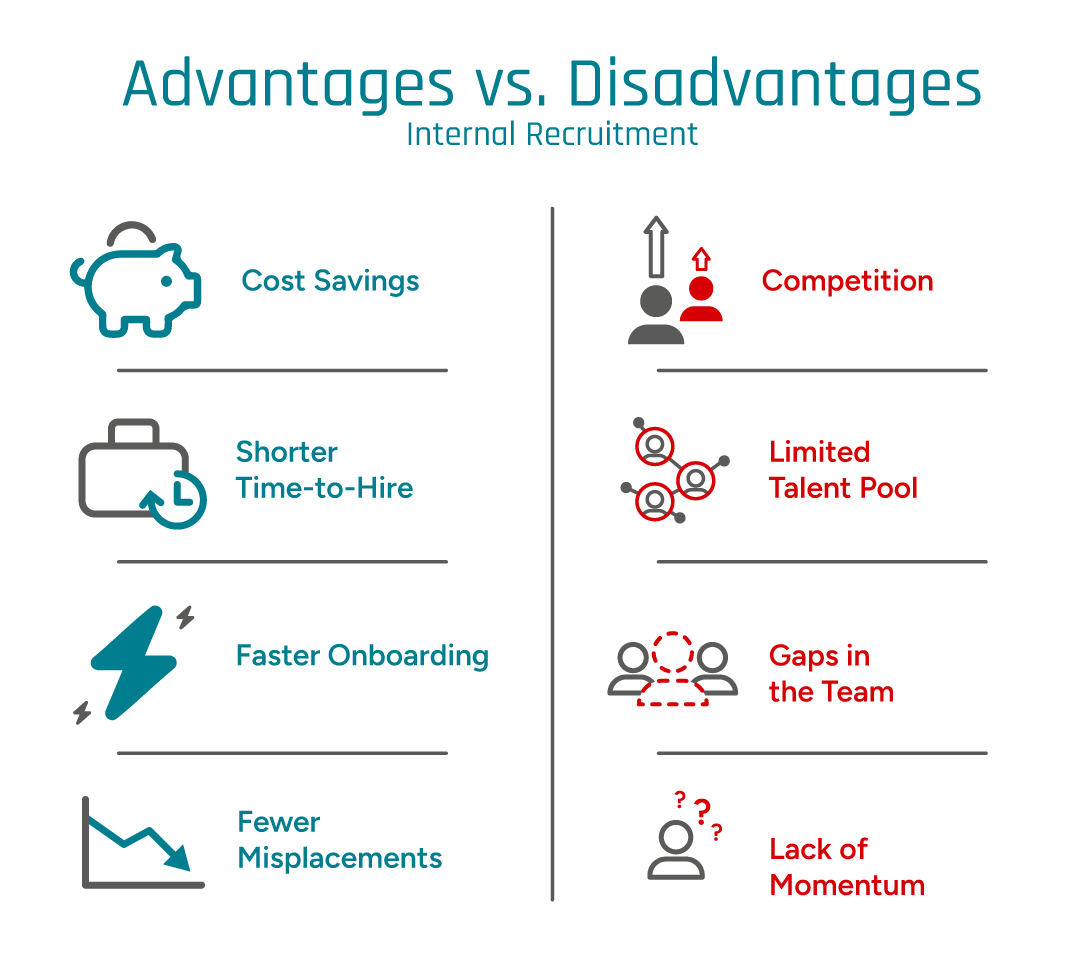
Organizations and HR managers should not ignore some of the advantages and disadvantages of internal recruitment methods; Image © GFOS Group
Advantages of Internal Recruitment
Short processes and lower costs: The advantages of internal talent management are wide-ranging. This process is also worthwhile in terms of employee retention if companies consider such a strategy. There are five key benefits to internal recruitment, which we describe below.
Lower Costs
External job advertisements or costly headhunters are not required for internal staffing. This saves time and money. The costs and expenses saved are then available for team building measures or similar formats, for example, which can be used to increase employee motivation within the team.
Shorter Time-to-Hire
The specialists are available to the departments more quickly, as the people can start their (new) tasks immediately after an internal handover. If internal staffing takes place, there are also no notice periods - the people do not have to go through a sometimes long candidate journey and can be taken into account directly in further employee scheduling.
Faster Onboarding
When new employees join the firm, they first have to be trained and familiarize themselves with the operational processes. This takes up capacity in many areas, as various specialists and managers focus on this induction phase.
In internal staffing, those involved are already familiar with all processes and the corporate strategy. Onboarding can be much shorter and more targeted here by concentrating on the new areas of responsibility.
Lower Risk of Wrong Hires
If positions are filled via internal recruitment channels, the probability that the employee in question does not have the right skills for the job is low overall.
As a rule, the skills, strengths and weaknesses of individual employees are well known internally, making it unlikely that the position will be filled by a candidate who does not have the necessary skills.
Confirmed Cultural Fit
The question of whether an applicant's personality is a good fit for the corporate culture does not arise for HR managers during internal staffing. The commitment, know-how and skills of the employees are already known. This makes it much easier to select the right applicants at this point.
If companies rely on internal recruitment, this can also have a motivating effect on employees as a whole. The prospect of further career steps within their own company can strengthen both employee commitment and employee retention.
Disadvantages of Internal Recruitment
Despite the many advantages, the internal recruitment process also poses some challenges that companies must take into account in order to utilize the full potential of their employees and successfully implement such a recruiting strategy.
Internal Competition / Rivalries
If several employees are working towards or applying for the same position, this can cause tension within the team. Specialists who do not qualify in the final step could feel demotivated - a reason for possible declining satisfaction and performance. This becomes particularly problematic if there is a suspicion of nepotism - transparent selection criteria are absolutely essential here.
Limited Pool of Applicants
It may well be that the internal talent pool is so small that there are simply no suitable candidates in the organization for a particular position. This is particularly common in fast-growing companies or in very specialized industries. Organization-wide investment in further education and training is therefore essential, as is a possible look beyond the boundaries of the company's own workforce.
Gaps in the Team
Where employees move to new positions (internal staffing with staff movement), a position necessarily becomes vacant in their old department. This can lead to the remaining employees having extra work due to the transfer of a colleague. In drastic cases, this new, vacant position must be filled, possibly even by an external candidate.
Lack of Impulses
New employees bring new ideas and fresh inspiration to day-to-day business - but if companies rely primarily on internal staffing, this effect does emerge. On the contrary: there is a risk that a certain degree of operational blindness will set in over time and certain (inefficient) processes will simply continue to exist because they are never or rarely questioned.
Internal Recruitment – Ways and Methods
Filling vacancies internally can be a valuable strategy for firms to staff important positions quickly at best and at the same time create new career prospects for employees. There are a number of possible ways in which such internal staffing can be initiated in practice.
Internal Job Posting
Like a traditional job advertisement, but internal: a vacancy is first communicated within the company and employees can apply for it. How it is published varies from business to business. Internal candidates then go through a (shortened) application process and, depending on their suitability, may be transferred or promoted to the new position.
Recommendations
The talents and skills of individual team members often become apparent when employees work together. A dedicated employee engagement strategy can also help to identify particular commitment within the workforce. In the best case scenario, the organization has an HR process that enables colleagues to be specifically recommended for (open) positions. Such recommendations can be made by both employees and line managers.
Mentoring / Coaching
If a position becomes vacant in the organization or additional staff are planned for the long term, it can be worthwhile “developing” employees internally for these positions. Various companies are already successfully using mentoring programs or coaching offers for this purpose. Another option for internal staffing is the targeted training and hiring of young talent.
Data-based Talent Development
Various companies maintain internal talent pools and keep track of exactly which employees have which skills and / or specializations. The use of such a database, ideally in conjunction with HR software or with AI support, allows candidates to be quickly identified for a position and thus offers the opportunity to handle internal recruitment within a very short time and with little effort.
The more professionally companies want to operate their employee development, the more worthwhile it is for them to use dedicated software solutions. We are happy to support you in selecting the right systems to fill vacancies with the best possible candidates at all times - both internally and externally.
HR-Software as the Key to Internal Recruiting
Who is qualified for the job and who is highly motivated? It's not easy to get an overview of these factors - especially when you have to manually comb through personnel files and various documents.
HR software offers companies the tools they need to optimize the internal recruitment process. Effective skills management, automated matching processes and the central administration of employee data help to identify, deploy and develop talent within the firm.
Companies that use modern HR solutions such as workforce management software benefit from accelerated internal recruitment methods. Some hurdles on the way to “New Work“ can be overcome with modern HR systems. Some important aspects are as follows.
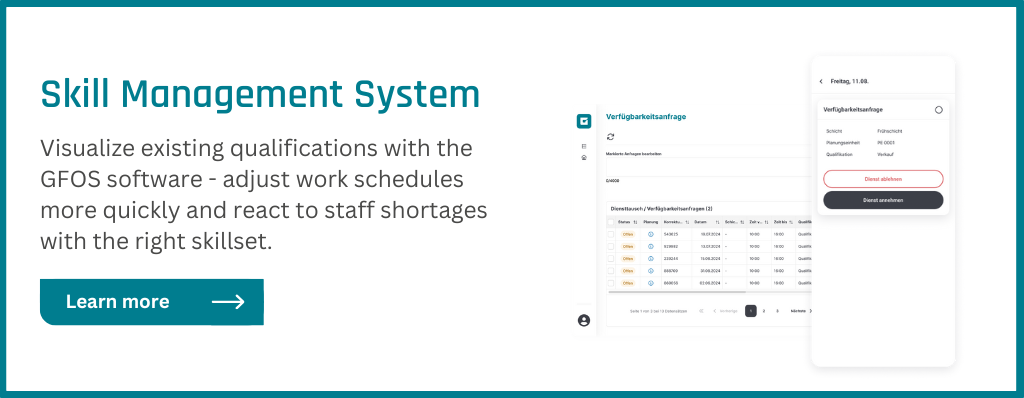
- Skill management processes: This refers to a systematic process in which the skills of skilled workers are recorded and categorized. In this way, those responsible for planning have an overview of the existing skills required for current projects, assignments, etc. at all times.
- Skills databases: The central management of skills in a database means that those responsible for planning can access up-to-date information at any time. This simplifies internal recruiting processes and ensures rapid adaptability to changing requirements
- Talent pools and internal recruiting: HR software can help to fill vacancies more quickly. HR managers can advertise these internally. Employees who are looking for a change have the opportunity to apply for this position. The database also creates a clear talent pool. Open or required positions can be compared with this talent pool. If the workload allows, capable employees can be automatically requested for the tasks.
- Matching & reporting: Detailed insights into the skills of the workforce help to identify gaps and support decisions. Where are skills currently lacking? Which certificates need to be refreshed at regular intervals? All this information is available at a glance via skill management software. For example, HR managers are reminded that certificates of individual specialists need to be refreshed or that specific further training was completed X months ago.
Modern HR solution from GFOS
Utilize your potential for internal recruitment by keeping an eye on all your employees' skills at all times. Our workforce management solution is ideal for this and can also make many other daily HR processes more effective.
