
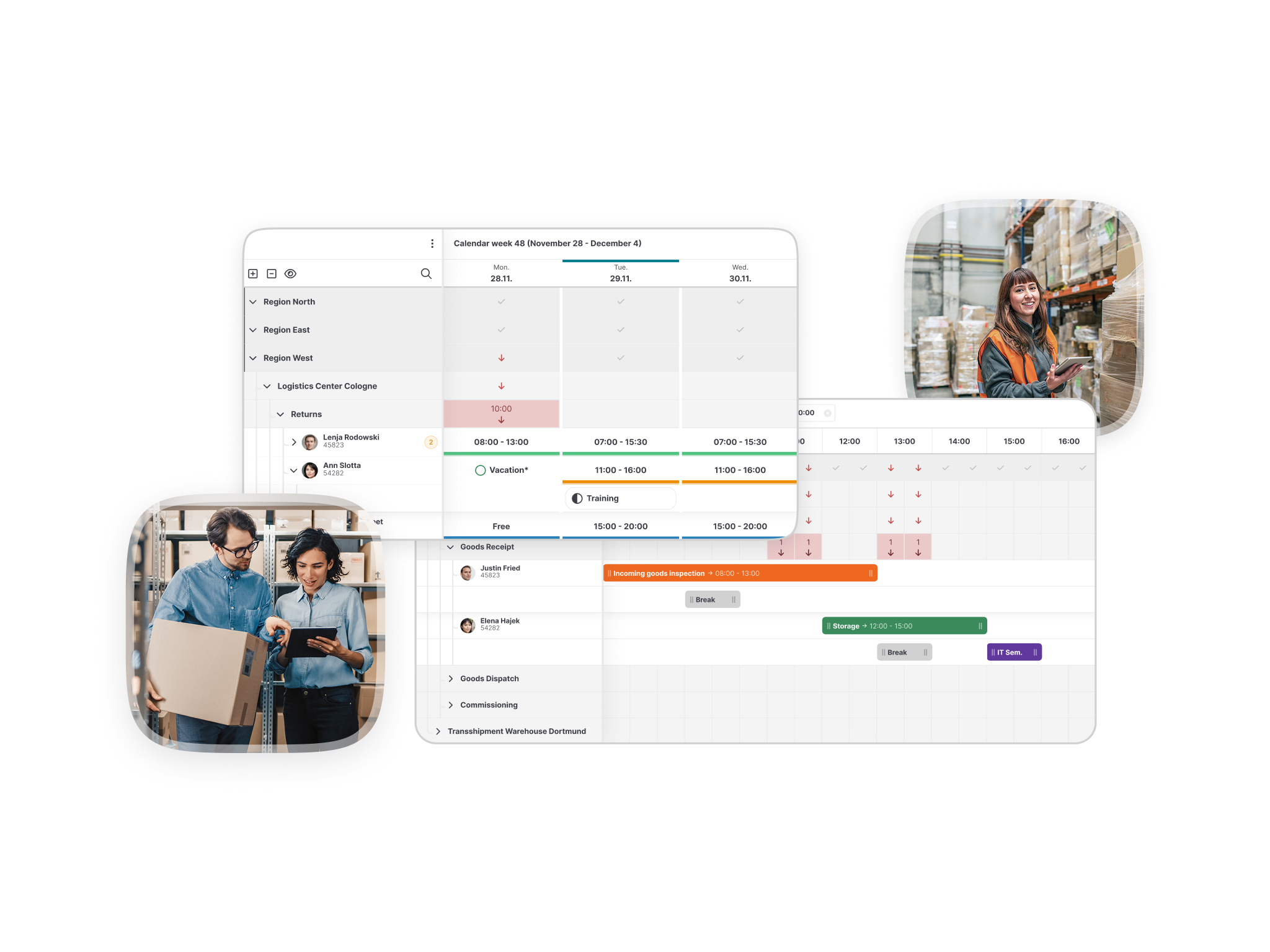
Scenarios That Quickly Become a Problem in Logistics
Conventional employee scheduling quickly reaches its limits in everyday logistics, because things often turn out differently than planned. This results in gaps in the shift schedule, overtime, unclear responsibilities, and decisions that must be made under time pressure.
- Tour and priority changes: Last-minute adjustments lead to missing or unfilled shifts and, without suitable software solutions, require a great deal of manual effort for rescheduling.
- Staff absences: In the event of illness or other absences, there is no overview of availability and qualifications, which makes it considerably more difficult to quickly find replacements for shifts.
- Lack of transparency throughout the day: Whether orders are brought forward or delayed, every change can also shift the requirements for workforce planning. Logistics teams that work with rigid staffing schedules are hardly able to respond to this.
- Manual employee scheduling: Many schedules are created using tools that are not designed for this purpose, such as Excel, or even just in the minds of experienced shift supervisors. However, as team sizes grow and changes occur at short notice, the likelihood of errors increases significantly—the entire process comes to a standstill, and quick and reliable decisions are lacking.
- Inefficient communication: Many logistics companies rely on paper shift schedules that are distributed or posted. Last-minute changes often reach the affected employees too late or not at all.
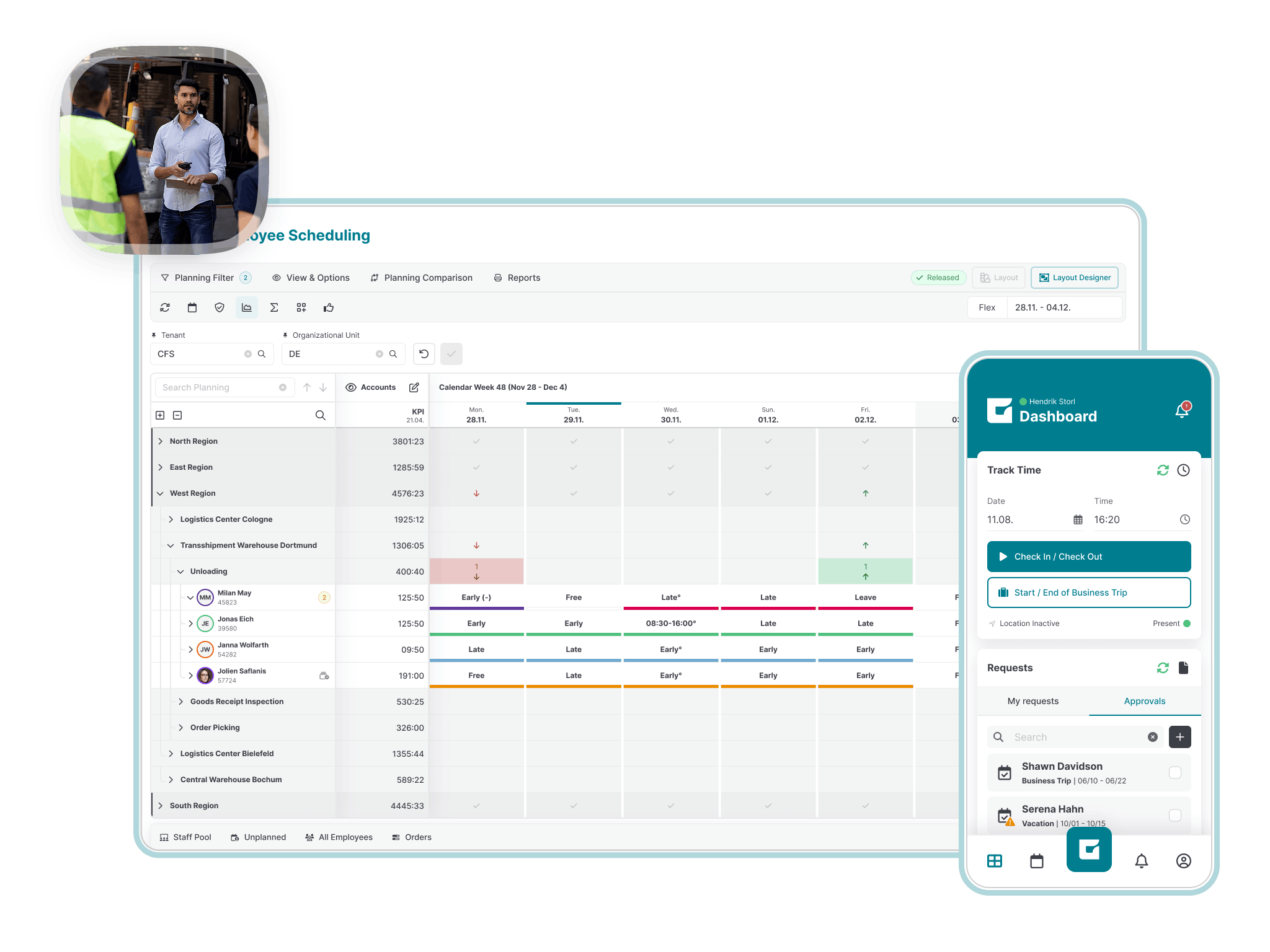
Real-Time Employee Scheduling for Dynamic Logistics Processes
When plans can change from one minute to the next, you need a solution that is just as flexible as everyday life itself. Instead of reacting to disruptions, logistics companies with the right software solutions always stay in control, identify bottlenecks early on, manage staff deployment, and make informed decisions even under time pressure.
Key Features for Logistics
With the right features, short-term disruptions become predictable processes:
Planning monitor
Real-time overview of shifts and availability, as well as alerts for conflicts, understaffing, overstaffing, or absences during planning or compliance checks
Automatic planning suggestions
AI-supported suggestions in the event of absences and changes, considering qualifications, availability, contracts, and compliance
Verification of qualifications
Avoid mismatches thanks to automatic comparison of requirements and qualifications, as well as their validity
Rapid absence management
Early detection of bottlenecks and suggestions for replacement planning in the event of illnesses and other absences, enabling immediate responses
Mobile communication
Digital shift schedules, push notifications for last-minute changes, and shift exchange platforms for greater flexibility
Intelligent analysis & forecasting
AI-driven absence analyses and location comparisons visualize meaningful data in seconds and enable accurate forecasting.
Integration of electronic certificates of incapacity for work
Connection to the electronic certificate of incapacity for work for seamless transfer of sick leave notifications into planning
Compliance monitoring
Automatic compliance with legal requirements regarding working hours and rest periods, and early warning system for overtime or rule violations
Flexibility and scalability
Mapping of all shift models and roles across different logistics locations
Flexible Shift Planning in Practice
In everyday logistics, additional capacity is often required at short notice. Whether in the warehouse or on the road, illness or other unforeseen absences mean that planning teams are faced with the challenge of making decisions quickly and accurately. The use of cloud-based employee scheduling reduces response times from hours to minutes and enables demand-driven workforce planning along the supply chain - without media discontinuity.
Shift Planning in Case of Sick Leave
An employee calls in sick at short notice and is recorded in the system by the shift supervisor. The software immediately displays the absence in the schedule as a critical gap for all responsible parties.
At the same time, the system checks which shifts, routes, or tasks the employee was scheduled for and which qualifications are required for the assignment. Understaffing and overtime are also automatically detected, and compliance risks are identified after the check has been initiated. This allows the shift supervisor to see at a glance where action is needed.
Based on availability, qualifications, working time regulations, and other planned assignments, the software suggests suitable substitute workers. The system considers valid certificates such as forklift or driver's licenses, location, shift model, and cost aspects.
The selected employees receive a mobile availability request via push notification, email, or the message center and can accept or decline the shift directly in the app. The first positive response is automatically added to the shift schedule, all further acceptances are canceled by the system, and the employees concerned are informed directly. The updated shift schedule can then be sent out specifically so that everyone involved is working with the same, up-to-date information.

Benefits of Shift Planning for Your Logistics Processes
In the event of short-term absences, software solutions for personnel resource planning enable quick and reliable responses.
The benefits at a glance:
- Immediate transparency regarding absences and affected shifts
- Automatic scheduling suggestions based on availability and qualifications
- Quick replacement finding via mobile availability requests
- Real-time updates of the shift schedule for all involved
- Easy compliance with working time and compliance requirements
- Data-driven decisions and less planning stress
- Greater adherence to deadlines and lower costs
Discover our packages now
From simple staff scheduling to complex scenarios – workforce planning tailored to your needs.
To the bundle Workforce Planning-
Base
Shift scheduling

Hour-based scheduling
Availability & requests

Service exchange platform
Cost-optimized scheduling
Staffing capacity planning
Automatic planning suggestion
Forecast
-
Professional
Shift scheduling
Hour-based scheduling
Availability & requests
Service exchange platform
Cost-optimized scheduling
Staffing capacity planning
Automatic planning suggestion
Forecast
-
Enterprise
Shift scheduling
Hour-based scheduling
Availability & requests
Service exchange platform
Cost-optimized scheduling
Staffing capacity planning
Automatic planning suggestion
Forecast
Get to Know GFOS Software




Would you like to learn more about our complete solution for logistics, warehousing, and transportation from GFOS? We would be happy to give you an overview of the software. Simply contact us at:
Tatjana Buchholz
+49 (0)201 / 61 30 00
buchholz.tatjana@gfos.com
Contact