Challenges in Processing Payroll Data
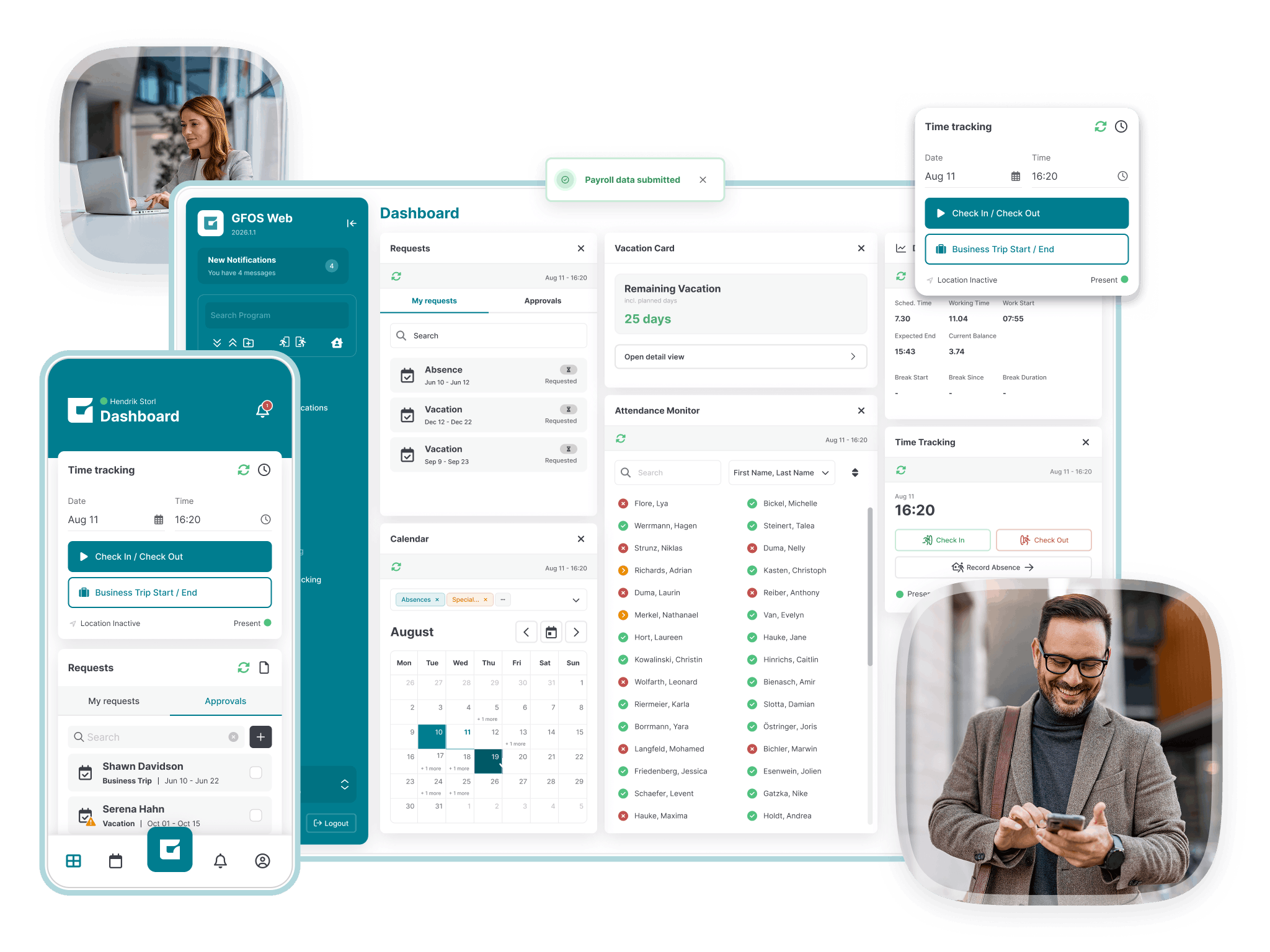
Between time tracking and payroll accounting, a wide range of information must be processed. The more complex the requirements, the greater the administrative effort, coordination needs, and risk of errors:
Map wage types correctly
Premiums, overtime, absences, and collective agreement requirements must be processed reliably and assigned to the correct wage types. As complexity increases, so does the workload for payroll teams.
Account for complex rules
Individual working time models, collective agreements, and company-specific requirements must be reflected in payroll data processing.
Reduce inefficient manual processes
When payroll-relevant data is prepared or transferred manually between different systems, recurring administrative work and avoidable process steps arise.
Prevent incorrect data transfer
The more manual steps are required without payroll integration, the higher the risk of incorrect or incomplete data. Corrections can also delay payroll processing.
Connect systems
Workforce management, time tracking, and payroll often run in different applications. Without suitable interfaces for payroll integration, data exchange becomes unnecessarily complex.
Payroll Integration: Automate Processes
Many payroll challenges result from manual process steps and isolated systems. Payroll integration connects these processes through an interface to payroll accounting, creating a continuous flow of information between time tracking, workforce management, and payroll.
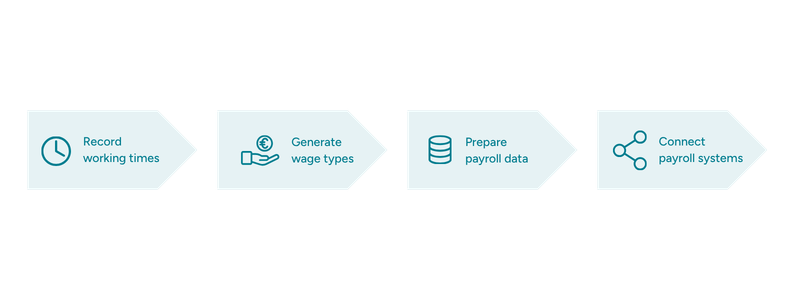
How the Payroll Interface Works with GFOS
Record Working Times
Working times and absences are digitally recorded and processed as the basis for payroll. This keeps all payroll-relevant information centralized, current, and available for further processing.
Generate Wage Types
Based on the recorded time data, premiums, absences, and overtime are automatically assigned to the appropriate wage types. Individual rules and collective agreement requirements are also considered.
Prepare Payroll Data
The calculated payroll data is provided in a structured format for downstream processing. The payroll software integration consolidates information as needed, brings it together, and exports it in the required format.
Connect Payroll Systems
The prepared data is then transferred automatically to payroll systems, tax offices, or third-party systems, enabling consistent processes between time tracking and payroll accounting.
Process Payroll Data Flexibly
Requirements for digital payroll processing vary from company to company. GFOS helps map individual requirements and automatically provide relevant information for payroll accounting. In practice, this creates a wide range of use cases:
Night, Sunday, and holiday premiums are calculated automatically based on recorded working times, eliminating the need to manually evaluate individual time bookings. All payroll-relevant information is therefore immediately available for further processing. Different premium rules are also taken into account, supporting transparent and consistent calculation.
Synchronize Absences
Payroll-relevant absences, such as vacation or sick leave, are transferred to the relevant downstream systems. If changes occur, absences are synchronized through cancellation or extension of the absence period. This helps maintain consistent, cross-system data on remaining leave or continued pay thresholds.
Reliably Map Collective Agreement Requirements
Collective agreements, works agreements, and individual working time models are stored in the wage type logic. This makes it possible to automate payroll processes. Changes to collective agreement or company requirements can be integrated flexibly into existing rule sets without recurring manual adjustments.
Automatically Evaluate Competing Wage Types
If several wage types apply to the same working time, the system automatically determines which wage type must be assigned based on stored rules, defined priorities, and dependencies. This allows even complex compensation models to be processed consistently and correctly while reducing administrative effort.
Implement Individual Requirements at the Employee Level
Wage types and rule sets can be assigned to individual employees. This makes it possible to map different contract models, employee groups, or individual agreements flexibly, regardless of rigid organizational structures. Payroll-relevant requirements are therefore considered exactly where they occur.
Payroll Integration: Connect Systems Flexibly
Successful payroll integration goes beyond processing payroll data. Reliable transfer of information to downstream systems is just as important. With a wide range of interfaces, GFOS enables payroll processes to be integrated seamlessly into existing IT landscapes.
Standard Interfaces for Payroll Systems
GFOS offers certified interfaces to numerous payroll solutions such as DATEV, PAISY, SAP, LOGA, and VEDA. This helps you avoid duplicate data entry.
Consistent Master Data for Payroll Processes
GFOS receives employee master data from payroll systems via REST API technology. This helps simplify individual integration scenarios and data exchange.
Data Exchange with Tax Offices and Third-Party Systems
Payroll data often needs to be transferred not only to the company’s own payroll accounting system, but also to external service providers. GFOS also supports structured data preparation and transfer for downstream processes.
Integration into Existing System Landscapes
Time tracking, workforce management, and payroll do not have to operate in isolation. By connecting different systems, companies create end-to-end processes and a consistent data basis for further processing.
Why Payroll Integration Pays Off
Benefits at a Glance:
- Less manual effort
- Transparent calculation
- Higher data quality
- Faster payroll processes
- Consistent data basis
- Flexible integration
Discover our new packages
Optimize your time tracking with Time & Attendance – flexibly scalable from Base to Enterprise.
Our Time & Attendance Bundles-
Base
Custom dashboard & widgets
Attendance & absence tracking
Employee self-service portal
Mobile time tracking & GFOS App
Electronic certificate of incapacity for work

GFOS Terminal App
Evacuation list app
Digital ID card creation
Temporary employment
Project time tracking & controlling
Customized analysis & reports
-
Professional
Custom dashboard & widgets
Attendance & absence tracking
Employee self-service portal
Mobile time tracking & GFOS App
Electronic certificate of incapacity for work
GFOS Terminal App
Evacuation list app
Digital ID card creation
Temporary employment
Project time tracking & controlling
Customized analysis & reports
-
Enterprise
Custom dashboard & widgets
Attendance & absence tracking
Employee self-service portal
Mobile time tracking & GFOS App
Electronic certificate of incapacity for work
GFOS Terminal App
Evacuation list app
Digital ID card creation
Temporary employment
Project time tracking & controlling
Customized analysis & reports
Get to Know the GFOS Software
GFOS offers interfaces to numerous payroll systems such as DATEV, PAISY, SAP, LOGA, VEDA, and other solutions. In addition, a neutral payroll interface is available to support individual requirements and integration scenarios.
Yes. In addition to standard interfaces, GFOS also supports the integration of individual payroll solutions. Flexible interface concepts and the neutral payroll interface make it possible to provide payroll-relevant data in a general format and transfer it to existing systems.
Yes. The prepared payroll data can also be transferred to external service providers or tax offices. This allows existing processes to be retained while also enabling automation.
The specific requirements depend on the existing system landscape and the payroll system in use.
Yes, payroll systems can be connected directly to GFOS. The type of integration, such as web service-based or file-based integration, depends on your IT landscape and the payroll system in use.

Would you like to learn more about GFOS software or receive additional information? Please feel free to contact us so we can discuss your needs together.
Contakt