Barriers with Global HR Solutions: Why Standard Software Often Falls Short
Data Sovereignty Uncertainty
Unclear legal requirements for transferring data to third countries, and concerns about access under the US CLOUD Act.
Complex Working Time Models
Software that struggles with deeply nested German collective agreements, shift models, and local works agreements.
Works Council Alignment Risk
Low acceptance from works councils due to non-transparent data flows and insufficient involvement.
Insufficient Support
Anonymous call centers in other time zones and languages, with limited understanding of country-specific pitfalls in German employment law.
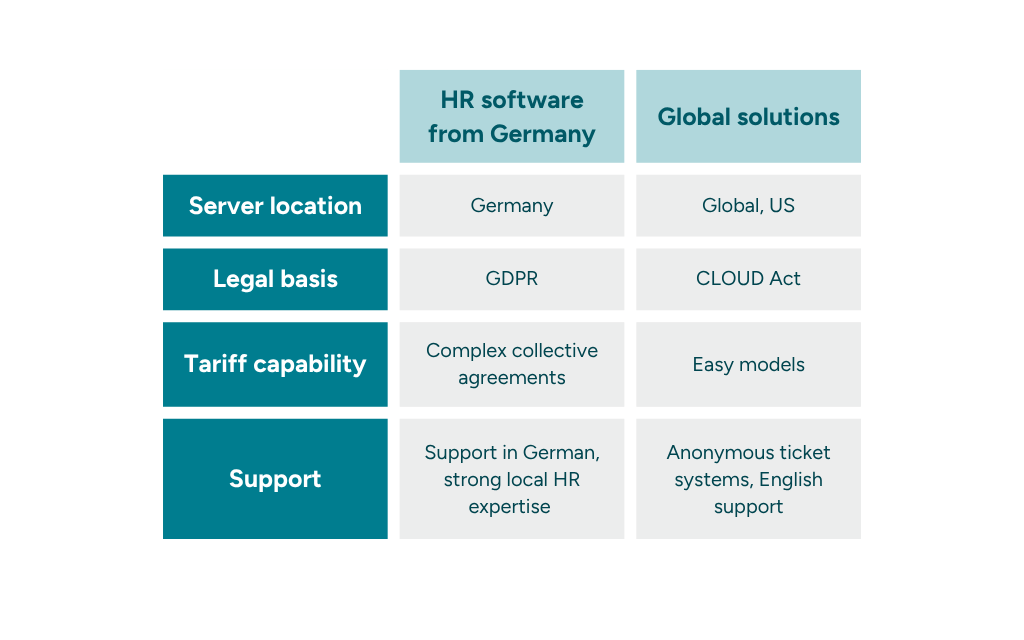
“Made in Germany” vs. US Standard: A Direct Comparison
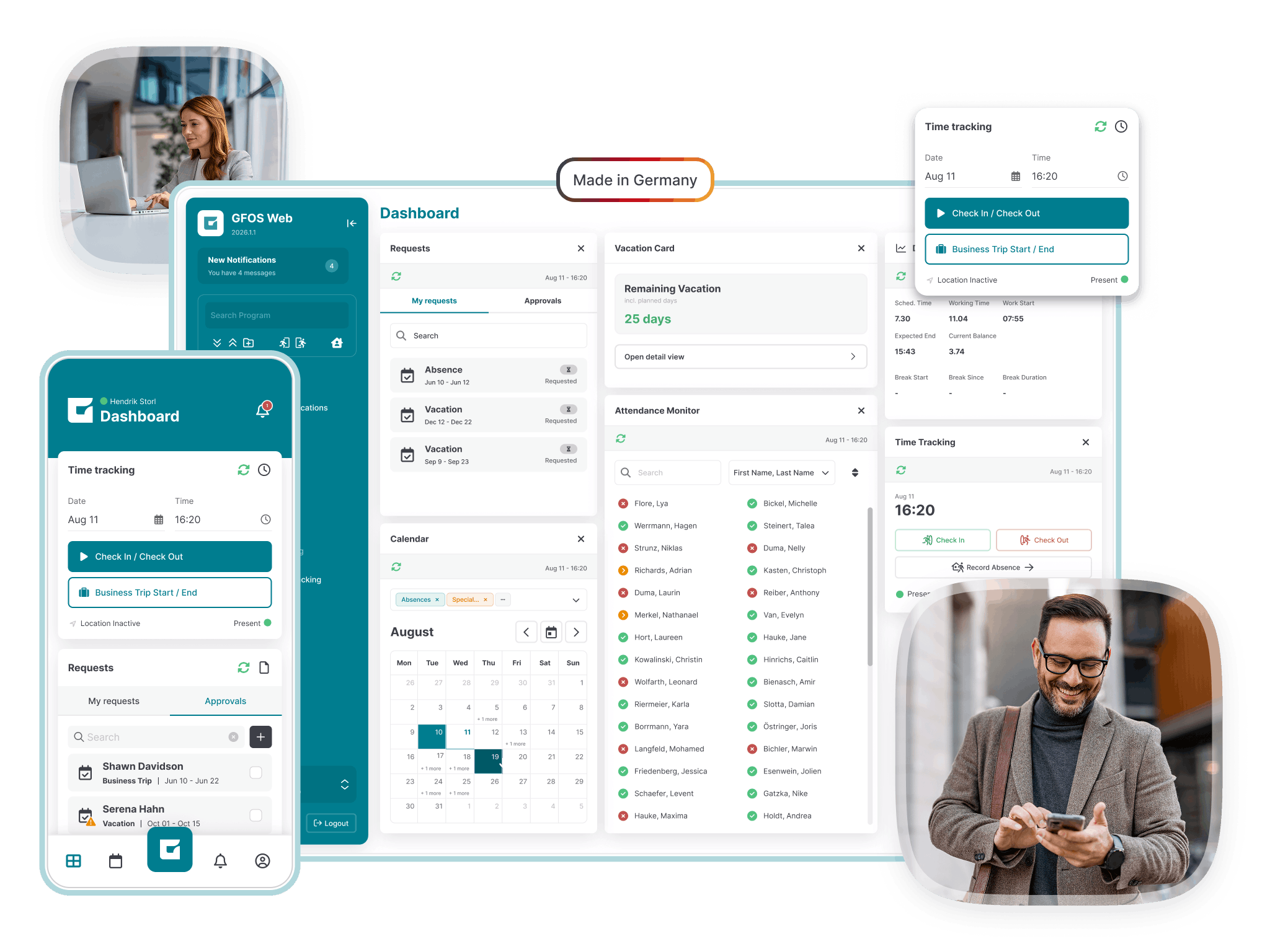
Polished interfaces, but limited depth: While US systems often require extensive customization, GFOS covers the complex requirements of the DACH region natively.
- Legal risk reduced: US providers are subject to the CLOUD Act, which can undermine full sovereignty over sensitive employee data.
- Functional gaps closed: Rigid standard templates often fail to model complex German collective agreements and Working Time Act requirements.
- Higher adoption: Insufficient support for codetermination rights frequently leads to works council objections.
- Integration roadblocks avoided: Missing native connectors to German payroll systems such as DATEV create manual error risks and fragmented processes.
Top 6 Reasons US Software Falls Short of German Standards
Choosing HR solutions from overseas can introduce legal and operational risk. Here are six decisive reasons why local expertise in data protection, collective bargaining logic, and codetermination makes the difference.
1 GDPR Compliance Without Compromise
HR software processes highly sensitive data, such as working hours, performance data, or sick days. The General Data Protection Regulation (GDPR) defines exactly what this means and how it must be handled. In Germany, time tracking must therefore be GDPR-compliant, including where the data is stored and how long it is retained.
US providers, by contrast, are subject to the CLOUD Act and may be required to disclose processed data upon request, even if it is physically stored in the European Union. Time tracking from Germany therefore offers a clear advantage: hosting in Germany, German data protection law, and full insulation from CLOUD Act access.
2 Collective Agreement Complexity Is Our Specialty
US vendors often struggle with the complexity of German collective agreements (for example, public sector, metalworking, retail, and detailed premium tables). “Made in Germany” time tracking supports premiums, special payments, and complex working time accounts natively, without requiring expensive workarounds.
US systems can be configured, but the detailed logic of German collective agreements usually must be rebuilt and continuously maintained. That drives time and cost through longer implementations and ongoing upkeep. Providers from Germany typically deliver these capabilities out of the box.
3 Works Council Adoption Is a Feature, Not a Barrier
In Germany, codetermination through the works council is required by law. German HR software is designed to provide transparency for employee representatives and to configure role concepts (for example, under Section 87 of the Works Constitution Act) so the works council is involved from the start. US-based solutions are therefore often rejected.
Providers with servers in Germany or the European Union and a transparent data protection architecture make works agreements significantly easier. In many cases, this shortens alignment cycles and accelerates implementation.
4 Shift Scheduling for Operational Excellence, Not Office-Only Defaults
Many US SaaS solutions are optimized for white-collar office roles. Workforce scheduling from Germany is built for the realities of manufacturing and retail: three-shift operations, rotating schedules, and last-minute absence coverage, while staying compliant with the Germany Working Time Act (ArbZG) and industry-specific rules.
Solutions from the DACH region are typically optimized for these requirements, while US products are primarily designed around US models and can only cover German edge cases with cumbersome workarounds.
5 Support That Speaks Your Language, Without Ticket Backlogs
When it matters, you need someone who understands your context. A German partner provides consulting and support in the same time zone and with a strong grasp of local requirements. Many DACH customers expect support in their native language, and insufficient language support can ultimately trigger a vendor change.
With “Made in Germany” HR software, consulting, support, training, and documentation are typically available in German by default. With US vendors, you often rely on English-language tickets, sessions, and documentation. That slows deployment and can reduce adoption across the organization. For highly complex requirements, it is also not always guaranteed that a US suite can implement your specific needs.
6 Deep Expertise in German HR and Payroll Processes
Night and Sunday premiums, performance-based pay, and many other edge cases: German time tracking providers are closely integrated with common payroll systems such as DATEV, SAP HCM, or Lexware. Ready-to-use exports and open or certified interfaces for automated data handover are standard, without manual rework.
US suites are strong when global standard templates are sufficient. However, when it comes to specific German process chains (time tracking > premium logic > wage type > DATEV), it often requires custom integrations and adaptation projects. Providers from the DACH region have implemented these requirements thousands of times.
Retail Reality Check: Why “Global Players” Fail in the Store
In German retail, global software standards often clash with local laws and complex workforce structures. HR software from Germany closes this gap where US systems require expensive workarounds. Key topics include store transfers and multi-store scheduling, part-time work and mini-jobs, and opaque data processing.
The Solution: Confident Workforce Planning for Retailers
- Secure shift scheduling: Coordinate staffing efficiently across all stores while enabling local managers to respond flexibly to customer demand. Automated checks for the Working Time Act and retail collective agreements run directly in the software.
- Employee self-service portal: Employees record time securely and swap shifts directly in the software, GDPR-compliant and without process breaks.
- “Black box” risk: Without native connectivity to German payroll systems (DATEV / SAP), retail organizations create error-prone data silos. Your workforce planners and HR leaders stay on the safe side.
Get to Know Our Bundles
From simple resource planning to complex scenarios – workforce planning tailored to your needs.
Our Workforce Planning Bundle-
Base
Shift scheduling

Hour-based scheduling
Availability & requests

Service exchange platform
Cost-optimized scheduling
Staffing capacity planning
Automatic planning suggestion
Forecast
-
Professional
Shift scheduling
Hour-based scheduling
Availability & requests
Service exchange platform
Cost-optimized scheduling
Staffing capacity planning
Automatic planning suggestion
Forecast
-
Enterprise
Shift scheduling
Hour-based scheduling
Availability & requests
Service exchange platform
Cost-optimized scheduling
Staffing capacity planning
Automatic planning suggestion
Forecast
Our success stories
Explore the GFOS Software Suite
Answers to Your Questions
Even if data is physically stored in Europe, US companies remain subject to the CLOUD Act. This can require them to provide US authorities access to data, even when it is stored outside the United States. With German software providers that operate under an exclusively European legal structure, this type of access is excluded. Learn more about the GFOS ISO 27001 certification.
Unlike many standardized US solutions, German HR software is built around local collective bargaining logic. Premiums, on-call duties, and complex working time accounts can be mapped without expensive custom development because the logic is already embedded in the core product.
To ensure time data can be processed seamlessly downstream, deep integration with your local systems landscape is essential. GFOS provides certified, field-tested interfaces to DATEV, SAP, and many other providers. This helps you avoid the manual exports or error-prone middleware solutions that are often required with US suites.
Would you like to explore our secure “Made in Germany” HR software? We would be happy to give you an inside look. Reach out to us directly.
info@gfos.com
+49 (0)201 / 61 30 00
Contact us