
What Is Workforce Management Reporting?
A workforce management reporting process refers to report generation within a company’s HR department. The analyses provide an overview of employee performance, workforce scheduling, and productivity. The analysis of this HR data helps managers make decisions so that personnel are deployed optimally and efficiently.
Challenges in Workforce Management Reporting
A workforce management report presents the HR department with various challenges. The key aspects at a glance:
Manual Data Consolidation
Manually consolidating data takes a great deal of time. When timesheets, vacation requests, and shift schedules are combined by hand in Excel spreadsheets, the HR team is often occupied for several days, meaning other tasks have to be put on hold.
Information Delays
Information delays can quickly become a challenge. Reports are often only available at the end of the month. If, for example, they show an acute accumulation of overtime, there is no time left to initiate operational countermeasures and actively address the problem.
Data Silos
When processes such as time recording, workforce scheduling, or payroll run side by side in the ERP system without points of contact, this makes communication between departments more difficult. The resulting lack of transparency impairs decision-making within the company.
Operational vs. Strategic Workforce Management Reporting
In principle, a distinction is made between operational and strategic workforce management reporting:
Operational Workforce Management Reporting
Operational reporting focuses on the current day or the current week. This means that HR KPIs are derived from a target/actual comparison of employees’ working hours. In addition, short-term absences and the staffing levels of shifts are examined.
Strategic Workforce Management Reporting
For a strategic HR report, a management perspective is adopted with a view to long-term trends and developments. Key figures include overtime trends, turnover patterns by department, or long-term personnel demand forecasts.
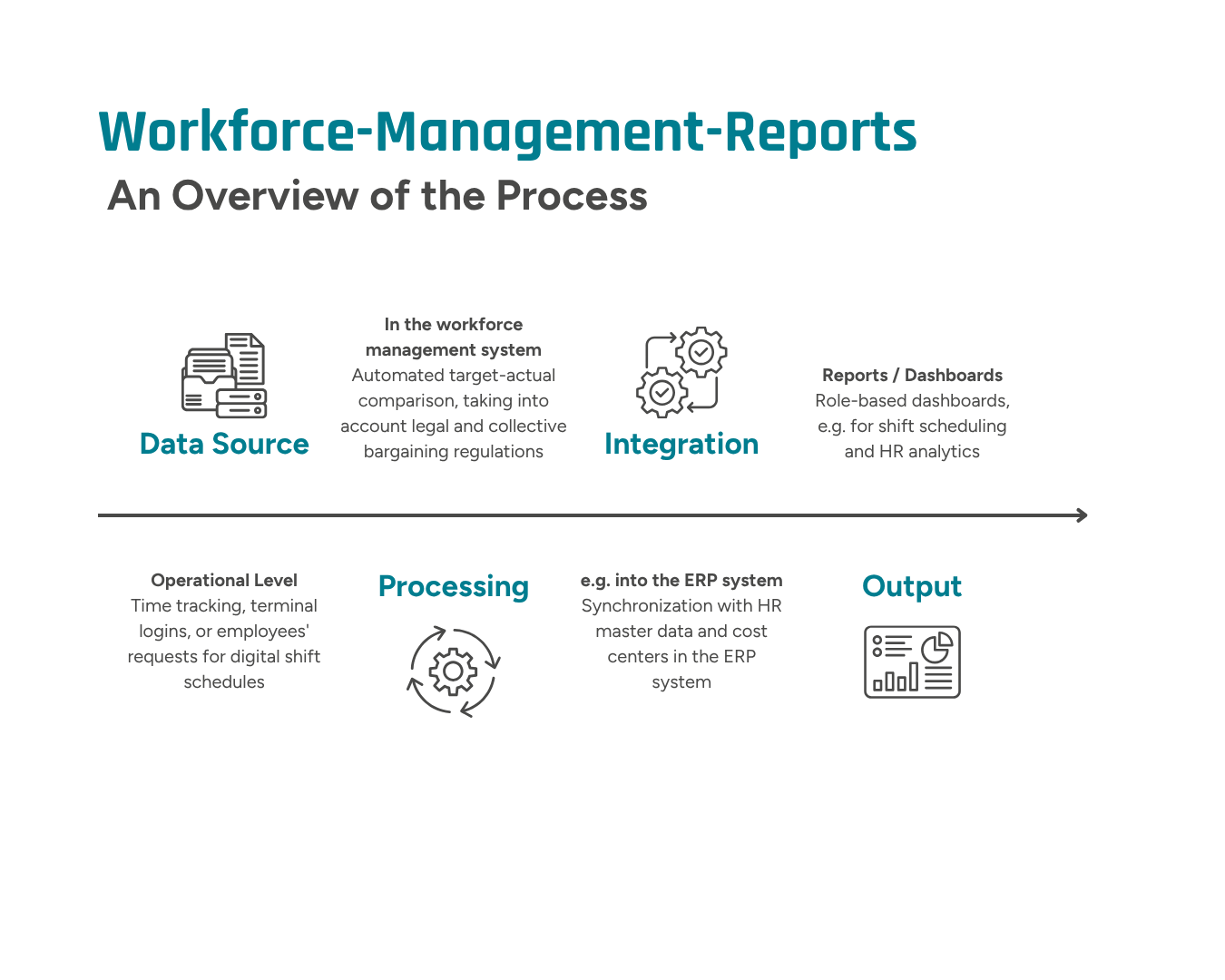
The workforce management reporting process at a glance. Image © GFOS Group
Success Methods for Report Generation
The practices that make report generation successful at a glance:
Role-Based Dashboards
The individual departments within a company require different data. For a shift supervisor, for example, it is important to know who is present and who is unavailable. For the HR manager, other information is relevant. For planning purposes, they need to know, among other things, how high sickness rates are in a quarterly comparison. Role-based dashboards enable collaborative work in one system in which each user only sees the data that is relevant to them.
Task Automation
Automated processes make everyday work easier for HR managers. Tasks can be completed faster and more efficiently: in this way, reports can, for example, be sent automatically to the responsible parties on a recurring basis on a fixed weekday. This process optimization increases productivity and relieves employees.
Consider Data Protection & the Works Council
Workforce management reporting must be GDPR-compliant. Granular authorization concepts that precisely define who in the company may view which personal data simplify the secure handling of personal data.
Added Value for the Entire Company with Tailored Software
Directly available reporting in the workforce management system — for example as part of an HR dashboard — provides managers and management with the data they need for important personnel decisions. In this way, HR and operations move from administrative managers to strategic co-creators — the data provides the basis for this.
Analyses create transparency, which promotes communication between departments and simplifies decision-making. This makes it possible to increase productivity while identifying and addressing current trends at an early stage.
People analytics software such as GFOS Intelligence supports reporting managers in quickly making personnel and planning data visible. Core HR and attendance and absence data can be evaluated time-efficiently using preconfigured dashboards and AI-supported analysis functions. The benefits include the following:
- Data-based decisions
- Fast results
- Seamless integration with your GFOS system
- AI-supported analyses and assistance
- Information security
- Real-time answers
Current Trends and Developments in HR Analytics
Current developments show that traditional, statistical planning processes cannot keep pace with today’s dynamics. Instead, companies need agile, data-based planning and predictive reporting to increase their operational efficiency.
A Gallup study takes a look at the state of HR in Germany in 2026. According to the study, HR departments are under significant pressure to consolidate and must more closely interlink data, performance, and implementation. This supports the centralized use of all data available within a company — for example by means of workforce analytics systems.
A US Gallup study also shows that shift and workforce scheduling have a measurable impact on employee retention, well-being, and quality of work. Only 35% of respondents said they had a so-called “high-quality work schedule.” This makes it clear that a data-based workforce schedule that takes preferences, availability, and more into account can subsequently contribute to a company’s employee retention.
Transparent Decision-Making Processes with GFOS
Relieve HR managers and optimize report generation in your company with tailored software.
