What is a Piecework Wage?
Piecework wages are paid to employees who perform piecework. Payment is directly linked to performance and is therefore a performance-based wage - the working time itself is usually irrelevant. The benchmark for calculating piecework wages is a clearly defined quantity of work/number of pieces within a fixed period of time, usually per hour, shift or working day.
Such a piece rate creates incentives for the employee to prioritize the work relevant for calculating the wage and to complete it as time-efficiently as possible. The aim is to produce many results (installations/assemblies) within the shortest possible time. The better the individual work performance, the higher the respective compensation.
This type of payment assumes that the work is highly similar, manual and less complex. As piecework wages typically serve to reward a high pace of work and a high output, the individual effort of the employee must have a relevant influence on the production process.
What Types of Piecework Wage Exist?
When calculating piecework wages, a distinction is made between two different variants: time piecework and money piecework. These two variants are used either as individual piecework or as group piecework.
Time Piecework
Two factors are taken into account when calculating the wage for the time piecework (also: piece time chord):
- Production quantity/number of pieces
- Working time of the employee
In practice, the piece time chord is the most common form of piecework wage today. First of all, the normal output is defined. This is the average quantity of products/pieces etc. produced per time interval (hour/shift/day). Another decisive factor is how long it takes to produce each individual product/item. This is usually referred to as the target time.
If this standard performance is achieved, employees receive the piecework rate. If the performance is higher, i.e. more is achieved in a shorter time, the employee's compensation is correspondingly higher. If performance is poorer, however, the piecework rate paid is lower than the reference rate.
Good to know: If the employee's performance is significantly worse, i.e. significantly below the normal performance, the employee's compensation may still not be lower than the statutory or collectively agreed minimum wage.
Calculating Piecework Wages - Example: Time Piecework
Relevant formulas
- Piecework wage = number of pieces produced x standard time per piece x minute factor
- Minute factor = piecework rate / 60
- Piecework rate = minimum wage + piecework surcharge (in euros)
- Piecework surcharge = minimum wage x piecework surcharge (in percent)
Practical example
An employee (Mr. Meier) works as an assembly assistant for small parts. Proper assembly takes an average of 2 minutes per piece. Mathematically, 30 pieces per hour (60 minutes / 2 minutes per piece) can therefore be completed. This results in a target time per piece of 2 minutes.
- Minimum wage
At this point, the minimum wage refers to the standard hourly wage that Mr. Meier would receive for normal performance. For this example, the minimum wage should be 16 Euro.
- Piecework surcharge
The amount of the piecework surcharge is typically up to a maximum of 25% of the minimum wage. The company stipulates that this maximum of 25% is fully utilized. The piecework surcharge is therefore 4 Euro(16 Euro minimum wage x 25% piecework surcharge).
- Piecework rate
The next step is to determine the piecework rate. In simple terms, this is the hourly wage for piecework. The piecework reference rate corresponds to the compensation for normal performance and in our example amounts to 20 Euro (16 Eurominimum wage + 4 Euro piecework surcharge).
- Minute factor
The minute factor is now calculated on the basis of the piecework rate. This is the hourly wage for piecework divided by a factor of 60, i.e. calculated down to the individual minute. In the case of Mr. Meier, the minute factor is 20 Euro/ 60 = 0.33.
With regard to the formula for piecework wages described above, the following calculation results for Mr. Meier:
- 30 (number of pieces produced) x 2 (target time per piece) x 0.33 (minute factor) = 20 Euro
If Mr. Meier makes an additional effort and manages to complete 36 pieces per hour instead of 30, the calculation changes as follows:
- 36 (number of pieces produced) x 2 (target time per piece) x 0.25 (minute factor) = 24 Euro
Within the framework of the agreement reached on piecework, Mr. Meier receives a piecework wage of 24 Euro for an assembly performance of 36 pieces per hour.
Money Piecework
The money piecework is special in that the working time plays no role in the calculation of the piecework wage. The employee’s payment is based solely on the quantity produced - there is no basic compensation or minimum wage. This form of piecework is the oldest variant and is only used very occasionally today.
The starting point for calculating the piecework wage is still normal performance. However, if an employee is unable to produce anything during an hour or a shift, for example due to a lack of materials, they do not, strictly speaking, earn any money during this time. In the worst case scenario, the employee effectively works for an hourly wage of 0 Euro during this period.
Good to know: This theoretical scenario does not play a role in this form in Germany. Corresponding regulations on collectively agreed wages and minimum wages ensure that employees receive compensation even in the case of a money piecework model - even if they were unable to produce anything.
Calculating Piecework Wages - Example: Money Piecework
Practical example
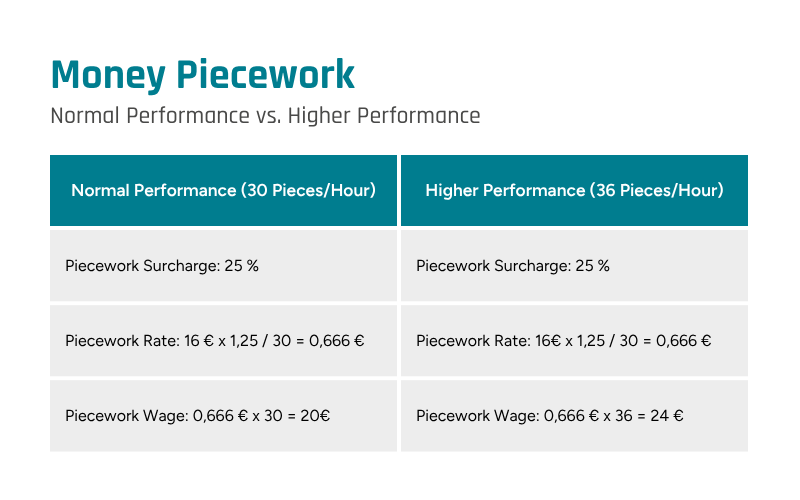
Mr. Meier's company has decided to calculate the piecework wage in such a way that only the quantity produced will be decisive for compensation in the future. Mr. Meier still receives a minimum wage of 16 Euro, the standard time per piece is two minutes.
- Piece rate
The piece rate also refers to the monetary unit per piece. For this purpose, the piecework rate (minimum wage + piecework surcharge in Euro) is divided by the normal output. The normal output is 30 pieces per hour. The piecework rate is therefore 0.666 Euro (16 Euro minimum wage x 1.25 piecework surcharge / 30).
The following calculation results for Mr. Meier based on the formula described above for the piece rate:
- 0.666 (piece rate) x 30 (number of pieces produced) = 20 Euro
With additional commitment, Mr. Meier manages to produce 36 pieces per hour instead of 30. This results in the following calculation:
- 0.666 (piece rate) x 36 (number of pieces produced) = 24 Euro
Under the agreement reached on piecework, Mr. Meier receives a piecework wage of 24 Euro for an assembly output of 36 pieces per hour.
Individual Piecework
In the case of individual piecework, each employee works towards achieving a standard performance defined in agreement with the employer and, at best, exceeding it. Their own performance determines the amount of their piecework wage; there are no other influencing factors.
Group Piecework
In the case of group piecework, several employees work together as a group to provide a standard performance defined in consultation with the employer and, at best, to exceed it. The performance of the entire group is decisive for the calculation of the piecework wage, not that of individuals.
For the introduction of a group piecework system, all employees concerned should have to perform comparable tasks in order to achieve a successful end result.
In Which Industries Are Piecework Wages Paid?
In industry, construction and manufacturing, the piecework/ piecework wage model is still the most popular. This form of work is particularly common in the following sectors:
- Production/Manufacturing
- Automotive
- Construction (assembly)
Packaging industry
The piecework model is frequently used in industries and fields of work where highly uniform, manual tasks are to be performed. These often take place in shifts and almost exclusively without customer contact.
In general, work for which the piecework model would be relevant is increasingly being taken over by machines in the course of automation. From an overall economic perspective, the importance of piecework is declining.
Piecework Wage – Advantages and Disadvantages
A performance-related form of payment sounds tempting - especially for those employees who are willing and able to regularly go the extra mile at work. But what if the model has financial disadvantages for employees? Or if they are unable to reliably deliver the required performance? We have compiled several advantages and disadvantages of piecework wages.
Piecework Wage: Advantages
Creating individual performance incentives
Employees who are willing to work harder for more money will be happy to receive piecework wages at the end of the month. This increase in productivity creates a win-win situation for employers and employees.
Simplified calculation of costs
The piecework wage models enable a very precise calculation of unit and production costs. This makes it easier for employers to determine where steps in the process can be optimized and/or costs reduced.
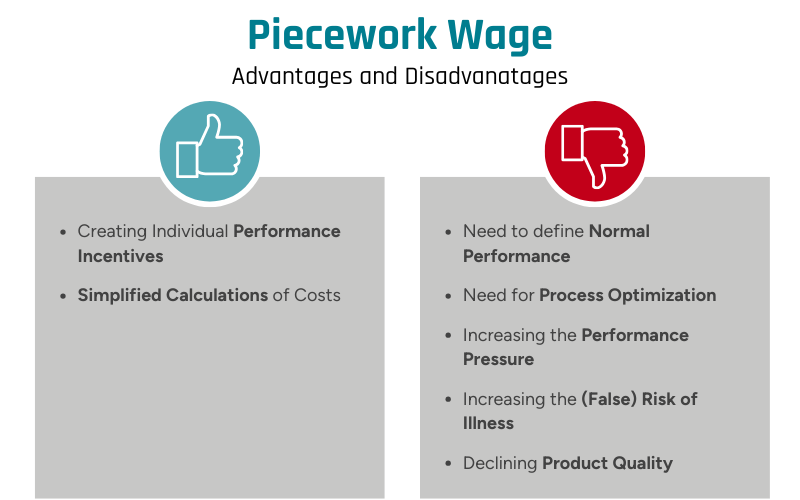
Piecework Wage: Disadvantages
Need to define normal performance
On the company side, it must be precisely determined where piecework is to be introduced. This requires a data-supported definition of the respective normal performance in advance - this cannot simply be determined on a gut feeling.
Need for process optimization
If the workstations and work processes on site are not (yet) designed for the possibility of piecework, a corresponding revision and optimization of the entire workflow can be very time-consuming. In such cases, the piecework model may even be less economical.
Increasing the pressure to perform
If employees' pay is directly linked to their work performance, they will be under considerable and constant pressure to perform. This can have a medium-term impact on the physical and mental fitness/health of employees. This constant stress also increases the risk of injury, sick leave and resignation.
Increasing the (false) risk of illness
If employees do not feel completely fit and it is foreseeable that they will not be able to perform at 100% on a given day, the piecework model actively creates incentives for these employees to call in sick. This means they receive their full salary, whereas they would otherwise run the risk of receiving less piecework pay than usual if their work performance is poorer.
Declining product quality
If the quantity of a product produced is always the top priority, there is a good chance that the quality of the product will suffer over time. As the quantity is what determines employees' piecework wages, they have little incentive to pay attention to quality.
With the help of suitable software solutions, it is possible to strengthen the individual advantages of piecework or compensate for the disadvantages in a targeted manner. For example, process optimization can often be further accelerated and implemented more efficiently, while a quality management software can help to identify any quality deficiencies at an early stage and take targeted countermeasures at the right point.
These Requirements Must Be Met
If employers wish to introduce a form of piecework in their company, this is simply not possible. These requirements must be met for piecework and a piecework wage based on it:
Measurability of performance
It must be clearly measurable and traceable what quantities an employee has produced in the relevant period or what predefined services they have provided. Therefore, the use of piecework requires objective, quantifiable results and a standard performance that must be determined.
Simple work processes
An employee's tasks must be continuously repeated. They must follow a clear pattern and be so simple that they can be reproduced again and again in identical quality without difficulty. The employee must be able to always adhere to the specified times per piece and be able to plan their work steps in advance.
Work without external influence
The work processes on site must be optimized and free of defects to such an extent that the employee's success is not dependent on external factors, but solely on their own willingness to perform. For this reason, work on the assembly line, for example, is not “chordable” - the speed of the machines directly influences the maximum possible working speed.
Employee health
It must be ensured that the employees involved are physically and mentally able to perform the piecework. Protective measures at the workplace must not be neglected or reduced in favor of higher work performance. Working conditions must not deteriorate overall and workplaces must be suitable for piecework.
In order to be able to define the level of performance above which a piecework wage is paid, a normal performance level must also be determined. This definition must be made in accordance with the guidelines of the Fair Labor Standards Act (FLSA).
Negotiations with Union Workers
If the employees are unionized, they have collective bargaining rights. This means a representative of theirs can bargain on their behalf prior to the implementation of a piecework model regarding terms and conditions.
They can negotiate with the employer until they reach an agreement or an impasse. If they reach an impasse, the employer can impose terms and conditions offered before the impasse. Once a contract is in place, both parties must follow its terms unless they agree to changes or extraordinary circumstances apply. If a contract expires before a new one is finalized, most terms continue during negotiations, except for union security, management rights, no-strike/no-lockout, and arbitration provisions.
Introduce Piecework and Calculate Piecework Wages - with Software from GFOS
A performance-related compensation model such as piecework can be interesting for employees and employers alike. At the same time, there are a number of potential stumbling blocks to consider from introduction to implementation. If you are planning to introduce such a pay model in your company or want to optimize an existing model, put your trust in the software solutions from GFOS - we make sure that piecework wages really pay off for you.
We provide you with a modular system that can be individually tailored to the requirements of your industry and your business. Our MES solutions from the smart manufacturing sector create transparency in all processes and enable precise, needs-based workforce scheduling. Optimize your material flow, automate your quality management and create the basis for a freely parameterizable, performance-based compensation system according to your requirements by connecting it to your payroll system. Please contact us for a personal consultation.
