In a Nutshell – Perimeter Protection
- Perimeter protection refers to security measures in outdoor areas
- A distinction is made between active and passive measures
- It ranges from simple walls and fences to security electronics
- The aim is to deter or slow down intruders
- Particularly relevant in the area of critical infrastructure
What Is Perimeter Protection? – Definition of the Term
The term “perimeter protection” describes all systems and measures designed to secure the outdoor area of a property. This is particularly relevant for companies that want to protect buildings or facilities against unauthorized access. Today, companies usually rely on a mix of traditional security mechanisms, such as fences, and electronic measures, such as alarm systems.
The core idea of perimeter protection is to effectively deter potential attackers and to identify actual attackers at an early stage while also stopping them effectively from carrying out their intentions. This includes both slowing down access and completely preventing attacks.
What Benefits Does a Perimeter Protection System Offer?
Companies have a vital interest in monitoring and securing their premises as seamlessly as possible. Rather than focusing on individual measures, more and more businesses are turning to comprehensive and intelligently structured perimeter protection systems. The benefits of such complete solutions are clear:
- Early detection of threats
- Delay/prevention of break-ins
- Option to integrate with existing systems
- Increased security/reduction of security gaps
The better the perimeter protection of a site and the surrounding area, the higher the likelihood that, even in real attack scenarios, people, physical assets, critical data, and trade secrets will not be harmed or fall into the wrong hands.
Whether in the construction of smart buildings or the planning of modern data centers, in many industries a correspondingly high level of protection has long been a key USP when deciding for or against cooperation with companies or service providers.
Perimeter Protection: Active and Passive Protective Measures
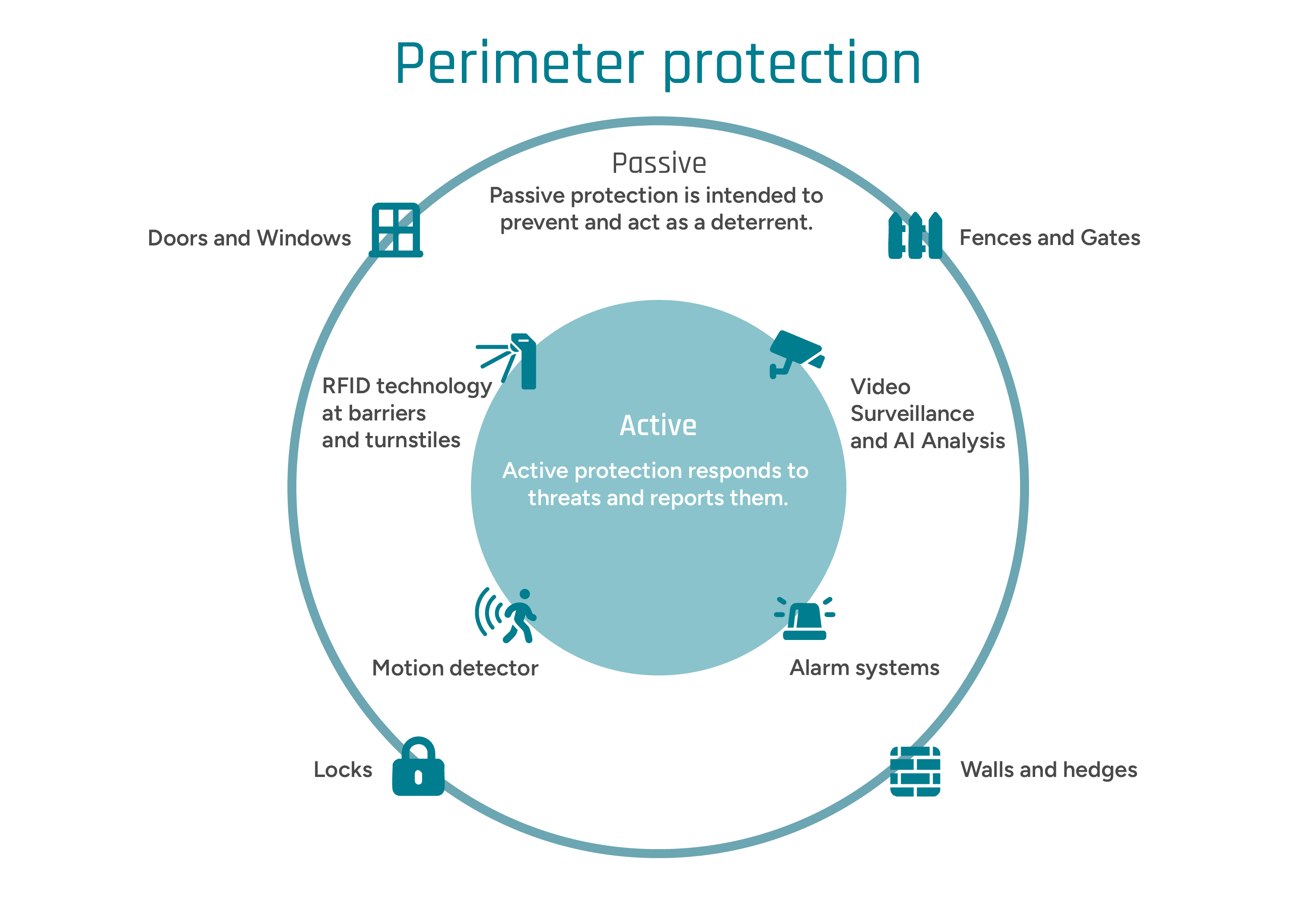
Effective protection of sites against unauthorized persons today consists of many individual components. These individual components are additionally divided into active and passive measures:
- Active perimeter protection: Active perimeter protection includes, for example, all systems that trigger a response as a result of an action. If a person enters the sensor area of a lighting system, for instance, this may activate a light and trigger a silent alarm. Further measures may then follow from this.
- Passive perimeter protection: This includes anything that prevents unauthorized persons from entering company premises through its mere presence. The simplest examples are fences, walls, and gates that do not allow access, or do not allow it without considerable effort. A visible dummy camera can also have a similarly deterrent effect.
The best protection concepts usually include both active and passive elements. This helps cover the full spectrum of threat scenarios and deters “opportunistic offenders” while also enabling a fast, precise, and consistent response to genuine threats.
Typical Components of Perimeter Protection
Below, we have listed numerous components that are typically found in a perimeter protection concept:
Physical Barriers/Structural Barriers
- Fences
- Walls
- Gates
- Barriers/bollards
- Turnstiles/personnel airlocks/single-person access systems
Sensors/Sensor Technology
- Photoelectric barriers
- Motion detectors (infrared)
- Pressure plates/floor sensors
- Vibration sensors
Surveillance Systems
- Camera surveillance of sites
- Thermal imaging cameras
- AI integration for analysis
Lighting
- Automatic lighting systems
- Illumination of paths and corridors
As already mentioned, all these active and passive protective mechanisms work together in a well-thought-out concept. The simplest example is sensor-controlled activation of a lighting system, which in turn ensures that surveillance cameras can capture a potential cause more effectively. This also enables security personnel to identify more quickly where a security breach has occurred and where intervention is required.
Intelligent Access Control as Part of the Protection Concept
When it comes to effectively restricting access to properties, access management inevitably plays an important role. The focus here is above all on granting authorized persons access as easily and conveniently as possible while keeping unauthorized persons effectively locked out.
Ideally, in practice this means a combination of convenience and intuitive use with full transparency regarding access events and easy access to security features. With appropriate access control solutions, this can look as follows in everyday operations:
- Vehicle access control: By using barrier systems and other electronic locking systems, only vehicles that can prove they are authorized are allowed onto the premises. This can be done, for example, using a transponder, a chip with mobile credentials, or license plate recognition.
- Access via ID card: Thanks to RFID technology, the range of access solutions has long extended beyond keys and similar items. Many companies already use employee cards or badges. The trend is also increasingly moving toward mobile access or biometrics: from tablets and smartphones to wearables such as smartwatches, authorizations can now be stored virtually anywhere.
- Recording access events: Modern access readers play an essential role in perimeter protection. They not only grant or restrict entry, but also log all interactions—ideal for uncovering potential irregularities. Locking systems with an anti-passback function, for example, record or prevent the multiple use of access authorizations.
- Integration into security systems: Perimeter protection solutions are generally designed so that they can be integrated almost seamlessly into existing security systems and concepts. This interconnection ensures, for example, that when doors to sensitive areas are left open, notifications are automatically sent to security personnel and all reports or incidents of this kind can be viewed via a central security dashboard—regardless of location and in real time.
When these measures and technical solutions go hand in hand, companies gain the best of both worlds from a security perspective: on the one hand, they create highly convenient access solutions for employees that can often be easily extended to visitor management. On the other hand, they have a coherent package of active and passive measures that enables them to ensure the safety and security of their buildings and premises effectively and efficiently.
Perimeter Protection – Where Is It Needed?
Measures for monitoring and securing a fixed perimeter are now used in a wide range of contexts. Common examples of areas where these protective measures are used include:
- Data centers
- Airports/train stations
- Military facilities
- Government buildings/facilities
- Critical infrastructure
- Logistics centers
- Large industrial complexes
In these areas in particular, awareness of protecting one’s own facilities has increased again in recent years. This is likely related both to concerns about industrial espionage and to the generally increasing availability of drones.
Application Examples for Perimeter Protection
Below, we use two specific examples to explain what protective measures at selected sites can look like. To do so, we look at a manufacturing company and a public institution.
Manufacturing Company (Vehicle Parts Manufacturer)
A manufacturing company uses a holistic security concept to protect physical goods, such as raw materials and machinery, as well as company secrets against unauthorized access. The following measures are used on site:
- Extensive factory premises: Multiple access points for different user groups, such as trucks, suppliers, and employees, require differentiated access controls and separate authorizations.
- Vehicle access control using barrier systems: RFID readers are used at access points to enable smooth entry for authorized vehicles.
- Site fencing with sensor technology: A combination of fixed fences and microwave detection triggers an alarm when someone approaches and sends real-time notifications to the control center.
- Video surveillance with AI analysis: At key points such as factory gates and logistics areas, cameras record movement patterns, detect potentially atypical behavior, and initiate alerts if necessary.
- LED lighting systems: Motion-dependent lighting increases visibility at night and also deters potential intruders.
- Digital access control: Employees authenticate themselves using ID cards or mobile access credentials, which are centrally managed and transparently visible.
Public Institution (Authority/Government Building)
An authority provides semi-public access for visitors and people with concerns, while at the same time it must reliably secure non-public areas of the building or premises against access.
- Partially publicly accessible premises: Need to separate sensitive areas from public zones, for example through signage and structural separation.
- Perimeter fence with defined access points: Access only via designated entrances controlled by personnel or automated systems.
- Access control systems with visitor management: Electronic pre-registration, identity checks at reception, and the issuing of time-limited access passes create transparency and a high level of control.
- Outdoor video surveillance: Cameras record all movements around the building. The recordings are stored in compliance with data protection requirements and evaluated accordingly in justified suspicious cases.
- Sensors for unauthorized access attempts: Motion detectors detect activity outside operating hours and trigger silent alarms that are forwarded to security services without an acoustic warning.
- Central control center: Information about all security-relevant events converges in a central control center that coordinates all decisions, which in turn enables rapid response times.
In practice, the type and scope of perimeter protection depend on a wide range of security-relevant considerations and planning factors, from the size of the site to the potential extent of damage. The considerations that are particularly important in advance are addressed in the next section.
Planning and Implementing a Perimeter Protection Concept – Important Steps
When it comes to effectively securing sites against unauthorized access and developing a corresponding concept, companies as well as authorities must take numerous points into account. We outline which topics are particularly relevant for perimeter security:
Comprehensive Risk Analysis
At the outset, it is necessary to evaluate which site specifically needs to be protected. Are there obvious hiding places or other vulnerabilities around the perimeter that could give potential attackers an advantage? At the same time, it is important to assess what level of protection is desired or potentially required. What damage could an intruder potentially cause?
For example, it makes sense to secure the construction of a new school against unauthorized entry during construction work. However, if it is a future government building, the potential risks resulting from intrusion are significantly higher—and this must also be reflected in the security measures.
Suitable Technology
Depending on the environment in which the site to be protected is located, different approaches to perimeter protection are required. In urban areas, effective and discreet protective mechanisms are usually needed, such as permanently installed access barriers and video surveillance that meets strict data protection requirements for passers-by and residents.
In rural and remote environments, drones can often be used much more easily for surveillance. Especially for large, difficult-to-oversee sites, companies also rely on powerful lighting systems to illuminate the area quickly and comprehensively in the event of a security breach. However, the actual equipment must always be decided on a case-by-case basis.
Mix of Measures
Alongside the selection of suitable technologies, the fundamentally right mix of active and passive measures is crucial in perimeter protection. Depending on the structural conditions on site, walls and high fences may already have a sufficient deterrent effect on potential intruders.
What matters here is an intelligent combination of visible and invisible measures to secure the premises. Security patrols and fences with vibration sensors, for example, can complement each other very well, as can visual barriers and motion detectors.
Legal Compliance
Especially when video-monitoring a site, it can easily happen that uninvolved persons are captured in video recordings. With regard to the data protection requirements of the GDPR, it must be ensured that such recordings ideally do not occur.
Wherever this cannot reasonably be avoided, strict requirements for the temporary storage, processing, and deletion of these recordings must be observed. These considerations and data protection requirements apply equally to companies and public institutions.
Selecting Service Providers
From personal property protection to the installation of security systems, the reliability and integrity of all partners or service providers involved in perimeter protection must be ensured. The respective partners should always be reviewed before cooperation begins.
This may include checking previous references, as well as asking about relevant certifications relating to property protection or technical systems, both with regard to hardware and software integration. Partners must be able to provide individual and comprehensive consulting around the company’s own requirements.
Go to Success Stories
