
Sven Janosch is the DevOps Team Lead at GFOS and is responsible for the technical processes behind the scenes that enable GFOS software to be operated reliably, securely, and at scale. His focus is on automating development, testing, and deployment processes, as well as building a modern cloud and container infrastructure. In short: while others build new features, Sven ensures those features can be delivered quickly and that the software runs stably in customers’ day-to-day operations. That is exactly what we are discussing in today’s interview.
You are the DevOps Team Lead at GFOS. What role does your work play in ensuring that GFOS 2026 not only delivers new features, but also runs reliably day to day?
Sven: As a DevOps team lead, I make sure innovation and stability are not mutually exclusive. My job is to provide a technical platform where new capabilities can be introduced quickly without putting day-to-day operations at risk.
In practical terms, that means we automate deployments, testing and monitoring, standardize environments, and build on resilient cloud and container architectures. This helps us identify issues early, roll out changes in a controlled way, and ensure that GFOS 2026 remains reliably available even under high load—day after day in our customers’ operational HR environment.
What Is Containerization
Containerization refers to the technical approach used to deliver software today. An application is packaged together with all required components—such as runtime, libraries, and configurations—into a single container. These containers are standardized and behave consistently across environments. This simplifies updates, improves stability, and forms the foundation of modern software delivery.
Cloud Containers: What Is the Difference?
A cloud container is a containerized application that runs not on individual servers, but on cloud infrastructure. In the context of cloud computing, these containers can be started, monitored, scaled, and updated automatically. For HR SaaS solutions, this translates into high availability, fast updates, and flexible scalability.
Why are topics like cloud infrastructure, containerization, and automation now just as critical as new features when selecting workforce management software?
Sven: Because modern workforce management software has become mission-critical. Features matter, but they only deliver value when the system is consistently available, performant, and secure.
Cloud infrastructure, containerization, and automation make that possible. They enable scalability, fast response to peak loads, and a high level of operational resilience. For customers, that means predictable availability, regular updates without downtime, and a solution that grows with their requirements instead of slowing them down.
What changes for IT teams when an HR SaaS solution like GFOS 2026 is operated in containers and in a cloud-ready setup?
Sven: For IT teams, the focus shifts significantly—from running individual servers to governing and integrating the platform strategically.
Containerized, cloud-ready SaaS solutions dramatically reduce the infrastructure and maintenance effort required on the customer side. Updates, scaling, high availability, and security patches are handled by GFOS. Customer IT can instead focus on identity management, process integration, reporting, or governance—creating value where it matters most for the organization.
How do container architectures reliably handle peak loads, many concurrent users, or growing organizations?
Sven: Containers are lightweight, standardized, and scalable. That allows us to scale individual application components up or down independently—automatically and based on demand.
Workforce management solutions see predictable spikes—for example during shift planning, time capture, or month-end close. Container architectures allow us to absorb that load dynamically, without systems becoming overloaded or requiring permanent overprovisioning.
Security and updates are central to any software decision: what advantages does a container-based architecture offer over traditional installations?
Sven: A major advantage is clear isolation and standardization. Each application runs in defined containers with explicit dependencies—this reduces the attack surface and prevents unintended side effects.
Updates can be rolled out selectively, automatically, and without downtime. Security vulnerabilities can be addressed faster because we do not have to account for individualized customer installations. For customers, that means an always up-to-date, validated software version—without the burden of patching or maintenance work.
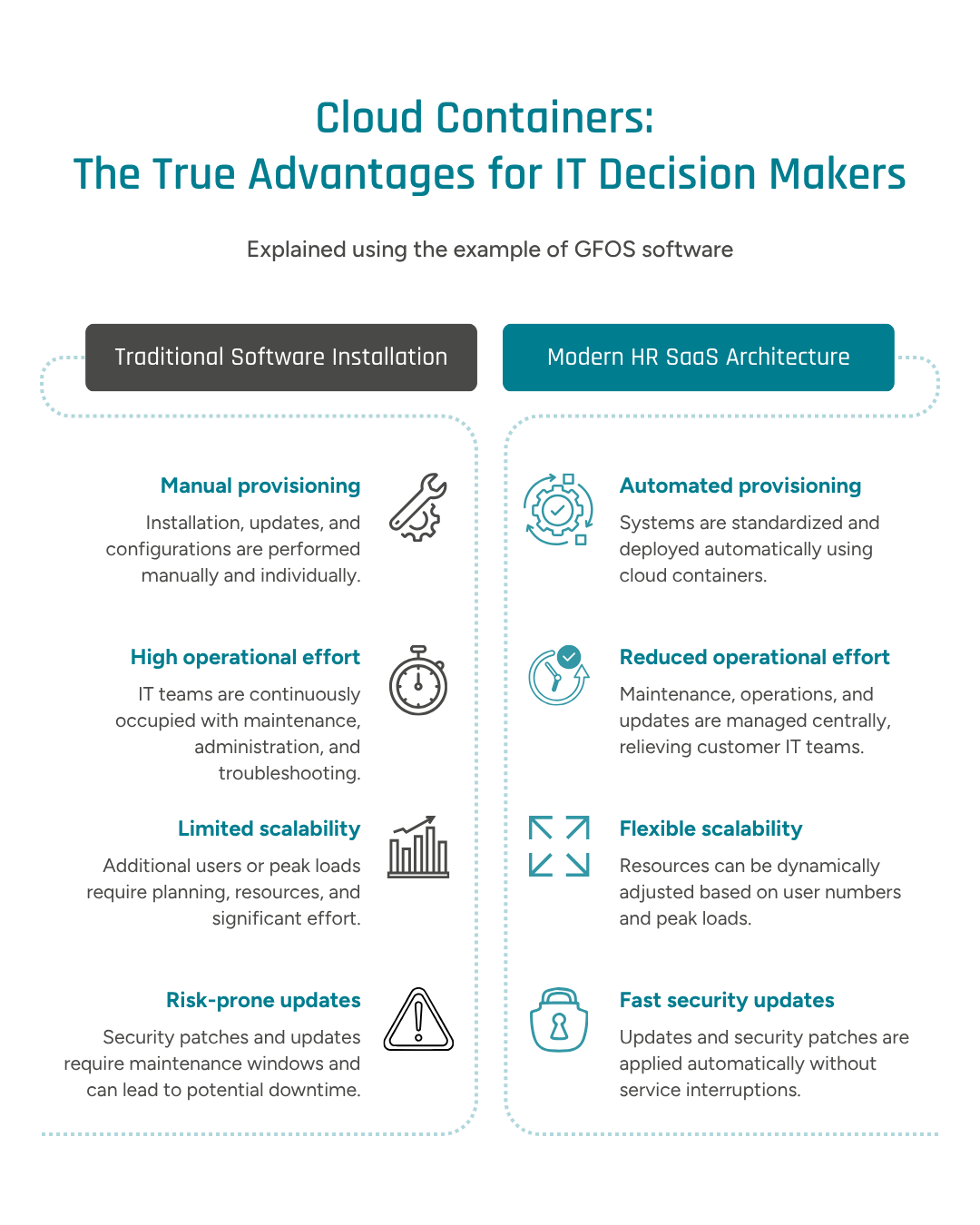
While traditional software installations require manual provisioning and substantial maintenance effort, cloud containers enable automated, stable operations for HR SaaS solutions; © Image: GFOS Group
Operating a comprehensive workforce management solution can be resource-intensive: how does the cloud and container architecture of GFOS 2026 help reduce time and effort?
Sven: Through automation across the stack: deployment, monitoring, scaling, backup, and recovery are largely automated.
This reduces manual intervention, minimizes sources of error, and significantly accelerates processes. For customers, that means less coordination effort, no complex release projects, no hardware planning—just a service that runs reliably and is continuously improved.
Many IT decision-makers feel that SaaS means giving up responsibility. How should responsibilities be split between customer IT and GFOS today, and why is that beneficial for both sides?
Sven: Responsibilities are clearly split: GFOS takes care of operating the platform securely, reliably, and on a current version. Customers retain full ownership of their data, users, roles, processes, and integrations.
This model works for both sides: customers benefit from enterprise-grade operations without having to maintain specialized expertise in-house. GFOS can ensure quality, security, and ongoing product development in a consistent and centralized way.
Responsibilities in a GFOS SaaS Project
SaaS does not mean losing control—it means clearly defined responsibilities.
| Area of Responsibility | Customer IT | GFOS |
|---|---|---|
| Infrastructure | — | ✔ |
| Operations & Maintenance | — | ✔ |
| Updates & Security | — | ✔ |
| Usage & Processes | ✔ | — |
Looking ahead to the next few years: why is the cloud and container foundation of GFOS 2026 a key enabler for future enhancements, especially for IT decision-makers?
Sven: Because it is what enables innovation in the first place. New features, integrations, AI-powered analytics, or international rollouts can be implemented faster, more securely, and more scalably on a cloud and container platform.
For IT decision-makers, this creates investment security: GFOS 2026 is built not only for today’s requirements, but is positioned technologically to remain flexible and extensible in the years ahead—without disruptive platform migrations.
Discover Secure SaaS Time Tracking From GFOS
Highly available and aligned with your requirements: GFOS software supports your need for innovative, flexible time tracking. Explore the features and see how it can fit your organization.
