
What Is Access Control as a Service?
Access Control as a Service (ACaaS) is a cloud service for controlling and securing the physical access of people to sites, buildings, or rooms. It is based on the Software as a Service (SaaS) model and provides all the functions required for the management and control of digital locking and access control systems via the internet.
Updates are automatically delivered from the cloud, ensuring that the solution remains up to date and secure at all times. At the same time, operational control is handled locally via controllers and gateways that enable direct access to doors, gates, and other entry points. In this way, Access Control as a Service combines the convenience of a cloud-based solution with the reliability of local control.
Typical Components of Access Control as a Service
Access Control as a Service typically includes the following components:
1. Cloud control plans | Centralized management of all access rights and rules via the cloud enables simple, cross-site control. Updates and changes are distributed automatically, minimizing security gaps and reducing administrative effort. Cloud control plans also offer flexible customization options for different user groups as well as for schedules and access areas.
2. Controllers | Controllers handle the local control of doors, gates, and other entry points. They execute the instructions of the cloud control plans, enable offline functionality during network interruptions, and ensure continued operation even during temporary connectivity issues. Modern controllers also support protocols such as OSDP for secure, standardized communication.
3. Readers | Readers at access points capture credentials (identification and authorization data) and authenticate users. They can process traditional ID cards, mobile credentials on smartphones or wearables, as well as biometric features such as fingerprints or facial recognition. Readers provide real-time information to the controller and the cloud, ensuring transparency, security, and rapid response capabilities.
4. Credentials | Credentials are used for the unique identification and authorization of individuals. These include physical ID cards, mobile digital solutions, or biometric data. They can be deployed flexibly, transmitted in encrypted form, and combined to increase the level of security. Mobile credentials also reduce material usage and enable contactless access—for greater convenience on the one hand and better hygiene on the other, as physical contact is avoided.
To ensure that systems from different manufacturers work together seamlessly, ACaaS is increasingly based on open standards for interoperability, such as:
- SIA OSDP (Open Supervised Device Protocol of the Security Industry Association) for secure communication between readers and controllers
- ONVIF (Open Network Video Interface Forum) for integration into video and security systems
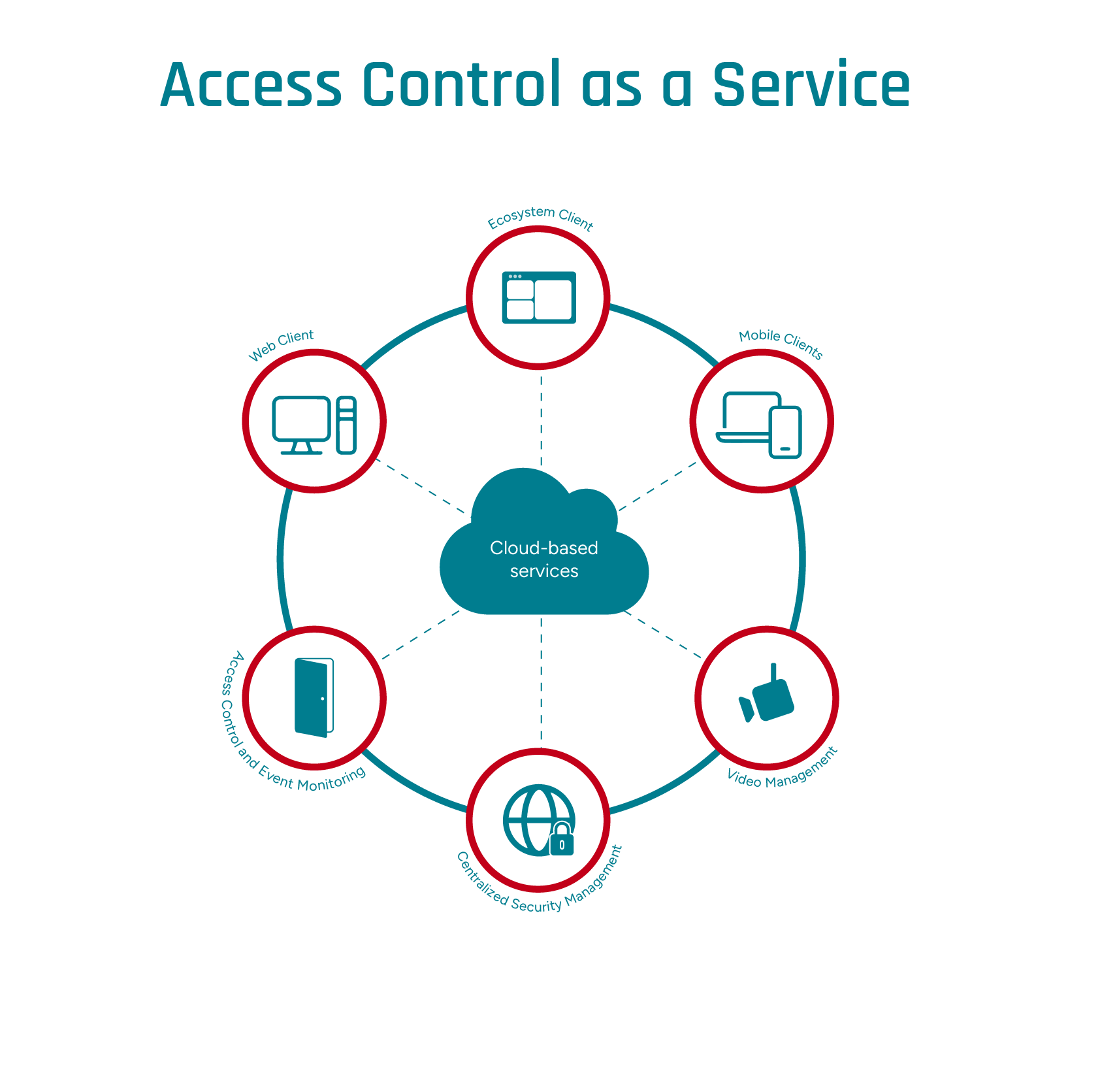
Access Control as a Service comprises various cloud-based measures that combine to ensure maximum security © GFOS Group
Benefits of Access Control as a Service
Access Control as a Service offers its users various benefits, including:
- Hardware independence | ACaaS makes it possible to connect different existing hardware components seamlessly to software-driven access control. This means that both small installations with a single door and large, complex environments with many access points can be centrally managed without having to replace existing investments.
- Individual scalability and high speed | Thanks to the flexible architecture, new sites, doors, or user groups can be connected within a very short time. This leads to a significantly faster rollout and enables dynamic adaptation to potential business growth. Flexible licensing models also support the cost-effective use and straightforward expansion of the system.
- High security | Automatic updates and patches from the cloud keep the system up to date at all times, without requiring manual intervention from administrators. Central security policies can be enforced consistently, reducing security gaps. At the same time, the lower maintenance effort reduces costs and administrative burdens.
- Increased productivity | New employees can be onboarded quickly and easily via remote approvals, which significantly simplifies the onboarding process. In addition, centralized administration reduces the effort required for support requests: frequent helpdesk tickets, such as those related to lost cards or access rights, are significantly reduced, preserving internal resources.
- Compliance and audit support | Granular user rights ensure that each person can only access the areas that correspond to their role. Supplemented by analyzable logs, this creates a high degree of transparency. Companies can therefore track at any time who had access to which area and when, and are well prepared for both internal and external audits.
- Offline capability | Even if the network connection fails, access management remains operational. Local caching of permissions ensures that predefined fallback scenarios take effect and operations do not come to a standstill. As soon as the connection is restored, the system automatically synchronizes with the cloud and updates all data.
- Strong authentication measures | Modern security standards such as multi-factor authentication, device certificates, or mobile credentials ensure that only authorized individuals gain access. These measures combine multiple layers of protection and make unauthorized access significantly more difficult. Mobile credentials in particular provide additional security, as they are encrypted and uniquely assigned to end devices.
Integrating ACaaS into HR and IT Ecosystems
Access Control as a Service can be easily integrated into existing HR and IT environments, creating additional value in day-to-day operations. For example, access rights can be granted on the basis of existing HR master data. This enables both lifecycle automation and SSO flows, allowing many routine tasks to be completed more quickly.
If ACaaS is integrated into workforce management or time and attendance tracking, door events can be used as time events, among other things. Shift-based access profiles can also be configured—for greater security on company premises.
In addition, ACaaS can be integrated into visitor management. Employees can then use the workforce management software to submit visitor requests themselves, obtaining temporary permissions for guests and external service providers that are documented in compliance workflows.
Migration from On-Premises Access Control to ACaaS
The migration from a traditional on-premises access control system to Access Control as a Service usually follows the process below:
Assessment of hardware and cabling + review of OSDP readiness
The process begins with an analysis of the existing infrastructure. Existing access readers, controllers, cabling, and networks are documented. Reviewing OSDP readiness is especially important, as this protocol enables secure communication. Older interfaces should be identified and replaced where necessary.
- Development of a credential strategy
The second step defines how credentials should be designed in the future. This includes determining whether the existing card technology is still sufficiently encrypted or whether a switch to newer standards is required. One reason for this is that even widely used technologies such as MIFARE Classic have serious security vulnerabilities, creating the risk of card-data manipulation and theft.
At the same time, it is defined which areas require additional factors such as a PIN or biometrics in order to better secure sensitive zones. - Creation of an authorization mapping
Next, user groups, access rights, and time windows are mapped. Employees, service providers, visitors, or temporary partners each receive defined access rights—for example, to certain doors or only at specific times. This mapping ensures that security and operational processes are aligned. Review of the pricing and operating model
The fourth step is an economic assessment: Which sites, doors, and readers need to be connected? Are extensions such as visitor management or mobile credentials required? At the same time, a decision is made as to whether a purchase model or a subscription model is better suited to long-term requirements, including maintenance and operating costs.
Data migration, training, and change management
Finally, existing access data is transferred to the new system. Training for administrators and users ensures ease of use, while accompanying change management helps secure employee acceptance. Transparent communication and clear instructions minimize uncertainty and enable a smooth transition.
This creates a structured process that takes technical, organizational, and economic aspects into equal account and ensures a successful transition to a modern access control system.
Trends and Developments in Access Control as a Service
Several key trends are emerging around Access Control as a Service. Mobile credentials are becoming increasingly important: smartphones and wearables are replacing traditional ID cards, which not only improves user convenience but also reduces the use of plastic.
For example, in the U.S., 75% of iPhone users have at least one card loaded into Apple Wallet. In parallel, standardization based on the protocols mentioned above (OSDP, ONVIF) is gaining importance because it accelerates the interoperability of different systems and thus simplifies the integration of cross-vendor solutions.
In view of increasing cyber threats, the Zero Trust principle is also becoming ever more important: access is not trusted by default but is continuously verified and secured. Sustainability is another growing focus: energy-efficient hardware reduces power consumption, while the shift to mobile credentials significantly lowers material usage. In summary, Access Control as a Service is becoming not only more secure and flexible, but also future-oriented and resource-efficient.
Make access more professional now
Stay ahead of trends and developments and secure a future-ready ACaaS solution from GFOS. Our access control bundle can be tailored precisely to the current security requirements of your company. We look forward to hearing from you.
