In a Nutshell – Capacity Planning
- Capacity planning helps align internal resources with the order situation in an economically sensible way.
- It prevents bottlenecks and minimizes delivery risks along the supply chain.
- It is important for ensuring the availability of personnel and machines.
- The more data-based capacity planning is, the more precise it becomes.
- For medium-sized to large companies, automated planning pays off.
What Is Capacity Planning? – Definition
Capacity planning helps companies determine which resources are available within the organization and over what period of time they are utilized. Capacity planning can therefore be used to determine whether, for example, a manufacturing company has the necessary personnel, machine, and time capacities to accept additional customer orders.
Ideally, a company’s capacities—taking all buffers into account—are utilized at close to 100 percent. If the value falls significantly below this level, employees or machines may, in the worst case, be left without tasks. If it rises above 100 percent, however, companies risk being unable to fulfill their orders on time or at all.
In view of global and sometimes highly complex supply chains, manufacturing companies in particular are more dependent than ever on intelligent capacity planning. If, for example, individual critical suppliers fail, this can bring entire production lines to a standstill. Companies therefore need an extremely precise overview of when, where, and to what extent raw materials, materials, and capacities are available.
These important insights require both intuitive systems and close integration of data sources so that information is available company-wide and without delay. Have upcoming vacations already been taken into account in workforce scheduling? What will next week’s shift schedules look like? Are there sudden problems with important suppliers? Ideally, all these aspects come together in real time to support decision-making.
Types of Capacity Planning
When considering the topic of capacity planning, practice typically distinguishes between two types of capacity planning:
Strategic capacity planning covers the “big picture,” especially with regard to the long-term development of sites, production lines, or future workforce planning, including the necessary workforce management solutions.
Its counterpart is operational capacity planning. Here, the focus is on the relatively immediate availability of skilled workers, machines, storage space, and similar resources. At this level, detailed production planning takes place, with capacities assigned to specific orders and prioritized—all with implementation in mind.
In short: Strategic planning represents a “vision of the future,” while operational capacity planning reflects day-to-day business. At the end of the year, this is where it becomes clear whether a company has achieved its business goals.
Objectives of Capacity Planning – Logistics & Production
Depending on the industry, efficient management of internal capacities is business-critical to varying degrees. In logistics and production in particular, however, margins are often so small and processes so cost-intensive that inefficiencies in operations can quickly become expensive.
Good capacity planning helps these industries achieve the following objectives:
- Avoiding bottlenecks: Forward-looking capacity planning ensures that bottlenecks do not occur in the production or delivery of goods. This ranges from planning the capacity of storage and overflow areas to the early identification of bottleneck machines and targeted workforce planning based on qualifications.
- Ensuring customer satisfaction: An overarching goal is always customer satisfaction—whether through high-quality manufactured products, parcels delivered on time, or compliance with individually agreed SLAs (Service Level Agreements).
These goals are formulated very broadly, which is inherent in capacity planning for employees, materials, and more. From an operational perspective as well, planning must consider the entire supply chain.
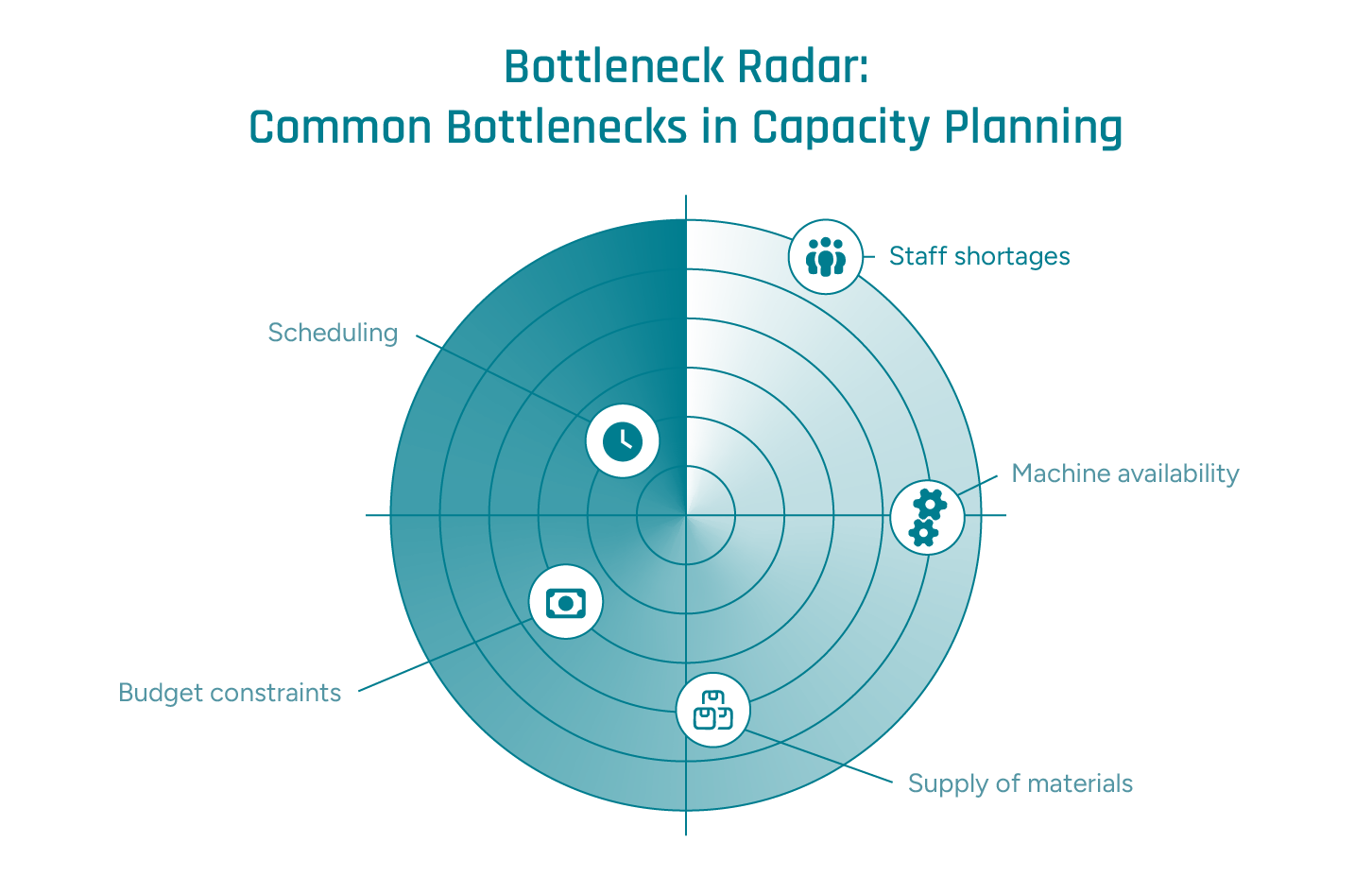
Typical Bottlenecks in Capacity Planning
For industry-specific capacity planning in logistics or production, it is important first to identify which capacities in these areas are of business-critical relevance. This includes both internal and external capacities. These primarily include:
- Skilled workers / personnel bottlenecks: Especially when handling certain production machines, trained specialists are needed who are able to keep a cool head even when complications occur at the machine and find practical solutions to resolve possible delays or blockages. The efficient deployment of skilled personnel is a cross-industry challenge that also affects areas such as the travel sector on a large scale.
- Suppliers / partners: The reliability of suppliers can make or break entire supply chains. Companies must know exactly which suppliers can deliver which goods and how reliably. If the performance of these partners fluctuates, along with the incoming quantities of various intermediate products, this makes planning across production and logistics more difficult.
- Machine availability: Whether for manufacturing small mechanical parts or sorting parcels, the required machines are sometimes highly specialized and designed for a specific purpose. Especially during peak production periods or seasonal events such as Christmas or Black Friday, bottleneck machines can impair production or obstruct important downstream processes.
- Critical resources / material supply: If certain raw materials or intermediate products become unavailable—for example due to strikes, export restrictions on rare earths or computer chips, or other complications—companies must always have a plan B. Individual components, especially in manufacturing, are difficult to substitute, whether for economic or quality-related reasons.
In these focus areas in particular, it makes sense to watch for early “warning signs”: Did a machine already fail last year? Does work come to a standstill in certain areas when employee X is absent? Or have overtime hours recently been accumulating in one department? All these are indications that smaller or larger complications could arise in a specific field of work in the future.
Preventing Bottlenecks – Forward-Looking Capacity Planning in Logistics & Production
To plan reliably with all the capacities described above, digital solutions are now essential. Without using digital resources for capacity planning, even minor deviations in processes are highly likely to have negative long-term consequences for a company’s ability to operate.
Digital efficiency or inefficiency influences capacity planning in production and logistics at a wide range of points:
- Planning machine utilization
- Determining cycle time
- Optimizing setup time
- Shift planning for skilled workers
- Determining handling capacity
- Order picking
- Using existing warehouse space
- Providing transport vehicles for shipping and similar tasks
In practice, problems often arise at the transition from production to warehouse or transport—usually when companies view these areas only in isolation. Pallets with products quickly pile up, shifts are extended at short notice, or errors even occur in order processing.
Capacity planning in one area is highly dependent on the capacities of others. Companies that ignore this risk inefficiencies that can negatively affect business operations, especially during peak periods such as Black Friday, the Christmas season, or vacation periods. Through end-to-end capacity planning—typically on a digital basis—companies can often avoid such problems very effectively.
Capacity Planning in Production & Logistics: The Role of Modern Workforce Management & Production Planning Systems
Modern digital solutions for capacity planning now draw on a wide range of data and information from across the entire company. Ideally, all relevant data points converge in one central place:
- A time recording system provides up-to-date information on the attendance and working hours of all employees.
- Workforce scheduling shows which employees are scheduled for which shift.
- MES solutions provide information on machine statuses and throughput times.
If all these systems are set up correctly and synchronized with each other, planning managers have access to real-time data on the utilization of individual departments. This integration of current data from workforce and machine planning significantly simplifies capacity planning.

Digital Workforce and Shift Planning as a Foundation
Employees are at the center of capacity planning, because even the best production line comes to a standstill without qualified skilled personnel. In production and logistics, planning is often based on shift work that must be aligned as precisely as possible with the company’s requirements.
A wide range of factors must be considered:
- Employees’ availability in terms of time, including vacation, illness, and rest periods
- Personnel qualifications, including authorizations and approvals
- Availability of work equipment such as machines and vehicles
- Current order situation, including order volume and effort per order
To avoid costly planning errors, companies today often already use fully automated shift planning systems. The previously outlined integration of all data from production and workforce planning creates the necessary basis for optimal capacity planning in logistics and production—strictly according to availability and demand.
Such solutions are usually combined with Employee Self-Service (ESS) systems. These give employees the freedom to submit vacation requests for approval themselves or to swap shifts with one another. For the company, this also has the side effect that such administrative tasks no longer have to be handled internally, reducing the workload for HR.
Benefits of Capacity Planning: Manual vs. Automated
When companies have a clear overview of available capacities, this creates a high degree of planning reliability—something that is fundamentally important for businesses of every type and size. But is automated capacity planning necessary? Or is manual planning of internal capacities sufficient? We have summarized the advantages and disadvantages.
Manual Capacity Planning – Advantages & Disadvantages
Manual planning offers the following advantages:
- A high level of control over the process
- Flexible responses to special cases and exceptions
- Low costs thanks to simple tools such as Excel
- An efficient solution for small teams
Manual planning entails the following disadvantages:
- Correct maintenance of all data is necessarily time-consuming.
- There is a constant risk of errors due to manual data maintenance.
- Data is not available in real time.
- Scalability is limited as the company grows.
- Scenarios or case-based analyses are difficult to represent.
Conclusion: If a company has only a few employees, capacity planning can certainly be done manually. However, as tasks become more complex, the company grows, or “what-if” analyses are desired, this approach very quickly reaches its limits.
Automated Capacity Planning – Advantages & Disadvantages
Automated capacity planning provides the following advantages:
- Demand and capacity can be compared in real time.
- Possible bottlenecks in processes can be identified early.
- High data transparency, for example through dashboards.
- Automated planning or shift suggestions are possible.
- Scenario simulations for peak periods, for example using digital twins.
The following disadvantages should be considered in automated planning processes:
- High effort for initial implementation, setup, and integration
- High data quality is an essential prerequisite for successful planning
- Processes and data must be clearly standardized and regulated
- Employee training is required for use
- Ongoing costs for operation and use, depending on the scope
Conclusion: Automated capacity planning requires more preparatory work during setup. Thanks to access to real-time information and precise analysis of data points - now often with the help of AI—it enables highly accurate control of processes and workflows. For medium-sized to large companies, it is therefore the most robust and economical solution for planning processes.
