
Definition: What Is Short-Time Work?
With short-time work, an employee’s working hours are temporarily reduced. This can happen when a company cannot fully utilize its workforce due to economic challenges, for example when orders decline or liquidity is tight. Under the applicable legal requirements, the Federal Employment Agency then pays short-time work benefits.
The Most Important Rules for Short-Time Work
The amount of short-time work benefits is based on the loss of net pay: the Federal Employment Agency pays 60 percent of that loss; if the employee has at least one child in the household, the rate increases to 67 percent of the standardized net pay loss. Example: If an employee works 50 percent of their regular hours during short-time work, the employer pays 50 percent of the regular salary; the missing 50 percent is partially offset by the Federal Employment Agency at 60 or 67 percent.
During short-time work, the employer must document the hours actually worked, as well as any reduced hours or absences. The time tracking data must then be submitted to the Federal Employment Agency within three months in order to claim the associated entitlements.
How Common Is Short-Time Work in Germany?
According to an estimate by the Federal Employment Agency on short-time work, in December 2025 there were 7,668 companies nationwide using short-time work, with 138,700 employees on short-time work. This corresponded to a short-time work rate of 0.4 percent.
Why Excel Reaches Its Limits with Short-Time Work
Excel is often the go-to option when companies need to map processes quickly. When short-time work is introduced, many organizations start with spreadsheets for the same reason. But what begins as a practical workaround can quickly turn into a structural risk.
A major weakness of tracking short-time work in spreadsheets is the lack of version control. Short-time work is rarely static: working time models are adjusted temporarily, target hours are reduced, and reduction rates can change multiple times. In Excel, these changes are often overwritten, which makes it difficult to reconstruct which rules applied at what point in time. That transparency is essential when companies need to demonstrate to the Federal Employment Agency how short-time work was calculated.
In addition, Excel is not a reliable foundation for complex time calculations. In a short-time work scenario, multiple dimensions must be considered at once: contractual target hours, the reduced target hours during short-time work, actual hours worked, and the resulting lost hours. When these values are calculated manually or managed through individualized formulas, the risk of error increases significantly, especially across large workforces.
As organizations scale, Excel-driven processes create inconsistencies and reduce transparency. In the worst case, they can lead to issues when claiming short-time work benefits, particularly during audits by the Federal Employment Agency.
Legal Foundations: Why Clean Documentation Is Essential During Short-Time Work
Time tracking requirements during short-time work stem from several legal provisions. While Germany’s Social Code (German: Soziales Gesetzbuch, SGB) does not prescribe a specific technical implementation, the obligation to capture short-time work correctly arises indirectly from the documentation requirements that apply when claiming benefits from the Federal Employment Agency.
As a general rule, companies must document employees’ actual working time completely and without gaps. In the context of short-time work, these requirements become even more stringent. For each employee and each payroll month, detailed records must be available.
General statements or estimated values are not sufficient. Instead, companies must be able to trace every time entry and every lost hour precisely, and substantiate it in a way that is transparent and defensible.
Required data typically includes:
- Target working time
- Actual hours worked
- Lost hours
- Reasons for lost working time
- Underlying agreements (for example, a works agreement or individual agreement)
This information forms the foundation for calculating and approving short-time work benefits.
In addition, Section 95 of SGB III defines the minimum requirements for short-time work. These include, among other criteria, a significant loss of work with loss of pay, fulfillment of operational and personal requirements, and the proper notification of the loss of work. Even if time tracking is not explicitly named, it is effectively required as part of the time tracking obligation in order to substantiate these requirements.
Another important aspect is co-determination: introducing short-time work is not possible without involving the works council. A right of co-determination exists under Section 87(1) No. 3 of the Works Constitution Act (BetrVG). This also applies to the time tracking systems used, especially when they are used to manage or analyze working time.
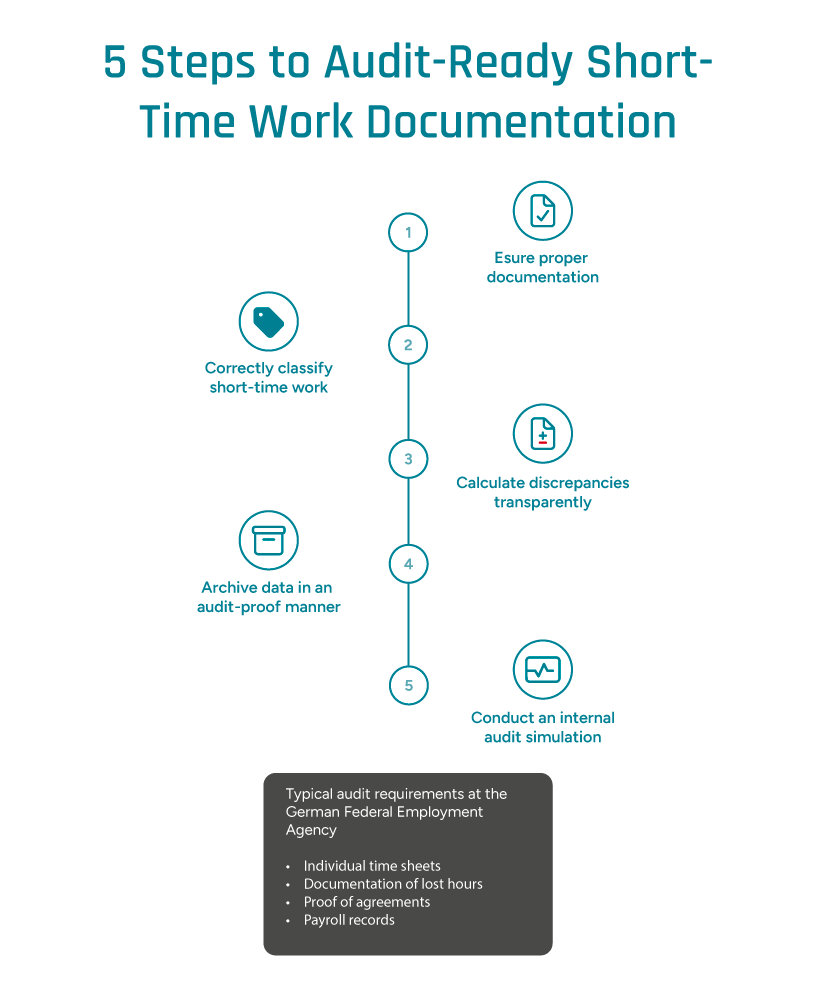
Companies must be able to explain to authorities why short-time work was reported; image © GFOS Group
Audit-Ready Documentation: The Decisive Success Factor
Clean, audit-ready documentation is the key to implementing short-time work in a legally compliant way. This is not only about capturing hours, but also about storing all relevant information in a structured, traceable manner.
A core capability of modern systems is the built-in labeling of short-time work hours. This clearly distinguishes regular working time, reduced working time, and lost hours. This differentiation is essential not only for payroll, but also for reporting and audits later on.
Equally important is the ability to export all relevant data at any time. In an audit, companies must respond quickly and provide complete evidence, including individual employee records, agreement documentation, payroll documentation, and working time accounts.
Another critical requirement is version control for working time models. Changes to target hours or reduction rates must remain historically traceable. Modern time tracking systems automatically record when an adjustment was made, what changed, and what it was based on.
During audits, authorities typically request documents such as:
- Detailed, employee-level time records
- Evidence of short-time work agreements
- Payroll documentation
- Overviews of working time accounts
Only when this information is organized and complete can a Federal Employment Agency audit be completed without excessive effort.
Preparing for Audits: Proactive Instead of Reactive
Many organizations only take a close look at their time tracking data when an audit is imminent. A proactive approach is far more efficient. Companies should regularly ask themselves: “Could we withstand an external audit today?”
A proven method is an internal audit simulation, checking whether all relevant data is available in full and can be evaluated correctly. In addition, spot checks for individual employees are recommended. These reviews validate target versus actual hours, lost hours, and the underlying agreements in detail. Sampling helps identify and correct systematic errors early.
Another key building block is plausibility checks. Aligning shift planning with actual captured working time is particularly important. Deviations must be documented and explainable, especially in complex working time models. A good example is time tracking for shift work.
Finally, exception cases must be documented cleanly, such as short-notice changes to short-time work, individual deviations, or special rules for specific employees. These cases often receive particular attention during audits.
Where Short-Time Work Becomes Especially Complex: Industries in Focus
How complex short-time work becomes depends heavily on the industry. In many sectors, additional requirements make manual administration nearly impossible.
In logistics, fluctuating route planning meets variable staffing requirements. Many activities are also tied to specific qualifications, for example handling hazardous materials or certain vehicle classes. On top of that, companies often need to combine short-time work with short-notice demand spikes.
In retail, complexity primarily results from the often decentralized setup. Different utilization levels by location, short-time work in only selected stores, and flexible shift models with reduced opening hours make centralized control difficult.
Manufacturing brings its own challenges: machine runtime and staffing must be coordinated precisely. Partial shutdowns of individual production lines, plus complex shift patterns such as rotating or continuous shifts, further increase coordination effort.
In health care, the situation is particularly sensitive. While some areas, such as nursing, remain fully utilized, administrative units may move to short-time work. This differentiation must be documented precisely to meet both operational needs and legal requirements.
KPIs for HR Controlling During Short-Time Work
Especially in larger organizations, HR controlling plays a central role in managing short-time work. Beyond documentation, the goal is to make confident decisions based on dependable data.
Key metrics typically include:
- Short-time work rate by function or location
- Average lost hours per employee
- Productivity relative to hours worked
- Variance between planned and actual working time
- Cost trends related to short-time work
These KPIs can only be measured reliably when the underlying data is captured systematically and consistently.
Digitalizing Time Tracking: The Dependable Solution
Digitizing time tracking is the decisive step for managing short-time work efficiently and in a legally compliant way. This is not only about replacing Excel, but also about establishing end-to-end processes.
A central platform creates a single source of truth and prevents disconnected workflows. For organizations with multiple locations, this delivers transparency and comparability. Cloud-based solutions add further advantages, including location-independent access, high scalability, and automatic updates. Modern systems such as SaaS time tracking (Software as a Service) also make it possible to map complex working time models with the flexibility that HR and IT teams require.
Time tracking should also be tightly integrated with broader HR processes. An integrated cloud HR software approach ensures that all relevant data is processed consistently, from time entry through payroll. Regardless of the digital solution you choose, it is essential to ensure that all processes are designed to be GDPR-compliant.
Conclusion: Short-Time Work Requires Professional Time Tracking
Short-time work creates organizational and legal challenges that go far beyond basic time tracking. Requirements for documentation, traceability, and audit readiness are significantly higher.
Excel is not built for these requirements over the long term. Missing version control, manual calculations, and limited transparency quickly create risk, both operationally and legally. Digital, audit-ready time tracking provides the foundation you need. It enables complete documentation, automated reporting, and smooth preparation for audits.
Especially in enterprise environments with multiple locations, an integrated solution is essential. The right system enables companies to manage short-time work in a structured, efficient, and compliant way.
If you want to manage short-time work sustainably and professionally, you should invest early in modern time tracking, for compliance reasons and as a strategic advantage for HR management.
How GFOS Time Tracking Software Works
With time tracking software, the data required to calculate short-time work benefits can be generated automatically. You can then use it to support payroll processing. By capturing employee time, the system can calculate short-time work hours directly. These hours are offset against the hours actually worked and are based on the target working time stored in the time tracking system.
With individual employee time accounts, you can easily represent different scenarios, such as 50 percent or 70 percent short-time work, and then store them in the system automatically. The same data remains available later in the software and can be used for reporting.
Implement Short-Time Work with Confidence Using GFOS
Do you need a clear, reliable solution for time tracking during short-time work? We are here to help, with a modular workforce management platform that includes time management.
